International Research Journal of Engineering and Technology (IRJET)
e-ISSN: 2395-0056
Volume: 07 Issue: 07 | July 2020
p-ISSN: 2395-0072
www.irjet.net
Application of Wood-Armer Moments in the Design of Concrete Skew Slab Bridges Janet Maria Eugine1, Tennu Syriac2 1PG
Scholar, Department of Civil Engineering, SCMS School of Engineering and Technology, Kerala, India Professor, Department of Civil Engineering, SCMS School of Engineering and Technology, Kerala, India ---------------------------------------------------------------------***---------------------------------------------------------------------2Assistant
Abstract - Skewed bridges are those bridges which are not
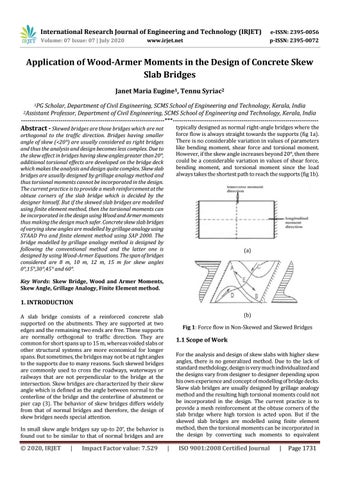
typically designed as normal right-angle bridges where the force flow is always straight towards the supports (fig 1a). There is no considerable variation in values of parameters like bending moment, shear force and torsional moment. However, if the skew angle increases beyond 20°, then there could be a considerable variation in values of shear force, bending moment, and torsional moment since the load always takes the shortest path to reach the supports (fig 1b).
orthogonal to the traffic direction. Bridges having smaller angle of skew (<20°) are usually considered as right bridges and thus the analysis and design becomes less complex. Due to the skew effect in bridges having skew angles greater than 20°, additional torsional effects are developed on the bridge deck which makes the analysis and design quite complex. Skew slab bridges are usually designed by grillage analogy method and thus torsional moments cannot be incorporated in the design. The current practice is to provide a mesh reinforcement at the obtuse corners of the slab bridge which is decided by the designer himself. But if the skewed slab bridges are modelled using finite element method, then the torsional moments can be incorporated in the design using Wood and Armer moments thus making the design much safer. Concrete skew slab bridges of varying skew angles are modelled by grillage analogy using STAAD Pro and finite element method using SAP 2000. The bridge modelled by grillage analogy method is designed by following the conventional method and the latter one is designed by using Wood-Armer Equations. The span of bridges considered are 8 m, 10 m, 12 m, 15 m for skew angles 0°,15°,30°,45° and 60°.
(a)
Key Words: Skew Bridge, Wood and Armer Moments, Skew Angle, Grillage Analogy, Finite Element method.
1. INTRODUCTION (b)
A slab bridge consists of a reinforced concrete slab supported on the abutments. They are supported at two edges and the remaining two ends are free. These supports are normally orthogonal to traffic direction. They are common for short spans up to 15 m, whereas voided slabs or other structural systems are more economical for longer spans. But sometimes, the bridges may not be at right angles to the supports due to many reasons. Such skewed bridges are commonly used to cross the roadways, waterways or railways that are not perpendicular to the bridge at the intersection. Skew bridges are characterized by their skew angle which is defined as the angle between normal to the centerline of the bridge and the centerline of abutment or pier cap (3). The behavior of skew bridges differs widely from that of normal bridges and therefore, the design of skew bridges needs special attention.
Fig 1: Force flow in Non-Skewed and Skewed Bridges
1.1 Scope of Work For the analysis and design of skew slabs with higher skew angles, there is no generalized method. Due to the lack of standard methdology, design is very much individualized and the designs vary from designer to designer depending upon his own experience and concept of modelling of bridge decks. Skew slab bridges are usually designed by grillage analogy method and the resulting high torsional moments could not be incorporated in the design. The current practice is to provide a mesh reinforcement at the obtuse corners of the slab bridge where high torsion is acted upon. But if the skewed slab bridges are modelled using finite element method, then the torsional moments can be incorporated in the design by converting such moments to equivalent
In small skew angle bridges say up-to 20°, the behavior is found out to be similar to that of normal bridges and are
© 2020, IRJET
|
Impact Factor value: 7.529
|
ISO 9001:2008 Certified Journal
|
Page 1731