International Research Journal of Engineering and Technology (IRJET) e-ISSN: 2395-0056 Volume: 07 Issue: 07 | July 2020
www.irjet.net
p-ISSN: 2395-0072
Plasma Arc Machining: A Review Parth Lad1, Vaibhav Wani2, Pranit Mehata3 1,2Diploma
Students, Department of Mechanical Engineering, St. John College of Engineering and Management (St. John Polytechnic), Palghar, Maharashtra, India, 401404 3Lecturer, Department of Mechanical Engineering, St. John College of Engineering and Management (St. John Polytechnic), Palghar, Maharashtra, India, 401404 ---------------------------------------------------------------------***----------------------------------------------------------------------
Abstract – This paper presents an idea about plasma arc cutting process which was developed for difficult to machine materials in order to overcome the inefficiency and ineffectiveness of conventional machining method when it come to complex shape and work piece. Technology today in metal cutting process require high quality cut surfaces and good dimensional correctness without further operation. Plasma arc cutting process does high temperature and high velocity contracted arc via amount of gas between the electrode and the work material to be engrave. Key Words: Plasma Arc Cutting
1. INTRODUCTION The three states of matter are solid, liquid and gases. The fourth state of matter is obtained when gases are heated to temperatures about 5500°C. At this temperature, the gases are partially ionized and exist in the form of mixture of free electrons, positively charged ions and neutral atoms. This mixture is termed as Plasma. When a gas is heated, then the number of collision between the atoms increases. Due to this the gas ionize, (i.e. the atoms are stripped-off their outer electron) which results in electron and ions. The electron thus produced, in turn, collide with atoms, increase their kinetic energy and ionize them so that more electrons and ions are produced. Thus, the plasma has an ability to conduct electricity due to the presence of electrons. When the gas is completely ionized, then the temperature of the central part of the plasma is between 11000°C to 28000°C. When such an ionized gas is directed on the workpiece through a high velocity jet, the metal is removed by melting. This plasma is used for the metal removal process. The plasma arc machining process is used for cutting alloy steels, stainless steel, cast iron, copper, nickel, titanium, and aluminum, etc.
© 2020, IRJET
|
Impact Factor value: 7.529
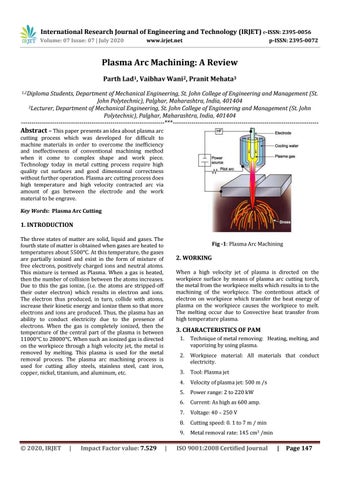
Fig -1: Plasma Arc Machining
2. WORKING When a high velocity jet of plasma is directed on the workpiece surface by means of plasma arc cutting torch, the metal from the workpiece melts which results in to the machining of the workpiece. The contentious attack of electron on workpiece which transfer the heat energy of plasma on the workpiece causes the workpiece to melt. The melting occur due to Convective heat transfer from high temperature plasma.
3. CHARACTERISTICS OF PAM
|
1.
Technique of metal removing: Heating, melting, and vaporizing by using plasma.
2.
Workpiece material: All materials that conduct electricity.
3.
Tool: Plasma jet
4.
Velocity of plasma jet: 500 m /s
5.
Power range: 2 to 220 kW
6.
Current: As high as 600 amp.
7.
Voltage: 40 – 250 V
8.
Cutting speed: 0. 1 to 7 m / min
9.
Metal removal rate: 145 cm3 /min
ISO 9001:2008 Certified Journal
|
Page 147