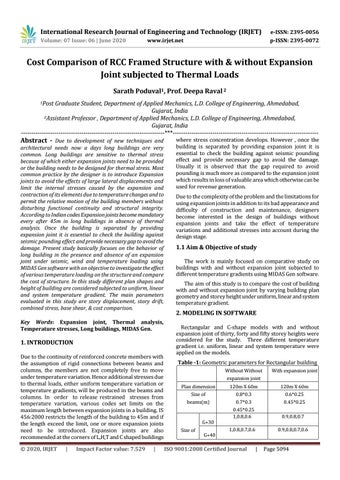
International Research Journal of Engineering and Technology (IRJET)
e-ISSN: 2395-0056
Volume: 07 Issue: 06 | June 2020
p-ISSN: 2395-0072
www.irjet.net
Cost Comparison of RCC Framed Structure with & without Expansion Joint subjected to Thermal Loads Sarath Poduval1, Prof. Deepa Raval 2 1Post
Graduate Student, Department of Applied Mechanics, L.D. College of Engineering, Ahmedabad, Gujarat, India 2Assistant Professor , Department of Applied Mechanics, L.D. College of Engineering, Ahmedabad, Gujarat, India ---------------------------------------------------------------------***----------------------------------------------------------------------
Abstract - Due to development of new techniques and
architectural needs now a days long buildings are very common. Long buildings are sensitive to thermal stress because of which either expansion joints need to be provided or the building needs to be designed for thermal stress. Most common practice by the designer is to introduce Expansion joints to avoid the effects of large lateral displacements and limit the internal stresses caused by the expansion and contraction of its elements due to temperature changes and to permit the relative motion of the building members without disturbing functional continuity and structural integrity. According to Indian codes Expansion joints become mandatory every after 45m in long buildings in absence of thermal analysis. Once the building is separated by providing expansion joint it is essential to check the building against seismic pounding effect and provide necessary gap to avoid the damage. Present study basically focuses on the behavior of long building in the presence and absence of an expansion joint under seismic, wind and temperature loading using MIDAS Gen software with an objective to investigate the effect of various temperature loading on the structure and compare the cost of structure. In this study different plan shapes and height of building are considered subjected to uniform, linear and system temperature gradient. The main parameters evaluated in this study are story displacement, story drift, combined stress, base shear, & cost comparison. Key Words: Expansion joint, Thermal analysis, Temperature stresses, Long buildings, MIDAS Gen.
1. INTRODUCTION Due to the continuity of reinforced concrete members with the assumption of rigid connections between beams and columns, the members are not completely free to move under temperature variation. Hence additional stresses due to thermal loads, either uniform temperature variation or temperature gradients, will be produced in the beams and columns. In order to release restrained stresses from temperature variation, various codes set limits on the maximum length between expansion joints in a building. IS 456:2000 restricts the length of the building to 45m and if the length exceed the limit, one or more expansion joints need to be introduced. Expansion joints are also recommended at the corners of L,H,T and C shaped buildings Š 2020, IRJET
|
Impact Factor value: 7.529
|
where stress concentration develops. However , once the building is separated by providing expansion joint it is essential to check the building against seismic pounding effect and provide necessary gap to avoid the damage. Usually it is observed that the gap required to avoid pounding is much more as compared to the expansion joint which results in loss of valuable area which otherwise can be used for revenue generation. Due to the complexity of the problem and the limitations for using expansion joints in addition to its bad appearance and difficulty of construction and maintenance, designers become interested in the design of buildings without expansion joints and take the effect of temperature variations and additional stresses into account during the design stage.
1.1 Aim & Objective of study The work is mainly focused on comparative study on buildings with and without expansion joint subjected to different temperature gradients using MIDAS Gen software. The aim of this study is to compare the cost of building with and without expansion joint by varying building plan geometry and storey height under uniform, linear and system temperature gradient.
2. MODELING IN SOFTWARE Rectangular and C-shape models with and without expansion joint of thirty, forty and fifty storey heights were considered for the study. Three different temperature gradient i.e. uniform, linear and system temperature were applied on the models. Table -1: Geometric parameters for Rectangular building Without Without
With expansion joint
expansion joint Plan dimension
120m X 60m
120m X 60m
Size of
0.8*0.3
0.6*0.25
beams(m)
G+30 Size of
G+40
0.7*0.3
0.45*0.25
0.45*0.25 1,0.8,0.6
0.9,0.8,0.7
1,0.8,0.7,0.6
0.9,0.8,0.7,0.6
ISO 9001:2008 Certified Journal
|
Page 5094