International Research Journal of Engineering and Technology (IRJET)
e-ISSN: 2395-0056
Volume: 07 Issue: 06 | June 2020
p-ISSN: 2395-0072
www.irjet.net
Performance Analysis of Tall Structures with Hexagrid Systems at Varying Depth Meenu Rachel Jose1, Nimiya Rose Joshuva2 1PG
Student, Department of Civil Engineering, Saintgits College of Engineering, Kerala, India Department of Civil Engineering, Saintgits College of Engineering, Kerala, India ---------------------------------------------------------------------***--------------------------------------------------------------------2Asst.Professor,
Abstract - The need for tall buildings are increasing due to
heavy urbanization and population growth. As the height of the building increase, the need for lateral load resisting are increased. Some of the lateral load resisting systems are rigid frame, braced frame, shear wall, tubular, diagrid, pentagrid, hexagrid and octagrid structures. Hexagrid has highly aesthetic and high structural performance and effective in minimize shear deformation because it carry shear by axial action of the diagonal members, while other structures carry shear by the bending of the horizontal spandrels and vertical coloumns. The aim of the present work is to study the performance of tall structures with hexagrid systems provided at varying depths and compare with the performance of structures when hexagrids are provided throughout the full depth of the building. A square shaped plan building of 36 storey with storey height 3.6m with size 36m x 36m, is considered. Modelling and analysis of the structure are considered in ETABS. Analysis and design are carried out for dead load, live load, lateral load, earthquake load and wind load. As compared with conventional frame, by providing hexagrids at varying depth, displacement and drift gradually decreases. The displacement and drift is almost similar for the models with hexagrid provided beyond mid height of the building.
Storey displacement, Structural weight
1. INTRODUCTION 1.1 General Due to heavy urbanization and population growth, the cost of land is increasing rapidly and the land availability has become a constraint for developers & builders and need for high rise buildings are increased. So, the lateral load resisting system becomes more important to resist lateral loads than structural system that resists gravitational loads. In grid structures all vertical columns on the perimeter are eliminated and diagonal columns inclined at a specific angle. The angle of the diagonal members of the hexagrid are depend on the storey height. Since the number of columns in structure is reduced, the material conception is less than conventional structural system. The main objective of this work is to study the performance of tall structures with |
Impact Factor value: 7.529
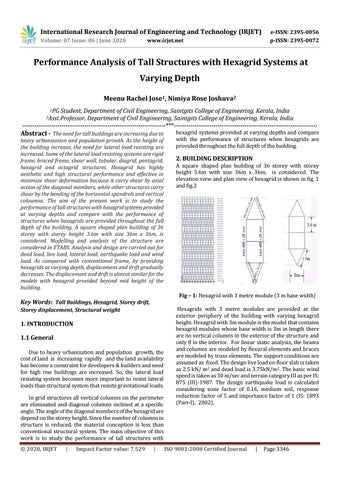
2. BUILDING DESCRIPTION A square shaped plan building of 36 storey with storey height 3.6m with size 36m x 36m, is considered. The elevation view and plan view of hexagrid is shown in fig. 1 and fig.2
Fig – 1: Hexagrid with 3 metre module (3 m base width)
Key Words: Tall Buildings, Hexagrid, Storey drift,
Š 2020, IRJET
hexagrid systems provided at varying depths and compare with the performance of structures when hexagrids are provided throughout the full depth of the building.
|
Hexagrids with 3 metre modules are provided at the exterior periphery of the building with varying hexagrid height. Hexagrid with 3m module is the model that contains hexagrid modules whose base width is 3m in length there are no vertical columns in the exterior of the structure and only 8 in the interior. For linear static analysis, the beams and columns are modeled by flexural elements and braces are modeled by truss elements. The support conditions are assumed as fixed. The design live load on floor slab is taken as 2.5 kN/ m2 and dead load is 3.75kN/m2. The basic wind speed is taken as 30 m/sec and terrain category III as per IS: 875 (III)-1987. The design earthquake load is calculated considering zone factor of 0.16, medium soil, response reduction factor of 5 and importance factor of 1 (IS: 1893 (Part-I), 2002).
ISO 9001:2008 Certified Journal
|
Page 3346