International Research Journal of Engineering and Technology (IRJET)
e-ISSN: 2395-0056
Volume: 07 Issue: 06 | June 2020
p-ISSN: 2395-0072
www.irjet.net
STUDY OF BEHAVIOUR OF STRUCTURE USING BRACING SYSTEM CONSIDERING LATERAL LOAD Sonal Dhodi1, Bhargavi Machhi1, Jalmin Patel1, Vishwa Patel1, Mr. Ravi Patel2, Mr. Zeeshan Munshi 2 1Students,
Dept. of Civil Engineering, LIT - Sarigam, GTU – Ahmedabad, Gujarat, India Dept. of Civil Engineering, LIT - Sarigam, GTU – Ahmedabad, Gujarat, India -----------------------------------------------------------------------***-----------------------------------------------------------------------Abstract:A study on performance of high rise steel building with bracings, carried out on a residential building by considering the 2Professor,
gravity loads and lateral loads in the form of earthquake loads and wind loads incorporating the bracing to reduce lateral load on structure element in this study. A steel frame structure has been selected to be idealized as multistory steel building model. The model is analyzed by using STAAD PRO 2008 structural analysis software with consideration of wind and earthquake loads at the same time the influence of the different types of bracing has been investigated. Different types of bracing systems have been investigated for the use in tall building in order to provide lateral stiffness. The use of bracings has potential advantage over other scheme, the bracings are provided for peripheral columns. A multi storey situated at a different seismic zone is subjected to lateral loads. The analysis and design as per IS:800-2007,the wind load analysis IS 875 (Part 3)–2015 and seismic or earthquake load according IS 1893 (Part 1) – 2016.
Keywords: High rise building, Bracing system, Lateral force, Nodal displacement, Storey drift, Axial force, Bending moment.
I. INTRODUCTION Structural engineer’s point of view the tall building or multi-storey building can be defined as one that, by virtue of its height, is affected by lateral forces due to wind or earthquake or both to an extent that they play an important role in the structural design. Buildings and structures are considered stable with lateral supports by using either bracing systems or shear system or both such as wall to ensure the stability of the building. Moreover, the important thing to consider are the software to be used for the analysis of tall building structure and wind speed at construction area to avoid any problems in future. In this, study is conducted for braced frame structures. Bracing is a highly efficient and economical method to laterally stiffen the frame structures against wind loads.
energy dissipation is difficult to achieve in concentrically braced frames.
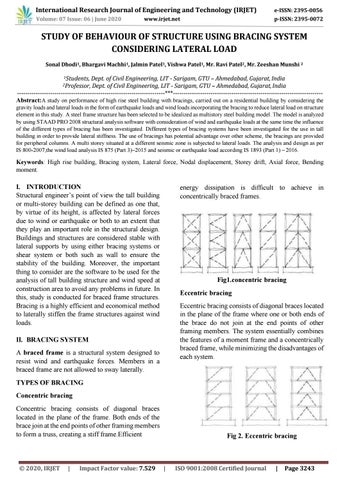
Fig1.concentric bracing Eccentric bracing Eccentric bracing consists of diagonal braces located in the plane of the frame where one or both ends of the brace do not join at the end points of other framing members. The system essentially combines the features of a moment frame and a concentrically braced frame, while minimizing the disadvantages of each system.
II. BRACING SYSTEM A braced frame is a structural system designed to resist wind and earthquake forces. Members in a braced frame are not allowed to sway laterally. TYPES OF BRACING Concentric bracing Concentric bracing consists of diagonal braces located in the plane of the frame. Both ends of the brace join at the end points of other framing members to form a truss, creating a stiff frame.Efficient
© 2020, IRJET
|
Impact Factor value: 7.529
Fig 2. Eccentric bracing
|
ISO 9001:2008 Certified Journal
|
Page 3243