International Research Journal of Engineering and Technology (IRJET)
e-ISSN: 2395-0056
Volume: 07 Issue: 06 | June 2020
p-ISSN: 2395-0072
www.irjet.net
Evaluation of Effect of Special Shaped Column Cross Section on Response Modification Factor of Reinforced Concrete Building Shruti R. Sarage1, Dr. S. K. Hirde2 1Post
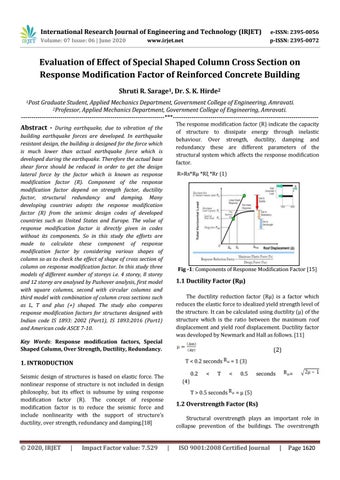
Graduate Student, Applied Mechanics Department, Government College of Engineering, Amravati. 2Professor, Applied Mechanics Department, Government College of Engineering, Amravati. ---------------------------------------------------------------------***---------------------------------------------------------------------The response modification factor (R) indicate the capacity of structure to dissipate energy through inelastic behaviour. Over strength, ductility, damping and redundancy these are different parameters of the structural system which affects the response modification factor.
Abstract - During earthquake, due to vibration of the building earthquake forces are developed. In earthquake resistant design, the building is designed for the force which is much lower than actual earthquake force which is developed during the earthquake. Therefore the actual base shear force should be reduced in order to get the design lateral force by the factor which is known as response modification factor (R). Component of the response modification factor depend on strength factor, ductility factor, structural redundancy and damping. Many developing countries adopts the response modification factor (R) from the seismic design codes of developed countries such as United States and Europe. The value of response modification factor is directly given in codes without its components. So in this study the efforts are made to calculate these component of response modification factor by considering various shapes of column so as to check the effect of shape of cross section of column on response modification factor. In this study three models of different number of storeys i.e. 4 storey, 8 storey and 12 storey are analysed by Pushover analysis, first model with square columns, second with circular columns and third model with combination of column cross sections such as L, T and plus (+) shaped. The study also compares response modification factors for structures designed with Indian code IS 1893: 2002 (Part1), IS 1893:2016 (Part1) and American code ASCE 7-10.
R=Rs*Rμ *Rξ *Rr (1)
Fig -1: Components of Response Modification Factor [15]
1.1 Ductility Factor (Rμ) The ductility reduction factor (Rμ) is a factor which reduces the elastic force to idealized yield strength level of the structure. It can be calculated using ductility (μ) of the structure which is the ratio between the maximum roof displacement and yield roof displacement. Ductility factor was developed by Newmark and Hall as follows. [11]
Key Words: Response modification factors, Special Shaped Column, Over Strength, Ductility, Redundancy.
(2) T < 0.2 seconds
1. INTRODUCTION
0.2
Seismic design of structures is based on elastic force. The nonlinear response of structure is not included in design philosophy, but its effect is subsume by using response modification factor (R). The concept of response modification factor is to reduce the seismic force and include nonlinearity with the support of structure’s ductility, over strength, redundancy and damping.[18]
© 2020, IRJET
|
Impact Factor value: 7.529
<
T
= 1 (3) <
0.5
seconds
=
(4) T > 0.5 seconds
= μ (5)
1.2 Overstrength Factor (Rs) Structural overstrength plays an important role in collapse prevention of the buildings. The overstrength
|
ISO 9001:2008 Certified Journal
|
Page 1620