International Research Journal of Engineering and Technology (IRJET)
e-ISSN: 2395-0056
Volume: 07 Issue: 06 | June 2020
p-ISSN: 2395-0072
www.irjet.net
Verification of Data Integrity using MD5 Hashing Function Silveri Anvesh1 1M.S,
Dept. Of ECE Engineering, VEDAIIT, Andhra Pradesh, India. ---------------------------------------------------------------------***----------------------------------------------------------------------
Abstract - With the growth of the personal computers and the internet, computers are now integrated into our lives. The advancement of technology is leading to data threats and security issues. A hacker may gain access to our most secret information by breaking through our firewall and gaining access to the internals of our computing system even though he is physically present somewhere else. Compromised computers may leak our most private information: personal documents, pictures and movies, browsing history, chat history, bank account passwords, etc.
A persistent problem for modern System-on-Chip is their vulnerability to code injection attacks. By tampering the memory content, attackers are able to extract secrets from the SoC and to modify or deny the SoC’s operation. This work proposes secure, and fast method to check the integrated data is safe or not present in Memory. All applications that need high security should be immune to both physical and software attacks through the secure architectures. Memory integrity verification is a major and important issue while implementing secure processors. This paper proposed a method to ensure data integrity. Key Words: Memory Integrity, data integrity, encryption, decryption.
1. INTRODUCTION
Redundancy Checks (CRCs) are accustomed detect the loss of information integrity. In these techniques, a digest of information is computed mathematically and appended to the information.
1.1.2 Active Threats In this type, an attacker can alter the data with malicious data. In other Words, if data is without digest, it is going to be converted without notice. The system appends CRC to information for knowing any changes. At higher level of threat, attacker may alter data and replaces with other digest for altered data from exiting digest. This can be possible if the digest is computed using mechanisms such as CRC. Hashing and Encryption are extremely used in verifying the data integrity and for maintenance of security.
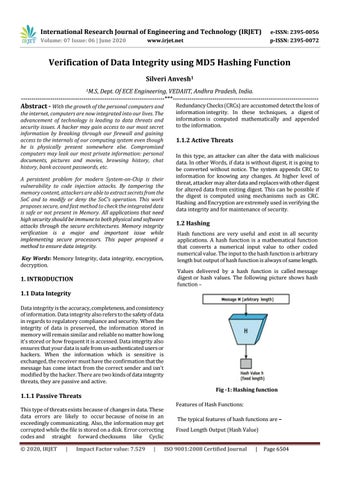
1.2 Hashing Hash functions are very useful and exist in all security applications. A hash function is a mathematical function that converts a numerical input value to other coded numerical value. The input to the hash function is arbitrary length but output of hash function is always of same length. Values delivered by a hash function is called message digest or hash values. The following picture shows hash function –
1.1 Data Integrity Data integrity is the accuracy, completeness, and consistency of information. Data integrity also refers to the safety of data in regards to regulatory compliance and security. When the integrity of data is preserved, the information stored in memory will remain similar and reliable no matter how long it’s stored or how frequent it is accessed. Data integrity also ensures that your data is safe from un-authenticated users or hackers. When the information which is sensitive is exchanged, the receiver must have the confirmation that the message has come intact from the correct sender and isn’t modified by the hacker. There are two kinds of data integrity threats, they are passive and active. Fig -1: Hashing function
1.1.1 Passive Threats This type of threats exists because of changes in data. These data errors are likely to occur because of noise in an exceedingly communicating. Also, the information may get corrupted while the file is stored on a disk. Error correcting codes and straight forward checksums like Cyclic © 2020, IRJET
|
Impact Factor value: 7.529
|
Features of Hash Functions: The typical features of hash functions are − Fixed Length Output (Hash Value) ISO 9001:2008 Certified Journal
|
Page 6504