International Research Journal of Engineering and Technology (IRJET)
e-ISSN: 2395-0056
Volume: 07 Issue: 06 | June 2020
p-ISSN: 2395-0072
www.irjet.net
Named Entity Recognition on legal text for secondary dataset Vikas Mastud1, Roshan Jaiswal2 1Student,
Dept. of Institute of Computer Science, MET College, Maharashtra, India Professor, Dept. of Institute of Computer Science, MET College, Maharashtra, India ---------------------------------------------------------------------***---------------------------------------------------------------------2Assistant
Abstract - The legal judgment documents contain valuable information which can be used for discovering unknown patterns from it. but Legal texts are full of challenges; they contain many typos which include space between a single word, two words merged. In India, each geographic region has its style and language to write judgment documents. Judgment documents are free text and real-life data, and these data sets are very hard to clean and process.
2. NER Named-entity recognition (NER) is the Extraction or identification of words as a predefined category like person names, currency, location, organizations, in the text.
This paper describes an approach to creating a secondary dataset using Named Entity Recognition (NER) in English language documents from the legal domain. The aim is the extraction of entity classes: person name, judge name, lawyer name, country, city, street, landscape, company, organization, court, brand, institution, law, ordinance, court decision, and legal literature. For performing Named Entity Recognition transfer learning is used. Frameworks and libraries used and tested for better accuracy are FlairNLP, Bert, AllenNLP, Spacy, NLTK.
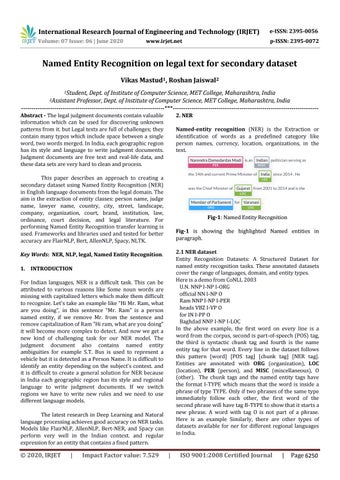
Fig-1: Named Entity Recognition Fig-1 is showing the highlighted Named entities in paragraph. 2.1 NER dataset Entity Recognition Datasets: A Structured Dataset for named entity recognition tasks. These annotated datasets cover the range of languages, domain, and entity types. Here is a demo from CoNLL 2003 U.N. NNP I-NP I-ORG official NN I-NP O Ram NNP I-NP I-PER heads VBZ I-VP O for IN I-PP O Baghdad NNP I-NP I-LOC In the above example, the first word on every line is a word from the corpus, second is part-of-speech (POS) tag, the third is syntactic chunk tag and fourth is the name entity tag for that word. Every line in the dataset follows this pattern [word] [POS tag] [chunk tag] [NER tag]. Entities are annotated with ORG (organization), LOC (location), PER (person), and MISC (miscellaneous), O (other). The chunk tags and the named entity tags have the format I-TYPE which means that the word is inside a phrase of type TYPE. Only if two phrases of the same type immediately follow each other, the first word of the second phrase will have tag B-TYPE to show that it starts a new phrase. A word with tag O is not part of a phrase. Here is an example Similarly, there are other types of datasets available for ner for different regional languages in India.
Key Words: NER, NLP, legal, Named Entity Recognition. 1. INTRODUCTION For Indian languages, NER is a difficult task. This can be attributed to various reasons like Some noun words are missing with capitalized letters which make them difficult to recognize. Let's take an example like “Hi Mr. Ram, what are you doing”, in this sentence “Mr. Ram” is a person named entity, if we remove Mr. from the sentence and remove capitalization of Ram “Hi ram, what are you doing” it will become more complex to detect. And now we get a new kind of challenging task for our NER model. The judgment document also contains named entity ambiguities for example S.T. Bus is used to represent a vehicle but it is detected as a Person Name. It is difficult to identify an entity depending on the subject's context. and it is difficult to create a general solution for NER because in India each geographic region has its style and regional language to write judgment documents. If we switch regions we have to write new rules and we need to use different language models. The latest research in Deep Learning and Natural language processing achieves good accuracy on NER tasks. Models like FlairNLP, AllenNLP, Bert-NER, and Spacy can perform very well in the Indian context. and regular expression for an entity that contains a fixed pattern.
© 2020, IRJET
|
Impact Factor value: 7.529
|
ISO 9001:2008 Certified Journal
|
Page 6250