International Research Journal of Engineering and Technology (IRJET)
e-ISSN: 2395-0056
Volume: 07 Issue: 06 | June 2020
p-ISSN: 2395-0072
www.irjet.net
ANALYTICAL STUDY OF POST TENSIONED SLAB TO EVALUATE THE PERFORMANCE OF FLOATING COLUMN IN MULTI STORIED BUILDING USING ETABS NAFNA NAUSHAD1, TEENA JOY2 1PG
Student, Dept.of Civil Engineering, Indira Gandhi Institute of Engineering and Technology, Kerala, India Professor, Dept.of Civil Engineering, Indira Gandhi Institute of Engineering and Technology,Kerala,India ---------------------------------------------------------------------***---------------------------------------------------------------------1.1 Floating Column Abstract – This research aims to develop analytical study of 2Assistant
post tensioned slab with floating column. In present scenario buildings with floating columns are of typical feature within the fashionable multi storey construction practices in urban India. Such sorts of constructions are highly undesirable in building inbuilt seismically active areas. For this buildings are given floating columns at one or more storey. These floating columns are highly disadvantageous during a building inbuilt seismically active areas. The earthquake forces that are developed at different floor levels during a building got to be carried down along the peak to the bottom by the shortest path. Deviation or discontinuity during this load transfer path leads to poor performance of the building. In this paper, the critical position of floating column in vertically irregular buildings has been discussed for G+11 buildings for zone II. Also the effect of size of beams and columns carrying the load of floating column has been assessed with tendons. The response of building like storey drift, storey displacement and storey shear has been wont to evaluate the results obtained using ETABS software. Key Words: Floating column, Irregular building, Post tensioned slab, Etabs, Response Spectrum Analysis, Storey displacement, Storey drift, Torsional Performance.
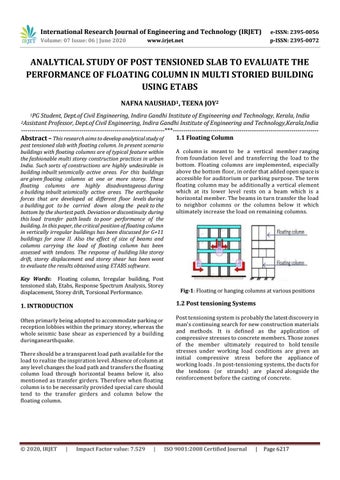
A column is meant to be a vertical member ranging from foundation level and transferring the load to the bottom. Floating columns are implemented, especially above the bottom floor, in order that added open space is accessible for auditorium or parking purpose. The term floating column may be additionally a vertical element which at its lower level rests on a beam which is a horizontal member. The beams in turn transfer the load to neighbor columns or the columns below it which ultimately increase the load on remaining columns.
Fig-1: Floating or hanging columns at various positions
1. INTRODUCTION
1.2 Post tensioning Systems
Often primarly being adopted to accommodate parking or reception lobbies within the primary storey, whereas the whole seismic base shear as experienced by a building duringanearthquake.
Post tensioning system is probably the latest discovery in man's continuing search for new construction materials and methods. It is defined as the application of compressive stresses to concrete members. Those zones of the member ultimately required to hold tensile stresses under working load conditions are given an initial compressive stress before the appliance of working loads . In post-tensioning systems, the ducts for the tendons (or strands) are placed alongside the reinforcement before the casting of concrete.
There should be a transparent load path available for the load to realize the inspiration level. Absence of column at any level changes the load path and transfers the floating column load through horizontal beams below it, also mentioned as transfer girders. Therefore when floating column is to be necessarily provided special care should tend to the transfer girders and column below the floating column.
Š 2020, IRJET
|
Impact Factor value: 7.529
|
ISO 9001:2008 Certified Journal
|
Page 6217