
IRJET- Math Model on Error Detection and Correction

Page 1

International Research Journal of Engineering and Technology (IRJET)

e-ISSN: 2395-0056

Volume: 07 Issue: 05 | May 2020

p-ISSN: 2395-0072

www.irjet.net

MATH MODEL ON ERROR DETECTION AND CORRECTION Mukunda D S1, Poornachandra prakash2, Manoj kumar P A3, Pavan kalyan V4, Prof.Pavan kumar E5 1-5Department of Electronics and Communication, Sai Vidya Institute of Technology, Bengaluru, India ----------------------------------------------------------------------***---------------------------------------------------------------------

Abstract Communication is a powerful tool that aids us to connect with people. In today’s world digital communication has made our life much easier. But in the process of digital communication, the messages transmitted are often vulnerable to noise. In other words, the information signal sent from the transmitter gets corrupted even before receiving back at the receiver. Hence the receiver must be capable of detecting the random error bits added to the original data. These random error bits are due to environmental interferences and physical defects or even due to technology scaling and variations in parameters and noise levels. This paper describes mathematical error detection/correction models (techniques) that can be utilized to protect the system against various types of errors. These detection/correction models have their own performance, complexity levels and requires a lot of effort to achieve the maximum efficiency in the digital transmission. This paper enumerates many error detection and correction math models that allow reliable delivery of digital data across unreliable communication channels. Keywords: bit flip, errors memory, error detection and correction, parity, hamming code.

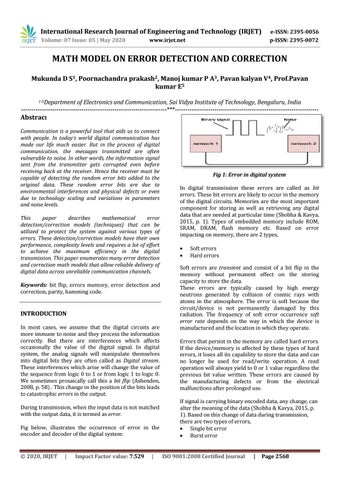
INTRODUCTION In most cases, we assume that the digital circuits are more immune to noise and they process the information correctly. But there are interferences which affects occasionally the value of the digital signal. In digital system, the analog signals will manipulate themselves into digital bits they are often called as Digital stream. These interferences which arise will change the value of the sequence from logic 0 to 1 or from logic 1 to logic 0. We sometimes prosaically call this a bit flip (Ashenden, 2008, p. 58) . This change in the position of the bits leads to catastrophic errors in the output. During transmission, when the input data is not matched with the output data, it is termed as error. Fig below, illustrates the occurrence of error in the encoder and decoder of the digital system:

© 2020, IRJET

|

Impact Factor value: 7.529

|

Fig 1: Error in digital system In digital transmission these errors are called as bit errors. These bit errors are likely to occur in the memory of the digital circuits. Memories are the most important component for storing as well as retrieving any digital data that are needed at particular time (Shobha & Kavya, 2015, p. 1). Types of embedded memory include ROM, SRAM, DRAM, flash memory etc. Based on error impacting on memory, there are 2 types,  

Soft errors Hard errors

Soft errors are transient and consist of a bit flip in the memory without permanent effect on the storing capacity to store the data. These errors are typically caused by high energy neutrons generated by collision of cosmic rays with atoms in the atmosphere. The error is soft because the circuit/device is not permanently damaged by this radiation. The frequency of soft error occurrence soft error rate depends on the way in which the device is manufactured and the location in which they operate. Errors that persist in the memory are called hard errors. If the device/memory is affected by these types of hard errors, it loses all its capability to store the data and can no longer be used for read/write operation. A read operation will always yield to 0 or 1 value regardless the previous bit value written. These errors are caused by the manufacturing defects or from the electrical malfunctions after prolonged use. If signal is carrying binary encoded data, any change, can alter the meaning of the data (Shobha & Kavya, 2015, p. 1). Based on this change of data during transmission, there are two types of errors,  Single bit error  Burst error

ISO 9001:2008 Certified Journal

|

Page 2568


Turn static files into dynamic content formats.
Create a flipbook