International Research Journal of Engineering and Technology (IRJET)
e-ISSN: 2395-0056
Volume: 07 Issue: 05 | May 2020
p-ISSN: 2395-0072
www.irjet.net
DESIGN AND TEST 3D PRINTED LATTICE STRUCTURE FOR UAV Prof. Shital Patel1, Akash Bhoi2, Vivek Maurya3 ,Akash Wankhede4, Rajat Bakshi5 1Prof.
Shital V. Patel, Dept. Mechanical Engineering, Bharati vidyapeeth college of engineering, Navi Mumbai, Maharastra, India 2-5 Dept. Mechanical Engineering, Bharati vidyapeeth college of engineering, Navi Mumbai, Maharastra, India ---------------------------------------------------------------------***--------------------------------------------------------------------pyramid or 3D honeycomb like interior structures. Abstract - The objective of this study is to analyze These structures provide optimal strength-to-weight different lattice structures and select the structure with ratio and relieves stress. optimum load and deflection characteristics. The study examines three lattice structures – honeycomb structure, 3D kagome structure and 3-D pyramid structure of different thickness spanning from 1 mm to 2mm with 0.2 mm step and manufactured using FDM process on Accucraft 3-D printer with rectangular cross-section of sample size 20*20*100 mm. The material used for 3-D printing is Acrylonitrile butadiene styrene (ABS). Static structural analysis is performed on SOLIDWORKS to study deflection of the structures. As the demand for UAV have increased exponentially in Military, Surveillance, agriculture and many other commercial applications, it becomes important to reduce its weight to enhance the efficiency by lowering the power requirement and allows to increase its payload capacity while retaining or even enhancing its structural strength. Key Words: UAV, 3-D printing, Lattice Structure, 3D Kagome, 3D Pyramid, 3D honeycomb
UAV structure must withstand the aerodynamic forces generated from rotors and the gravitational force due to its self-weight and mounted weights. The arm of the quad copter acts as a cantilever beam with end loading and the material behaves as σ = εE (Hooke’s law) 3 lattice structures are considered for this research. Namely Kagome, Honeycomb, Pyramid Structures. 3D Kagome structure
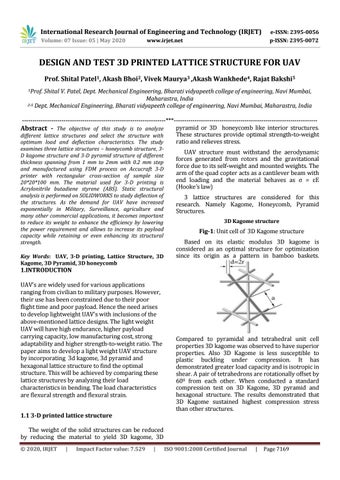
Fig-1: Unit cell of 3D Kagome structure Based on its elastic modulus 3D kagome is considered as an optimal structure for optimization since its origin as a pattern in bamboo baskets.
1.INTRODUCTION
UAV’s are widely used for various applications ranging from civilian to military purposes. However, their use has been constrained due to their poor flight time and poor payload. Hence the need arises to develop lightweight UAV’s with inclusions of the above-mentioned lattice designs. The light weight UAV will have high endurance, higher payload carrying capacity, low manufacturing cost, strong adaptability and higher strength-to-weight ratio. The paper aims to develop a light weight UAV structure by incorporating 3d kagome, 3d pyramid and hexagonal lattice structure to find the optimal structure. This will be achieved by comparing these lattice structures by analyzing their load characteristics in bending. The load characteristics are flexural strength and flexural strain. 1.1 3-D printed lattice structure
Compared to pyramidal and tetrahedral unit cell properties 3D kagome was observed to have superior properties. Also 3D Kagome is less susceptible to plastic buckling under compression. It has demonstrated greater load capacity and is isotropic in shear. A pair of tetrahedrons are rotationally offset by 600 from each other. When conducted a standard compression test on 3D Kagome, 3D pyramid and hexagonal structure. The results demonstrated that 3D Kagome sustained highest compression stress than other structures.
The weight of the solid structures can be reduced by reducing the material to yield 3D kagome, 3D © 2020, IRJET
|
Impact Factor value: 7.529
|
ISO 9001:2008 Certified Journal
|
Page 7169