
IRJET- Design and Implementation of a Controller for a Recirculating Aquaponics System using IoT

Page 1

INTERNATIONAL RESEARCH JOURNAL OF ENGINEERING AND TECHNOLOGY (IRJET)

E-ISSN: 2395-0056

VOLUME: 07 ISSUE: 05 | MAY 2020

P-ISSN: 2395-0072

WWW.IRJET.NET

Design and Implementation of a Controller for a Recirculating Aquaponics System using IoT Vitapu Gnanasagar1

Mannava Vivek2

Final year, Department of Electronics and Instrumentation SCSVMV (deemed to be university) Enathur, Kanchipuram, Tamilnadu.

Final year, Department of Mechatronics SCSVMV (deemed to be university) Enathur, Kanchipuram, Tamilnadu.

Abstract – This paper details the automation of the Aquaponics system, where the required parameters needed for the growth of plants are controlled, and are monitored using IoT. By utilizing this system, we achieve a symbiotic relationship between the plants and the fish. The IoT part of this system helps in monitoring the parameters from anywhere by connecting to the ‘ThingSpeak’ server. Keywords – RAS (Recirculating Aquaponics System), IoT, Controlled environment, Symbiosis.

I. INTRODUCTION In our current way of life, healthy, natural food is a luxury only a few can afford. The increased demand for food supply has made companies across the globe to turn to chemical means, to increase food production, which results in crops being contaminated by unwanted pesticides and other chemical growth substances. These means for an increase in production rates, has also reduced the nutrition values of the food. In the future, the increase in population, demand for the ground water level will severely affect food production, and result in a drastic reduction of the nutritional level of the food. To overcome these problems researchers and innovators worldwide, have introduced vertical farming, which can turn out to be a viable solution. In vertical farming, there are so many methods like Hydroponics, Aeroponics and Aquaponics. Among all other methods the most sustainable method of growing food is Aquaponics. This was an ancient method used in the eastern and southern parts of the world, and it is now modified and re-introduced as a modern method of agriculture. This aquaponics is the combination of hydroponics and aquaculture, where in Hydroponics, plants are grown by using the artificial nutrients which are given directly to the roots by a stream of water, without using soil. Many engineering techniques like NFT, Raft system, Stacks, grow beds are used to cover the absence of soil. In a conventional hydroponic system, the major drawback is the water coming out of the system, as it is harmful to the environment and cannot be used again. Aquaculture is farming of fish in a separate area like tanks, ponds, raceways and in cages for increase in fish production, but in this method, the water coming out of the system is wasted and cannot be used again without using a proper filtration system. Upon careful consideration of the drawbacks of both, hydroponics and aquaculture, aquaponics was © 2020, IRJET

|

Impact Factor value: 7.529

|

introduced. In this system, the waste generated from the fish is converted into plant nutrients by using bacteria present in the water and then sent to plants to grow hydroponically. Hence the whole system is in recirculation and this is called the Recirculating Aquaponics System (RAS).

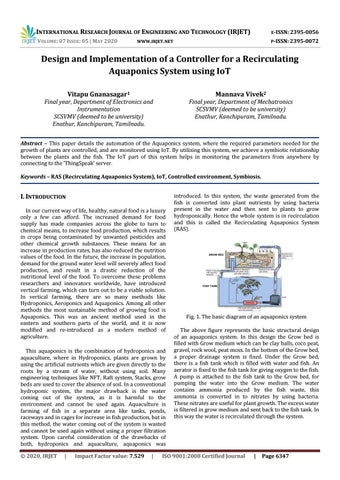
Fig. 1. The basic diagram of an aquaponics system The above figure represents the basic structural design of an aquaponics system. In this design the Grow bed is filled with Grow medium which can be clay balls, coco peat, gravel, rock wool, peat moss. In the bottom of the Grow bed, a proper drainage system is fixed. Under the Grow bed, there is a fish tank which is filled with water and fish. An aerator is fixed to the fish tank for giving oxygen to the fish. A pump is attached to the fish tank to the Grow bed, for pumping the water into the Grow medium. The water contains ammonia produced by the fish waste, this ammonia is converted in to nitrates by using bacteria. These nitrates are useful for plant growth. The excess water is filtered in grow medium and sent back to the fish tank. In this way the water is recirculated through the system.

ISO 9001:2008 Certified Journal

|

Page 6347


Turn static files into dynamic content formats.
Create a flipbook
IRJET- Design and Implementation of a Controller for a Recirculating Aquaponics System using IoT by IRJET Journal - Issuu