International Research Journal of Engineering and Technology (IRJET)
e-ISSN: 2395-0056
Volume: 07 Issue: 05 | May 2020
p-ISSN: 2395-0072
www.irjet.net
ACCIDENTCIAL PROGRESSIVE COLLAPSE ANALYSIS TALL BUILDING AND ITS COST MANAGEMENT N.TAMILSELVAN M.E(Construction Engineering and Management), Meenakshi Sundararajan Engineering College, Cheenai , Tamilnadu, India ---------------------------------------------------------------------***---------------------------------------------------------------------
redistribute the overloading, that portion of the structure or the whole of the structure may collapse. The columns of a building persist to fail until the extra loading on the column becomes steady. Consequently, a significant portion of the building may fall down because of the larger and superior damage to the building than the preliminary impact.
Abstract - The main objective of this study is to investigate
whether concentric, eccentric bracings and MRF steel structures that have been designed based on seismic codes, are able to resist progressive collapse with damaged columns in different locations under seismic loading. For this purpose, 3-D push-over analysis of structures is carried out. The progressive collapse potential has been assessed in connection with 20story tall buildings with 4 bay by applying the alternate load path method recommended in UFC and GSA 2013 guidelines. Member removal in this manner is intended to represent a situation where an extreme event, such as vehicle impact or past earthquake shock or construction error, may cause a critical column, as a result of local or global buckling, to lose a part or whole of its load bearing capacity. In the case of braces and middle column removal, the structure is minimum stiffness when compared with other different cases. The influence of story number, redundancy and location of critical eliminated elements has been discussed. And finally cost management in done.
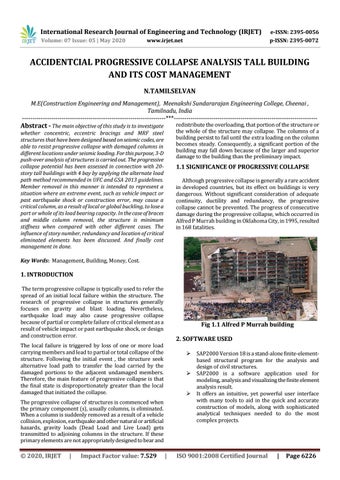
1.1 SIGNIFICANCE OF PROGRESSIVE COLLAPSE Although progressive collapse is generally a rare accident in developed countries, but its effect on buildings is very dangerous. Without significant consideration of adequate continuity, ductility and redundancy, the progressive collapse cannot be prevented. The progress of consecutive damage during the progressive collapse, which occurred in Alfred P Murrah building in Oklahoma City, in 1995, resulted in 168 fatalities.
Key Words: Management, Building, Money, Cost.
1. INTRODUCTION The term progressive collapse is typically used to refer the spread of an initial local failure within the structure. The research of progressive collapse in structures generally focuses on gravity and blast loading. Nevertheless, earthquake load may also cause progressive collapse because of partial or complete failure of critical element as a result of vehicle impact or past earthquake shock, or design and construction error.
Fig 1.1 Alfred P Murrah building 2. SOFTWARE USED
The local failure is triggered by loss of one or more load carrying members and lead to partial or total collapse of the structure. Following the initial event , the structure seek alternative load path to transfer the load carried by the damaged portions to the adjacent undamaged members. Therefore, the main feature of progressive collapse is that the final state is disproportionately greater than the local damaged that initiated the collapse.
The progressive collapse of structures is commenced when the primary component (s), usually columns, is eliminated. When a column is suddenly removed as a result of a vehicle collision, explosion, earthquake and other natural or artificial hazards, gravity loads (Dead Load and Live Load) gets transmitted to adjoining columns in the structure. If these primary elements are not appropriately designed to bear and
© 2020, IRJET
|
Impact Factor value: 7.529
|
SAP2000 Version 18 is a stand-alone finite-elementbased structural program for the analysis and design of civil structures. SAP2000 is a software application used for modeling, analysis and visualizing the finite element analysis result. It offers an intuitive, yet powerful user interface with many tools to aid in the quick and accurate construction of models, along with sophisticated analytical techniques needed to do the most complex projects.
ISO 9001:2008 Certified Journal
|
Page 6226