International Research Journal of Engineering and Technology (IRJET)
e-ISSN: 2395-0056
Volume: 07 Issue: 04 | Apr 2020
p-ISSN: 2395-0072
www.irjet.net
Study of Seismic Retrofitting Techniques Chetan Jaiprakash Chitte Department of Civil Engineering, R. C. Patel Institute of Technology, Shirpur-425405 Dist. Dhule, Maharashtra, India, ---------------------------------------------------------------------***----------------------------------------------------------------------
Abstract - Many parts of the country have suffered
earthquake in last three decades. Seismic protection of buildings is a need-based concept aimed to improve the performance of any structure under future earthquakes. Earthquakes of varying magnitude have occurred in the recent past in India, causing extensive damage to life and property. Some recently developed materials and techniques can play vital role in structural repairs, seismic strengthening and retrofitting of existing buildings, whether damaged or undamaged. The primary concern of a structural engineer is to successfully restore the structures as quickly as possible. Selection of right materials, techniques and procedures to be employed for the repair of a given structures have been a major challenges. Innovative techniques of the structural repairs have many advantages over the conventional techniques. The benefits of retrofitting include the reduction in the loss of lives and damage of the essential facilities, and functional continuity of the life line structures. For an existing structure of good condition, the cost of retrofitting tends to be smaller than the replacement cost. Thus, the retrofitting of structures is an essential component of long term disaster mitigation. In present study, global and local retrofitting techniques are discussed. Conventional techniques (Local and global) of retrofitting are compared with modern technique (Fiber Reinforced Polymers). Key Words: Retrofitting, seismic, FRP ,inertia force,
1. INTRODUCTION Damages caused by recent earthquakes have exposed the vulnerability of buildings in India. Many of the nonengineered and semi-engineered constructions lack the basic features required for seismic resistance. Many of the socalled âengineeredâ constructions, such as multi-storeyed apartments, are not adequately designed, detailed and constructed to provide the desired resistance against seismic forces. This may be attributed largely to a lack of awareness of seismic resistant design and code requirements. In recent years, particularly after the devastating Gujarat earthquake in 2001, there has been a concerted effort nation-wide to provide for increased awareness, in education and practice, with regard to seismic resistant design of buildings. There is now a greater awareness and insistence on adherence to design code requirements, with regard to new buildings, especially those constructed by major organizations in the public and private sectors. It is hoped that this healthy practice becomes mandatory and adopted by all builders. Mechanisms need to be evolved by local approving bodies (corporations, municipalities, development authorities) to Š 2020, IRJET
|
Impact Factor value: 7.34
|
ensure that the buildings conform to the National Building Code. In particular, the structural design has to be proofchecked by a competent third party for code compliance. Ordinary people, investing their life savings in buildings such as apartment complexes, should also insist on this, in their own interest. All this is possible with buildings to be built in the future. But, what is to be done about existing buildings? Many of these will be found to lack compliance with the current codes of practice, especially in terms of earthquake resistance. This is partly attributable to the increased seismic demand and up-gradation of some seismic zones in the country, as reflected in the recently revised code of practice for seismic analysis (IS 1893 Part 1: 2016. Even âengineeredâ buildings built in the past are likely to lack the seismic strength and detailing requirements of the current design codes, such as IS 1893: 2016 and IS 13920: 2016, because they were built prior to the implementation of these codes.
2. SEISMIC EFFECTS ON STRUCTURES 2.1 Inertia forces in Structure
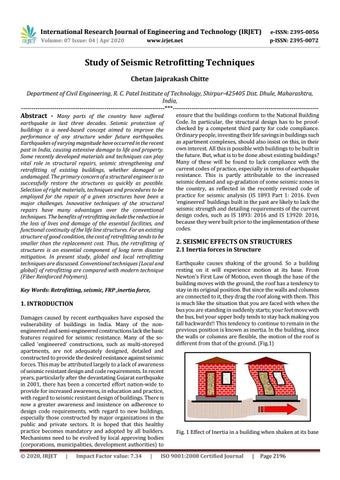
Earthquake causes shaking of the ground. So a building resting on it will experience motion at its base. From Newtonâs First Law of Motion, even though the base of the building moves with the ground, the roof has a tendency to stay in its original position. But since the walls and columns are connected to it, they drag the roof along with them. This is much like the situation that you are faced with when the bus you are standing in suddenly starts; your feet move with the bus, but your upper body tends to stay back making you fall backwards!! This tendency to continue to remain in the previous position is known as inertia. In the building, since the walls or columns are flexible, the motion of the roof is different from that of the ground. (Fig.1)
Fig. 1 Effect of Inertia in a building when shaken at its base
ISO 9001:2008 Certified Journal
|
Page 2196