
IRJET- Design and Manufacturing of Aerodynamic Devices for Formula Student Car

Page 1

International Research Journal of Engineering and Technology (IRJET)

e-ISSN: 2395-0056

Volume: 07 Issue: 04 | Apr 2020

p-ISSN: 2395-0072

www.irjet.net

Design and Manufacturing of Aerodynamic devices for Formula Student Car Abhishek.M.Patil1, Viraj.S.Hole2, Suraj.S.patil3, Rushikesh.R.Kharat4 1Student,

Department of Mechanical Engineering, R.M.D Sinhgad School of Engineering, Pune, Maharashtra, India Department of Mechanical Engineering, R.M.D Sinhgad School of Engineering, Pune, Maharashtra, India 3Student, Department of Mechanical Engineering, R.M.D Sinhgad School of Engineering, Pune, Maharashtra,India 4Student, Department of Mechanical Engineering, R.M.D Sinhgad School of Engineering, Pune, Maharashtra,India 2Student,

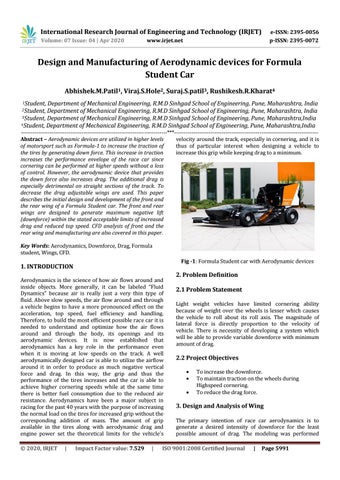
-----------------------------------------------------------------------------***---------------------------------------------------------------------------Abstract – Aerodynamic devices are utilized in higher levels velocity around the track, especially in cornering, and it is of motorsport such as Formula-1 to increase the traction of thus of particular interest when designing a vehicle to the tires by generating down force. This increase in traction increase this grip while keeping drag to a minimum. increases the performance envelope of the race car since cornering can be performed at higher speeds without a loss of control. However, the aerodynamic device that provides the down force also increases drag. The additional drag is especially detrimental on straight sections of the track. To decrease the drag adjustable wings are used. This paper describes the initial design and development of the front and the rear wing of a Formula Student car. The front and rear wings are designed to generate maximum negative lift (downforce) within the stated acceptable limits of increased drag and reduced top speed. CFD analysis of front and the rear wing and manufacturing are also covered in this paper. Key Words: Aerodynamics, Downforce, Drag, Formula student, Wings, CFD. Fig -1: Formula Student car with Aerodynamic devices

1. INTRODUCTION Aerodynamics is the science of how air flows around and inside objects. More generally, it can be labeled “Fluid Dynamics” because air is really just a very thin type of fluid. Above slow speeds, the air flow around and through a vehicle begins to have a more pronounced effect on the acceleration, top speed, fuel efficiency and handling. Therefore, to build the most efficient possible race car it is needed to understand and optimize how the air flows around and through the body, its openings and its aerodynamic devices. It is now established that aerodynamics has a key role in the performance even when it is moving at low speeds on the track. A well aerodynamically designed car is able to utilize the airflow around it in order to produce as much negative vertical force and drag. In this way, the grip and thus the performance of the tires increases and the car is able to achieve higher cornering speeds while at the same time there is better fuel consumption due to the reduced air resistance. Aerodynamics have been a major subject in racing for the past 40 years with the purpose of increasing the normal load on the tires for increased grip without the corresponding addition of mass. The amount of grip available in the tires along with aerodynamic drag and engine power set the theoretical limits for the vehicle's © 2020, IRJET

|

Impact Factor value: 7.529

|

2. Problem Definition 2.1 Problem Statement Light weight vehicles have limited cornering ability because of weight over the wheels is lesser which causes the vehicle to roll about its roll axis. The magnitude of lateral force is directly proportion to the velocity of vehicle. There is necessity of developing a system which will be able to provide variable downforce with minimum amount of drag.

2.2 Project Objectives   

To increase the downforce. To maintain traction on the wheels during Highspeed cornering. To reduce the drag force.

3. Design and Analysis of Wing The primary intention of race car aerodynamics is to generate a desired intensity of downforce for the least possible amount of drag. The modeling was performed

ISO 9001:2008 Certified Journal

|

Page 5991


Turn static files into dynamic content formats.
Create a flipbook
IRJET- Design and Manufacturing of Aerodynamic Devices for Formula Student Car by IRJET Journal - Issuu