International Research Journal of Engineering and Technology (IRJET)
e-ISSN: 2395-0056
Volume: 07 Issue: 03 | Mar 2020
p-ISSN: 2395-0072
www.irjet.net
Review on Information Retrieval for Desktop Search Engine Jahnavi.P1, Jammula Nikhil2, Arindam Chowdhury3, Karthik.S.A4 1,2,3Student,
Dept. of Information Science and Engineering, Dayananda Sagar of Technology and Management, Karnataka, India 4Guide, Asst.Professor, Dept. of Information Science and Engineering, Dayananda Sagar of Technology and Management, Karnataka, India ---------------------------------------------------------------------***---------------------------------------------------------------------2. METHODOLOGY Abstract - Search is an important aspect of information management often taken for granted. Domain specific repositories are growing in both size and numbers calling for efficient search and retrieval of documents. This paper explores the possible techniques and necessary system components for a search engine charting several iterative optimizations over the last few years. This paper focuses on NLP models while retaining basic principles from other methods that assist in information search. Key Words: Information Retrieval, Query Understanding, Feature Extraction, Entity Recognition, Similarity Measures
1. INTRODUCTION Data generation has increased exponentially with time as computing has grown ubiquitous. The internet is a great facilitator when it comes to knowledge discovery and dissemination. This property of the internet stems from extremely efficient data cataloguing, storage, and retrieval from large scale real time distributed system. Initially, rudimentary information retrieval systems constituted a simple query to access a particular document from a local database. Over time these databases have grown to span across networks and storage mediums and these gave rise to search algorithms designed for user convenience. Accessing documents from a database through a query mentioning document id or title proved to be difficult when one wanted to retrieve large number of documents. It was also an issue to actually give correct values for the document details such as title, author, keywords, domain and more. Later this lead to rise of Information Retrieval based on ontology where documents were classified with respect to some entities they contain. It used inverted indexing of the classes they belong to and the keywords they contain [1]. However, information retrieval improved to the levels where user need not necessarily know the keywords to get desired documents. It was possible due to efforts to understand the intent behind the user’s query and the concept the document entails.
© 2020, IRJET
|
Impact Factor value: 7.34
|
2.1 Feature Extraction – Entity Recognition Extracting entities is a preprocessing technique either based on linguistic rules or n-grams word or phrase extraction [2][3]. Algorithms based on linguistic rules to tag parts of speech are popular for feature extraction. Their rules are manually written and updated with regards to standards of English Grammar. Entities and their associative categories, either manually tagged [2][4] or classified by an algorithm, become important features that influence retrieval models. The possibility of including the synonyms, antonyms, acronyms and more with help of word embeddings enrich the extracted features to cover the meaning behind the context and help the model infer meaning behind the query.
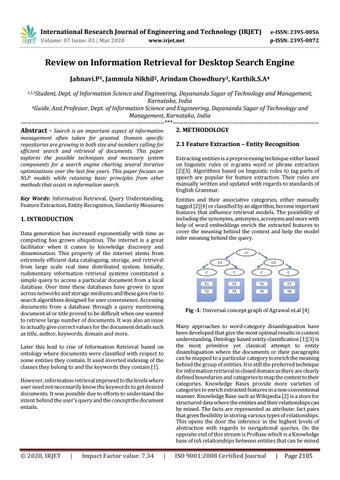
Fig -1: Universal concept graph of Agrawal et.al [4] Many approaches to word-category disambiguation have been developed that give the most optimal results in context understanding. Ontology based entity classification [1][3] is the most primitive yet classical attempt to entity disambiguation where the documents or their paragraphs can be mapped to a particular category to enrich the meaning behind the group of entities. It is still the preferred technique for information retrieval in closed domain as there are clearly defined boundaries and categories to map the context to their categories. Knowledge Bases provide more varieties of categories to enrich extracted features in a non-conventional manner. Knowledge Base such as Wikipedia [2] is a store for structured data where the entities and their relationships can be mined. The facts are represented as attribute: fact pairs that gives flexibility in storing various types of relationships. This opens the door the inference in the highest levels of abstraction with regards to navigational queries. On the opposite end of this stream is ProBase which is a Knowledge base of isA relationships between entities that can be mined
ISO 9001:2008 Certified Journal
|
Page 2105