International Research Journal of Engineering and Technology (IRJET)
e-ISSN: 2395-0056
Volume: 07 Issue: 02 | Feb 2020
p-ISSN: 2395-0072
www.irjet.net
FINITE ELEMENT ANALYSIS OF RETROFITTING OF RC BEAM WITH CFRP USING ABAQUS Suresh Kumar Paul1, Pukhraj Sahu2 1M.TECH.
(Structural Engineering) Student, Department of Civil Engineering, GEC Jagdalpur, 494001. Chhattisgarh, India 2Assistant Professor, Department of Civil Engineering, GEC Jagdalpur, 494001, Chhattisgarh, India ---------------------------------------------------------------***---------------------------------------------------------------limited working space and impact on nearby structures. Abstract - Concrete structures retrofitted with fibre
When possible, it is often better to repair or upgrade the structure by retrofitting. Retrofitting of the structures is a cost efficient and more practical method than the replacement. For the retrofitting and strengthening of concrete structures, the use of bonded steel plates was very common. However disadvantages of steel such as tendency to corrode, heavy weights, deterioration of the bonds at their steel-concrete interfaces and the requirement of massive scaffolding during installation. There has been an increasing interest in the use of high strength composites for repair and rehabilitation of reinforced concrete components in recent decades. Fibre reinforced Polymers (FRPs) are being used increasingly as promising composite materials for the enhancing of reinforced concrete structures in civil constructions. The significant increase in use of FRP in construction industry, particularly for the retrofit and repair of concrete structure has started since 1990.
reinforced plastic (FRP) applications have become widespread in the last decade due to the economic benefit from it. This paper presents a finite element analysis which is validated against laboratory tests of eight beams. All beams have the same rectangular cross-section geometry and all beams are loaded under four point bending, but different in the length of the carbon fibre reinforced plastic (CFRP) plate. The commercial numerical analysis tool ABAQUS has been used and different material models have been evaluated with respect to their ability to describe the behavior of the beams. Linear elastic isotropic and orthotropic models have been used for the CFRP and a perfect bond model has been use for the concrete–CFRP interface. A plastic damage model has been used for the concrete. The analysis results show good agreement with the experimental data regarding load–displacement response, crack pattern. There is no significant difference between the elastic isotropic and orthotropic models for the CFRP. The results showed that when the length of CFRP in flexural retrofitting increases, the load capacity of the beam increases as well.
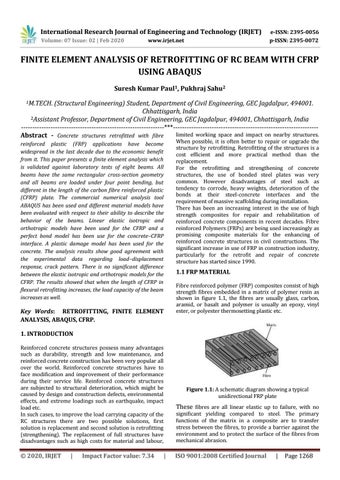
1.1 FRP MATERIAL Fibre reinforced polymer (FRP) composites consist of high strength fibres embedded in a matrix of polymer resin as shown in figure 1.1, the fibres are usually glass, carbon, aramid, or basalt and polymer is usually an epoxy, vinyl ester, or polyester thermosetting plastic etc.
Key Words: RETROFITTING, FINITE ELEMENT ANALYSIS, ABAQUS, CFRP. 1. INTRODUCTION Reinforced concrete structures possess many advantages such as durability, strength and low maintenance, and reinforced concrete construction has been very popular all over the world. Reinforced concrete structures have to face modification and improvement of their performance during their service life. Reinforced concrete structures are subjected to structural deterioration, which might be caused by design and construction defects, environmental effects, and extreme loadings such as earthquake, impact load etc. In such cases, to improve the load carrying capacity of the RC structures there are two possible solutions, first solution is replacement and second solution is retrofitting (strengthening). The replacement of full structures have disadvantages such as high costs for material and labour,
© 2020, IRJET
|
Impact Factor value: 7.34
Figure 1.1: A schematic diagram showing a typical unidirectional FRP plate
These fibres are all linear elastic up to failure, with no
significant yielding compared to steel. The primary functions of the matrix in a composite are to transfer stress between the fibres, to provide a barrier against the environment and to protect the surface of the fibres from mechanical abrasion.
|
ISO 9001:2008 Certified Journal
|
Page 1268