International Research Journal of Engineering and Technology (IRJET)
e-ISSN: 2395-0056
Volume: 07 Issue: 01 | Jan 2020
p-ISSN: 2395-0072
www.irjet.net
Smart Classroom Attendance System: Survey Akshay Deshpande1, Ashutosh Khode2, Shivam Srivastava3, Suraj Bobe4, Aarti Gaikwad5 1,2,3,4Dept. of Information Technology, D.Y Patil College of Engineering Pune, Maharashtra, India 5Dept. of Computer Engineering, D.Y Patil College of Engineering Pune, Maharashtra, India
-------------------------------------------------------------------------***---------------------------------------------------------------------
Abstract - Attendance marking system has been become a challenging task in the real-time system. It is tough to mark the attendance of the candidate in the huge classroom/hall, and there are many students attend the class. Many attendance management systems have been implemented in the current research. Different methods are proposed by the researcher to detect the face with varying accuracy. None of the systems can give 100% accuracy in face detection. We are giving a brief survey of different techniques by different researchers used for detection of the faces. Keywords – Face Detection, Face Recognition, Attendance Haar classifier, Improved Support Vector Machines (IVSM), face classification. 1. INTRODUCTION FACE Recognition has received many interests in recent years of face recognition development and has become a popular research. Moreover, it is a critical application in image analysis, and it is a very challenge to create an automated system based on face recognition; which has an ability to recognize human face accuracy [2]. Solving the manual attendance problem and time-consuming, much research has been conducted with the automated or smart attendance management system to resolve the issues of manual attendance [2, 3]. Authentication is an issue in computer-based communication. Face recognition is widely used in many applications such as system security and door control system [1]. This system has been implemented by taking student's attendance using face recognition. Face recognition has drawn the attention of researchers in fields from security and image processing to computer vision [5]. Face recognition has also proven useful in multimedia information processing areas.
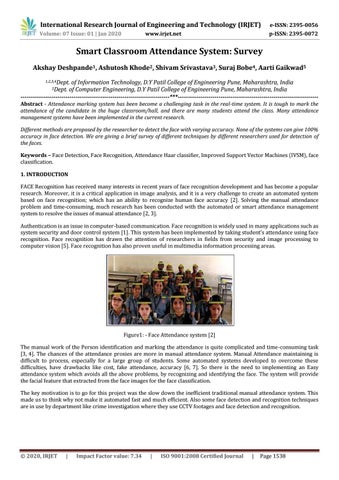
Figure1: - Face Attendance system [2] The manual work of the Person identification and marking the attendance is quite complicated and time-consuming task [3, 4]. The chances of the attendance proxies are more in manual attendance system. Manual Attendance maintaining is difficult to process, especially for a large group of students. Some automated systems developed to overcome these difficulties, have drawbacks like cost, fake attendance, accuracy [6, 7]. So there is the need to implementing an Easy attendance system which avoids all the above problems, by recognizing and identifying the face. The system will provide the facial feature that extracted from the face images for the face classification. The key motivation is to go for this project was the slow down the inefficient traditional manual attendance system. This made us to think why not make it automated fast and much efficient. Also some face detection and recognition techniques are in use by department like crime investigation where they use CCTV footages and face detection and recognition.
© 2020, IRJET
|
Impact Factor value: 7.34
|
ISO 9001:2008 Certified Journal
|
Page 1538
International Research Journal of Engineering and Technology (IRJET)
e-ISSN: 2395-0056
Volume: 07 Issue: 01 | Jan 2020
p-ISSN: 2395-0072
www.irjet.net
2. LITERATURE REVIEW Conventional Neural Network: The approach of predicting face attributes using CNN's trained for face recognition proposed in [2]. Combining with conventional face localization techniques we get the CNN with off-the-shelf architectures as inffig2. and publicly available models like Google's FaceNet with the conventional pipeline to study the prediction power of different representations from the trained CNN. Here the face descriptors are constructed from different levels of the CNN for different attributes to best facilitate face attribute prediction. By properly leveraging these off-the-shelf CNN representations, we achieved accurate attribute prediction with current state-of-the-art performance using the two datasets LFWA and CelebA.
Figure 2: - Constructing off-the-shelf deep representations [4] The fig2.represent the network architecture of the proposed system of [2]. The networks used experiments shared the same format: they were composed of off-the-shelf filter stacks followed by two Fully Connected (denoted by FC1 and FC2) layers. The system divides into different stages as follows:
Training: For training it uses around 10000identities with 350000 image of the WebFace Dataset. Feature Extraction: Feature Extraction: To extract face descriptors from CNNs, only the center patch (112 × 112) and its mirrored version of aligned face images were fed into the CNNs unless otherwise stated. For evaluating their attribute estimation performance to identify the most effective representation corresponding to each attribute, they use different levels of the network, i.e., “Spat.1 × 1”, “Spat.3 × 3”, “FC1”, and “FC2”. Attribute Prediction: The face attribute prediction performance was evaluated on the released version of CelebA and LFWA datasets. Evaluation & Comparison: The extracted features from aligned face images and the alignment process was independent of the network, we selected the corresponding approach as the baseline method. The current state of the art in [14] is denoted by “Two-stage CNN” and “LNet+ANet” in proposed system.
The paper [4] gives the recurrent attention convolutional neural network for fine-grained recognition, that recursively learns discriminative region attention and region-based feature representation at multiple scales. The proposed RA-CNN is optimized by an intra-scale classification loss and an inter-scale ranking loss, to mutually learn accurate region attention and fine-grained representation that gives the accuracy gains of 3.3%, 3.7%, 3.8%, on CUB Birds, Stanford Dogs, and Stanford Cars, respectively. The paper [7] gives a conceptual model for automated attendance system through facial recognition using an integral validation process which enhances the reliability of your model. Hemantkumar Rathod et al. [9] proposed automated attendance system by using algorithms like Viola-Jones and HOG features along with SVM classifier are used to detect the face. S Poornima et al. [8] give a system that can automatically detect the student in the classroom and marks the attendance by recognizing their face. This system is developed by capturing real-time human faces in the class. The detected faces are matched against the reference faces in the dataset and marked the attendance for the attendees. Finally, the absentee lists are said aloud through voice conversion system for confirmation. Secondly, the system is trained to classify the gender of the students present in the class. The Proposed system contains three different modules as follows,
© 2020, IRJET
|
Impact Factor value: 7.34
|
ISO 9001:2008 Certified Journal
|
Page 1539
International Research Journal of Engineering and Technology (IRJET)
e-ISSN: 2395-0056
Volume: 07 Issue: 01 | Jan 2020
p-ISSN: 2395-0072
www.irjet.net
1) Attendance through Face Recognition Module: In this module the system can capture the real time student images in classroom. In Preprocessing involves converting the color image to gray scale and passing it through a Gaussian Filter and Median Filter for image enhancement. 2) Voice Converted Output Module: This module is used for cross checking to ensure that the attendance is marked correctly. The names of the absentee are converted to voice using Microsoft Speech API. 3) Gender classification Module: Gender classification consists of 3 main steps: (1) preprocessing (2) geometric based feature extraction, (3) classification. In this system the detection of gender using facial features is done by using the methods like Gabor wavelets, artificial neural networks and support vector machine. Local Binary Patterns algorithm LBPs: Omar Abdul Rahman Salim et al. use Raspberry Pi which is programmed to handle the face recognition by implementing the Local Binary Patterns algorithm LBPs. If the student's input image matches with the trained dataset image the prototype door will open using Servo Motor, then the attendance results will be stored in the MySQL database. The system gives the 95% accuracy with the dataset of 11 person images. The author proposed recognition face in [6] using (HOG) features extraction and fast principal component analysis (PCA) algorithm. Haar-feature classifier is used to extract and extract the original data, and then the HOG features [15] are extracted from the image data and the PCA dimension reduction is processed, and the Support Vector Machines (SVM) algorithm is used to recognize the face. In this paper the PAC algorithm used for face detection and recognition. The system firstly preprocesses the raw data as fig [4] and then extracts the feature using HOG for face detection.
Figure3: - System Flow [5] Context Aware-Local Binary Feature Learning (CA-LBFL) Method: Yueqi Duan, et al.[10] gives a context-aware local binary feature learning (CA-LBFL) method for face recognition. The main feature of CA-LBFL is that it exploits the contextual information of adjacent bits by constraining the number of shifts from different binary bits so that more robust information can be exploited for face representation. It also gives two methods to heterogeneous face matching by coupled learning methods (C-CA-LBFL and C-CA-LBMFL).
© 2020, IRJET
|
Impact Factor value: 7.34
|
ISO 9001:2008 Certified Journal
|
Page 1540
International Research Journal of Engineering and Technology (IRJET)
e-ISSN: 2395-0056
Volume: 07 Issue: 01 | Jan 2020
p-ISSN: 2395-0072
www.irjet.net
Figure4: - Face Detection Image [3] Local Binary Patterns Histograms: The paper [12] compares facial recognition accuracy of three well-known algorithms namely Eigenfaces, Fisherfaces, and LBPH. The accuracy obtained from LBPH is 81.67% off in still-image-based testing. So, LBPH is the most suitable algorithm to apply in a class attendance to get better accuracy. Table: - Algorithm Comparison Sr No. 1.
Author
3.
Kasar, M., Bhattacharyya, D. and Kim, T. [9]
Visar [1]
Shehu
Algorithm
Problem
Summary
PCA
The recognition rate is 56%, having a problem to recognize student in year 3 or 4
NeuralNetwork
Using HAAR Classifier and computer vision algorithm to implement face recognition. Accurate only if large size of image was trained.
2.
Viola, Jones [8]
M.
J.
Viola and Jones algorithm
© 2020, IRJET
|
Impact Factor value: 7.34
|
Detection process is slow and computation is complex. Overall performance is weaker than ViolaJones algorithm. In Viola and Jones the result depends on the data and weak classifiers. The quality of the final detection depends highly on the consistence of the training set. Both the size of the sets and the interclass variability are important factors to take in account. The analysis shows very bad results when in case of multiple person with different sequence.
The training of the data should be done in correct manner so that the quality final detection will increase. System overview should contain the overall architecture that will give the clear and comprehensive information of the project.
ISO 9001:2008 Certified Journal
|
Page 1541
International Research Journal of Engineering and Technology (IRJET)
e-ISSN: 2395-0056
Volume: 07 Issue: 01 | Jan 2020
p-ISSN: 2395-0072
www.irjet.net
4.
Suman Kumar Bhattacharyya & Kumar Rahul. [6]
Fisher face/ LDA (Linear Discriminant Analysis )
5.
Md. Abdur Rahim et al [11]
LBP(Local Binary Pattern)
Bigger database is required because images of different expression of the individual have to be trained in same class. It depend more on database compared to PCA. Training time is longer than PCA and LDA.
Images of individual with different illumination, facial expressions able to be recognized if more samples are trained.
It is able to overcome variety of facial expressions, varying illumination, image rotation and aging of person. Accuracy till 90.45%
3. PROPOSED SYSTEM
Figure: - System Architecture Description: By considering the disadvantages of some systems mentioned in above table the attempt is made to implement the automated facial attendance system using SVM on LBP feature as LBP algorithm gives good accuracy as compare to other systems respectively. The proposed system introduces an automated attendance system which integrates an Android app and face recognition algorithms. User uploads a video / grabs images using camera of Android mobile and send it to application server. Apply the Haar cascade Classifier for the face detection in images. The faces apply the preprocessing on images like noise removal, normalization etc. The preprocessing of the images contains couple of tasks like RGB to Gray Scale Image and Local Binary Patterns Histograms respectively. Finally face recognition and attendance marking is done.
© 2020, IRJET
|
Impact Factor value: 7.34
|
ISO 9001:2008 Certified Journal
|
Page 1542
International Research Journal of Engineering and Technology (IRJET)
e-ISSN: 2395-0056
Volume: 07 Issue: 01 | Jan 2020
p-ISSN: 2395-0072
www.irjet.net
Competitive Advantages of Proposed System:
Currently either manual or biometric attendance systems are being used in which manual is hectic and time consuming. The biometric serves one at a time, so there is a need of such system which could automatically mark the attendance of many persons at the same time. This proposed system is cost efficient, no extra hardware required just a daily mobile or tablet, etc. Hence it is easily deployable. Not only in institutes or organizations, it can also be used at any public places or entry-exit gates for advance surveillance. One of the big benefits of using facial attendance systems in any organization is that you won’t have to worry about time fraud.
4. CONCLUSION The smart classroom system is designed for educational or commercial organizations that can be used for monitoring student’s attendance in a lecture, section or laboratory by detecting the faces of the student. It saves time and effort, particularly if students are huge in number. Haar Feature Algorithm is used for face detection. Haar cascade has high performance as compared Naïve Bayse and KNN performance which is not easily estimated. Support Vector Machines (SVM) for the classification of the faces. 5. REFERENCES [1] Hamdi Dibeklio˘glu, Member, IEEE, Fares Alnajar, Student Member, IEEE, Albert Ali Salah, Member, IEEE, and Theo Gevers, Member, IEEE, "Combining Facial Dynamics With Appearance for Age Estimation", IEEE TRANSACTIONS ON IMAGE PROCESSING, VOL. 24, NO. 6, JUNE 2015. [2] Yang Zhong Josephine Sullivan Haibo L KTH Royal Institute of Technology, 100 44 Stockholm, Sweden "Face Attribute Prediction Using Off-the-Shelf CNN Features", IEEE 2016. [3] Max Ehrlich, Timothy J. Shields, Timur Almaev, and Mohamed R. Amer, "Facial Attributes Classification using MultiTask Representation Learning",2016 IEEE Conference on Computer Vision and Pattern Recognition Workshops. [4] Jianlong Fu1, Heliang Zheng2, TaoMei1"Look Closer to See Better: Recurrent Attention Convolutional Neural Network for Fine-grained Image Recognition", 2017 IEEE Conference on Computer Vision and Pattern Recognition. [5] Yun-Fu Liu, Member, IEEE, Jing-Ming Guo, Senior Member, IEEE, Po-Hsien Liu, Jiann-Der Lee, and Chen-Chieh Yao, "Panoramic Face Recognition", IEEE, Transactions on Circuits and Systems for Video Technology. [6] Xiang-Yu Li Zhen-Xian Lin, "Face Recognition Based on HOG and Fast PCA Algorithm", Springer International Publishing AG 2018 P. Krömer et al. (eds.), Proceedings of the Fourth Euro -China Conference on Intelligent Data Analysis and Applications, Advances in Intelligent Systems and Computing. [7] Mashhood Sajid ; Rubab Hussain ; Muhammad Usman "A conceptual model for automated attendance marking system using facial recognition", Ninth International Conference on Digital Information Management (ICDIM 2014) [8] S Poornima ; N Sripriya ; B Vijayalakshmi ; P Vishnupriya, "Attendance monitoring system using facial recognition with audio output and gender classification", 2017 International Conference on Computer, Communication and Signal Processing (ICCCSP). [9] Hemantkumar Rathod ; Yudhisthir Ware ; Snehal Sane ; Suresh Raulo ; Vishal Pakhare ; Imdad A. R, "Automated attendance system using machine learning approach", 2017 International Conference on Nascent Technologies in Engineering (ICNTE). [10]
Yueqi Duan, Jiwen Lu, Senior Member, IEEE, Jianjiang Feng, Member, IEEE, and Jie Zhou, Senior Member, IEEE, "Context-Aware Local Binary Feature Learning for Face Recognition", IEEE Transactions on Pattern Analysis and Machine Intelligence2017.
[11]
Samuel Lukas1, Aditya Rama Mitra2, Ririn Ikana Desanti3, Dion Krisnadi4, "Student Attendance System in Classroom Using Face Recognition Technique", 2016 IEEE.
© 2020, IRJET
|
Impact Factor value: 7.34
|
ISO 9001:2008 Certified Journal
|
Page 1543
International Research Journal of Engineering and Technology (IRJET)
e-ISSN: 2395-0056
Volume: 07 Issue: 01 | Jan 2020
p-ISSN: 2395-0072
www.irjet.net
[12]
Manop Phankokkruad, Phichaya Jaturawat, "Influence of Facial Expression and Viewpoint Variations on Face Recognition Accuracy by Different Face Recognition Algorithms", 2017 IEEE.
[13]
H. Dibeklio˘glu, A. A. Salah, and T. Gevers, “Are you really smiling at me? Spontaneous versus posed enjoyment smiles,” in Proc. ECCV, 2012, pp. 525–538.
[14]
X. W. Ziwei Liu, Ping Luo and X. Tang. Deep learning face attributes in the wild. In Proceedings of International Conference on Computer Vision (ICCV), 2015.
[15]
Lv, S.D., Song, Y.D., Xu, M., Huang, C.Y.: Face detection under complex background and illumination. J. Electron. Sci. Technol. 13(1), 78–82 (2015). doi:10.3969/j.issn.1674-862X. 2015.01.014.
[16]
Zhu, X.T., Xi, W.: Design and implementation of face recognition system based on C++ and OpenCV. Autom. Instrum. 8, 127–128 (2014)
© 2020, IRJET
|
Impact Factor value: 7.34
|
ISO 9001:2008 Certified Journal
|
Page 1544