International Research Journal of Engineering and Technology (IRJET)
e-ISSN: 2395-0056
Volume: 07 Issue: 01 | Jan 2020
p-ISSN: 2395-0072
www.irjet.net
Hybrid Dielectric Resonator Antenna for Wi-Max Application Deepika Sharma1, Nisha Dhiman2 1,2Department of Electronics and Communication Engineering, Roorkee College of Engineering, Roorkee,
Uttrakhand, India ----------------------------------------------------------------------***---------------------------------------------------------------------
ABSTRACT:- In this article I have shown a dual-band ring di-electric resonator antenna for Wi-MAX applications. The introduced antenna is made up of several elements of ring di-electric resonator antenna and an improved square shaped slot antenna. A modified square shaped slot is used as both radiator and excitation mechanism for ring DRA. The layout of this antenna is made with the aid of Ansoft HFSS simulation software. The resonance frequency of the proposed DRA is 3.2 GHz and 5.7 GHz respectively. The introduced, radiator operates in two frequency bands like 2.81–3.47 GHz, 5.54–5.96 GHz respectively. The application of the presented antenna is Wi-Max application.
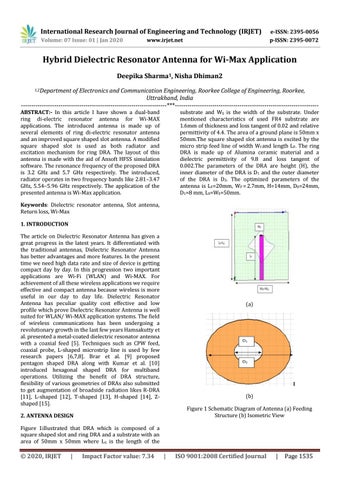
substrate and WS is the width of the substrate. Under mentioned characteristics of used FR4 substrate are 1.6mm of thickness and loss tangent of 0.02 and relative permittivity of 4.4. The area of a ground plane is 50mm x 50mm.The square shaped slot antenna is excited by the micro strip feed line of width Wf and length LF. The ring DRA is made up of Alumina ceramic material and a dielectric permittivity of 9.8 and loss tangent of 0.002.The parameters of the DRA are height (H), the inner diameter of the DRA is D1 and the outer diameter of the DRA is D2. The optimized parameters of the antenna is LF=20mm, WF = 2.7mm, H=14mm, D0=24mm, D1=8 mm, LS=WS=50mm.
Keywords: Dielectric resonator antenna, Slot antenna, Return loss, Wi-Max 1. INTRODUCTION The article on Dielectric Resonator Antenna has given a great progress in the latest years. It differentiated with the traditional antennas, Dielectric Resonator Antenna has better advantages and more features. In the present time we need high data rate and size of device is getting compact day by day. In this progression two important applications are Wi-Fi (WLAN) and Wi-MAX. For achievement of all these wireless applications we require effective and compact antenna because wireless is more useful in our day to day life. Dielectric Resonator Antenna has peculiar quality cost effective and low profile which prove Dielectric Resonator Antenna is well suited for WLAN/ Wi-MAX application systems. The field of wireless communications has been undergoing a revolutionary growth in the last few years Hamsakutty et al. presented a metal‐coated dielectric resonator antenna with a coaxial feed [5]. Techniques such as CPW feed, coaxial probe, L-shaped microstrip line is used by few research papers [6,7,8]. Brar et al. [9] proposed pentagon shaped DRA along with Kumar et al. [10] introduced hexagonal shaped DRA for multiband operations. Utilizing the benefit of DRA structure, flexibility of various geometries of DRAs also submitted to get augmentation of broadside radiation likes R-DRA [11], L-shaped [12], T-shaped [13], H-shaped [14], Zshaped [15].
(a)
(b) Figure 1 Schematic Diagram of Antenna (a) Feeding Structure (b) Isometric View
2. ANTENNA DESIGN Figure 1illustrated that DRA which is composed of a square shaped slot and ring DRA and a substrate with an area of 50mm x 50mm where LS is the length of the
© 2020, IRJET
|
Impact Factor value: 7.34
|
ISO 9001:2008 Certified Journal
|
Page 1535
International Research Journal of Engineering and Technology (IRJET)
e-ISSN: 2395-0056
Volume: 07 Issue: 01 | Jan 2020
p-ISSN: 2395-0072
www.irjet.net
3. SIMULATION RESULT
4. CONCLUSION
The presented hybrid DRA is designed and the software generated result was carried out using Ansoft HFSS. Figure 2 is exhibit Reflection coefficient of the presented antenna which shows that the resonance frequency of the proposed radiator is3.2GHz, 5.72GHz respectively with return loss of -35.18dB, -23.66 dB respectively. The figure 3 shows the VSWR of the proposed antenna.
This research paper has explained the design and analysis of dual-band integrated antenna. Integrated antenna is the combination of slot and dielectric resonator based radiator. The suggested integrated radiator gives dual-band working frequency is 2.9–3.6 GHz, 5.2–5.6 GHz respectively. The important feature of the suggested article is generating of Dual-band (2.9–3.6 GHz and 5.2–5.6 GHz). The suggested antenna is suitable for Wi-MAX applications. REFERENCES 1.
Petosa, A. (2007). Dielectric resonator antenna handbook. Norwood, MA: Artech House.
2.
Long, S. A., McAllister, M. W., & Shen, L. C. (1983). The resonant dielectric cavity antenna. IEEE Transaction on Antennas and Propagation, 31(3), 406–412.
3.
Luk, K. M., & Leung, K. W. (2003). Dielectric resonator Antenna. Baldock, Hertfordshire: Research Studies Press Ltd.
4.
Balanis, C. A. (2005). Antenna theory: Analysis and design (3rd ed.). Hoboken: Wiley.
5.
Hamsakutty, V., Kumar, A. V. P., Bindu, G., Thomas, V., Lonappan, A., Yohannan, J., et al. (2005). A multi frequency coaxial-fed metal coated dielectric resonator antenna. Microwave and Optical Technology Letters, 47, 573–575.
6.
Ghosh, B., Ghosh, K., & Panda, C. S. (2009). Coplanar waveguide feed to the hemispherical DRA. IEEE Transactions on Antennas and Propagation, 57, 1566–1570.
7.
Huitema, L., Koubeissi, M., Mouhamadou, M., Arnaud, E., Decroze, C., & Monediere, T. (2011). Compact and multiband dielectric resonator antenna with pattern diversity for multi standard mobile handheld devices. IEEE Transactions on Antennas and Propagation, 59, 4201–4208.
8.
Satish, K., Manveer, S., & Brar, K. (2013). Aperture coupled pentagon shaped dielectric resonator antennas providing multiband and wideband performance. Microwave and Optical Technology Letters, 55,395–400.
9.
Hamasakutty, V., Kumar, A. V. P., Yohannan, J., Bindu, G., & Mathew, K. T. (2006). Co-axial fed hexagonal shaped dielectric resonator antenna for multi frequency operations. Microwave and Optical Technology Letters, 48, 878–880.
Figure 2 S11 of Proposed Radiator
Figure 3 VSWR of Proposed Radiator
© 2020, IRJET
|
Impact Factor value: 7.34
|
ISO 9001:2008 Certified Journal
|
Page 1536
International Research Journal of Engineering and Technology (IRJET)
e-ISSN: 2395-0056
Volume: 07 Issue: 01 | Jan 2020
p-ISSN: 2395-0072
www.irjet.net
10. Bemani, M., Nikmehr, S., & Younesiraad, H. (2012). A novel small triple band rectangular dielectric resonator antenna for WLAN and WiMAX applications. Journal of Electromagnetic Waves, 25, 1688–1698. 11. Denidni, T. A., Rao, Q., & Sebak, A. R. (2005). Broadband L-shaped dielectric resonator antenna. IEEE Antennas and Wireless Propagation Letters, 4, 453–454. 12. Rao, Q., Denidni, T. A., & Sebak, A. R. (2006). Broadband compact stacked T-shaped DRA with equilateral-triangle cross sections. IEEE Antennas and Wireless Propagation Letters, 16, 7–9. 13. Liang, X. L., & Denidni, T. A. (2008). H-shaped dielectric resonator antenna for wideband applications.IEEE Antennas and Wireless Propagation Letters, 7(7–9), 163–166. 14. Denidni, T. A., Weng, Z., & Niroo-Jazi, M. (2010). Z-shaped dielectric resonator antenna for ultra wideband applications. IEEE Transactions on Antennas and Propagation, 58, 4059–4062. 15. Zou, L., & Fumeaux, C. (2011). A cross-shaped dielectric resonator antenna for multifunction and polarization diversity applications. IEEE Antennas and Wireless Propagation Letters, 10, 742–745.
© 2020, IRJET
|
Impact Factor value: 7.34
|
ISO 9001:2008 Certified Journal
|
Page 1537