International Research Journal of Engineering and Technology (IRJET)
e-ISSN: 2395-0056
Volume: 06 Issue: 07 | July 2019
p-ISSN: 2395-0072
www.irjet.net
A Design of Sewage Treatment Plant for Parbhani City Mr. Shrikant S. Dhage1, Miss. Mayuri S. Joshi2, Mr. Suryakant S. Gaikwad3, Miss. Neha B. Mundlik4, Mr. Vinod J. Darekar5, Mr. Namdev S. Pawar6 1,2,3,4,5,6BE
Students in Civil Department, SSIEMS, Parbhani, Maharastra, India. ---------------------------------------------------------------------***----------------------------------------------------------------------
Abstract:- The main objective of this project is carried out to design of sewage treatment plant for a Parbhani city municipality, because it has a developing place due to steady increasing population, which in a results excess of sewage is produced. To avoid this problem, to construct the sewage treatment plant. This project focus on sewage generation in Parbhani city which was estimated 60 MLD considering the population of next 30 years.
disinfected chemically or physically prior to discharge into stream, river & land.
Key Words:- Sewage treatment plant, ground water, irrigation, fertilizer. 1. INTRODUCTION Sewage treatment is the process of removing contaminants from waste water primarily from house hold sewage. Physical, Chemical & Biological process are used to reduce contaminants & produce treated waste water that is safe for environment.
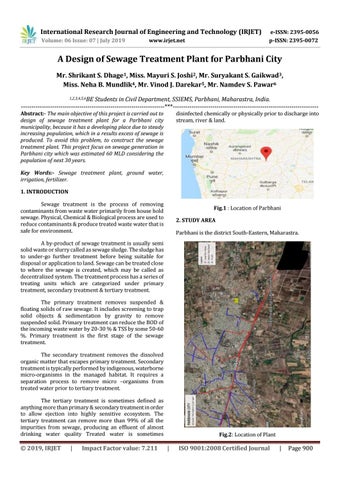
Fig.1 : Location of Parbhani 2. STUDY AREA Parbhani is the district South-Eastern, Maharastra.
A by-product of sewage treatment is usually semi solid waste or slurry called as sewage sludge. The sludge has to under-go further treatment before being suitable for disposal or application to land. Sewage can be treated close to where the sewage is created, which may be called as decentralized system. The treatment process has a series of treating units which are categorized under primary treatment, secondary treatment & tertiary treatment. The primary treatment removes suspended & floating solids of raw sewage. It includes screening to trap solid objects & sedimentation by gravity to remove suspended solid. Primary treatment can reduce the BOD of the incoming waste water by 20-30 % & TSS by some 50-60 %. Primary treatment is the first stage of the sewage treatment. The secondary treatment removes the dissolved organic matter that escapes primary treatment. Secondary treatment is typically performed by indigenous, waterborne micro-organisms in the managed habitat. It requires a separation process to remove micro –organisms from treated water prior to tertiary treatment. The tertiary treatment is sometimes defined as anything more than primary & secondary treatment in order to allow ejection into highly sensitive ecosystem. The tertiary treatment can remove more than 99% of all the impurities from sewage, producing an effluent of almost drinking water quality Treated water is sometimes
Š 2019, IRJET
|
Impact Factor value: 7.211
Fig.2: Location of Plant
|
ISO 9001:2008 Certified Journal
|
Page 900