International Research Journal of Engineering and Technology (IRJET)
e-ISSN: 2395-0056
Volume: 06 Issue: 07 | July 2019
p-ISSN: 2395-0072
www.irjet.net
Implementation of Lenz Law for the Application of Electromagnetic Disk Braking. Yash Ghayal1 1U.G.
Mechanical Engineering Student, Zeal College of Engineering and Research ---------------------------------------------------------------------***----------------------------------------------------------------------
Abstract – Electromagnet is the temporary magnet which when supplied by an electric current, it induces magnetic field and Eddy current is generated that retards the vehicle without friction. Although brakes are primarily based on the friction principle, particularly conversion of Kinetic energy into heat energy, but electromagnetic system is a quite steady system that prevents the Disk from heating. So, it don’t need any kind of cooling system for dissipation of heat. This paper presents the Application of Lenz law as Electromagnetic Disk Braking, its design, Experimental setup, fabrication and scope in the future.
1.2 Limitations of Electromagnetic Braking System
Key Words: Electromagnet, Magnetic field, Eddy Current, friction, Lenz Law.
Lenz law states that “The current induced in a circuit due to a change or a motion in a magnetic field is so directed as to oppose the change in flux and to exert a mechanical force opposing the motion.”
It needs Electric supply for braking.
Sensitive to surface effects.
Secondary Brake is required for Vehicles.
High heat generates in the coil.
2. LENZ LAW AND PRINCIPLE OF WORKING OF ELECTROMAGNETIC BRAKING
1. INTRODUCTION Braking system is used to inhibit the motion of the vehicle. Brakes are exactly contrast to that of clutch. Mostly, Braking system utilize Frictional energy by converting the velocity of moving vehicle into heat energy, though other methods of energy conversion can also be employed like Regenerative Braking system in which braking force is transformed into electrical energy and later it is used for various purposes. Eddy Current are electric currents induced in conductors when exposed to a changing magnetic field. The inductance in the eddy current is responsible for generation of magnetic fields. This fields can cause Repulsion, Attraction, Propulsion, Drag and heating effects. Eddy current brakes are responsible for slowing an object such as rotating machineries, a moving train or even a roller coaster. This Paper gives information about various parts of Electromagnetic braking system, also this paper shows various challenges in the operation of electromagnetic brakes.
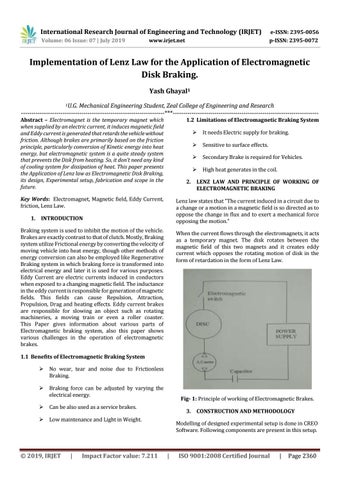
When the current flows through the electromagnets, it acts as a temporary magnet. The disk rotates between the magnetic field of this two magnets and it creates eddy current which opposes the rotating motion of disk in the form of retardation in the form of Lenz Law.
1.1 Benefits of Electromagnetic Braking System
No wear, tear and noise due to Frictionless Braking.
Braking force can be adjusted by varying the electrical energy.
Can be also used as a service brakes.
Low maintenance and Light in Weight.
© 2019, IRJET
|
Impact Factor value: 7.211
Fig- 1: Principle of working of Electromagnetic Brakes. 3. CONSTRUCTION AND METHODOLOGY Modelling of designed experimental setup is done in CREO Software. Following components are present in this setup.
|
ISO 9001:2008 Certified Journal
|
Page 2360