International Research Journal of Engineering and Technology (IRJET) Volume: 06 Issue: 06 | June 2019
e-ISSN: 2395-0056
www.irjet.net
p-ISSN: 2395-0072
RICE HUSK AS A FILLER MATERIAL IN HIGH STRENGTH CONCRETE E. Vamshi Krishna1, G. Swamy yadav2, S. Yeshwanth kumar3, pruthvi raj4 1,3,4Student,
Department of Civil Engineering, SR Engineering College, Telangana, India of Civil Engineering, SR Engineering College, Telangana, India ---------------------------------------------------------------------***---------------------------------------------------------------------2Assistant Professor, Department
Abstract - Based on the test and investigation Rice husk ash
The chemical composition of husk is depended upon combustion conditions, when it is burned at high temperature above 700 degree Celsius only crystalline silica remains, which can be used in ceramic and steel industries. However, when crystalline silica is exposed to air it can be hazardous to human health. if it is burnt less than 700 degrees Celsius it produces silica which is used as a supplementary cementitious material in construction materials. The husk is highly reactive pozzolanic material; it has been successfully used to replace 5 to 10% of the cement in concrete.
(RHA) can be used as a filler material in high-performance concrete, To improve properties of concrete with less heat transmit. This experimental replacement of RHA in place of cement shows a good strength almost 30 N/mm2 after 28days. This is possible because of the pozzolanic reaction of silica present in RHA with water and CAO or Ca(OH)2 or other pozzolanic reactions to form a strong cementation matrix. Not only strength criteria but also construction cost can be reduced to a certain amount, by this locally available material (rice husk ash), This research is conducted because usage of natural resources is increasing day by day. Natural resources are used in higher quality in the construction industry to minimize the usage of natural resources like limestone, aggregate, sand, clay, wood, etc. We have taken this concept (RHA). This will promote the utilization of agricultural byproducts as replaceable or renewable construction material In the construction industry.
2. Materials and methods 2.1 materials: 2.1.1cement: Cement is one of the important materials used in concrete, its properties will not give any strength to concrete. cement acts as a binding material in concrete. So it is used in concrete to bind or hold fine aggregates and coarse aggregates. There are many types of cement OPC 33 grade 43-grade 53-grade cement. In this test OPC53 grade cement(IS:12269-1987) is used and conducted tests as per IS standards.
Key Words: high-performance, heat transmit, pozzolanic, cementation matrix, strength criteria, renewable, material
1. INTRODUCTION From the last decades, the world's population expands and developing Nations become wealthier, raised expectations of the lifestyle of the public. Due to this demand for construction activities increased. The construction industry is a major use of world non-renewable resources. Many materials used in construction are obtained from the finite resource which, exploded they can never be replaced, such as limestone, sand, wood, etc. in order to maintain sustainability, increase demand for non-renewable resources may be partially offset by discovery of new sources.
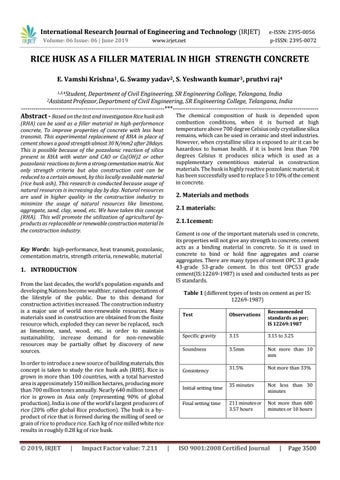
Table 1 (different types of tests on cement as per IS: 12269-1987)
In order to introduce a new source of building materials, this concept is taken to study the rice husk ash (RHS). Rice is grown in more than 100 countries, with a total harvested area is approximately 150 million hectares, producing more than 700 million tones annually. Nearly 640 million tones of rice is grown in Asia only (representing 90% of global production). India is one of the world’s largest producers of rice (20% offer global Rice production). The husk is a byproduct of rice that is formed during the milling of seed or grain of rice to produce rice. Each kg of rice milled white rice results in roughly 0.28 kg of rice husk.
Š 2019, IRJET
|
Impact Factor value: 7.211
Observations
Specific gravity
3.15
3.15 to 3.25
Soundness
3.5mm
Not more than 10 mm
31.5%
Not more than 33%
35 minutes
Not less than 30 minutes
211 minutes or 3.57 hours
Not more than 600 minutes or 10 hours
Consistency Initial setting time Final setting time
|
Recommended standards as per; lS 12269:1987
Test
ISO 9001:2008 Certified Journal
|
Page 3500