International Research Journal of Engineering and Technology (IRJET)
e-ISSN: 2395-0056
Volume: 06 Issue: 06 | June 2019
p-ISSN: 2395-0072
www.irjet.net
Seismic Analysis of Multistoried Building with and without Shear Wall using ETABS Subhash Reddy L1, Sunitha N2, Adarsha H G3, G T Jadesh Gouda4, Basavalingana Gowda M I5 1,2,3,4Students,
Department of Civil Engineering, RYMEC, Ballari professor, Department of Civil Engineering, RYMEC, Ballari ---------------------------------------------------------------------***---------------------------------------------------------------------5Assistant
Abstract - Shear walls are generally used in high earth quake prone areas, as they are highly efficient in taking the lateral loads. Not only the earthquake loads but also the wind loads which are quite high in some zones can be well resisted by these shear walls efficiently and effectively. Since two decades the principles of Structural design has not changed, now limit state method is turning into conventional it is no more accounted as modern design principle. Beyond the elastic design there is also a modern and futuristic method which involves the design beyond the material inelastic range and is known as ‘Performance based design for a complex multistoried building with and without shear wall for the seismic loads during earthquakes and the design above is verified for this same structure using extended three dimensional analysis of buildings (ETABS) software. The results are compared. And also to analyse storey drift , lateral displacement , shear ,storey stiffness model period and frequency on different floor with and without shear wall
additional strengthening. Consider the common case of an interior wall supported by a subfloor over a crawlspace and there is no continuous footing beneath the wall. For this wall to be used as shear wall, the subfloor and its connections will have to be strengthened near the wall. Shear walls carry the adequate lateral strength to resist incoming horizontal earthquake forces. When shear walls are well-built, they easily transfer the horizontal force to the next elements of load path below the shear walls. The next elements in the load path may be considered as another shear walls, floors, foundation walls, slabs or footings.
Key Words: Shear wall, seismic loads, wind loads, response spectrum, linear static analysis, storey drift, storey displacement, base shear, overturning moment. 1. INTRODUCTION I.
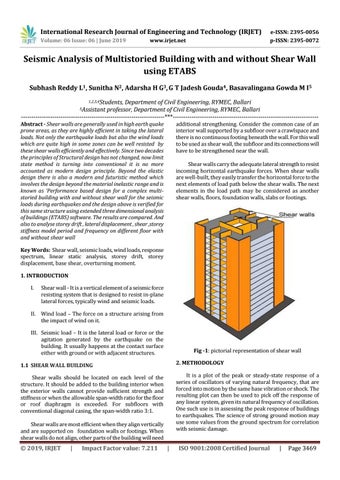
Shear wall - It is a vertical element of a seismic force resisting system that is designed to resist in-plane lateral forces, typically wind and seismic loads.
II. Wind load – The force on a structure arising from the impact of wind on it. III. Seismic load – It is the lateral load or force or the agitation generated by the earthquake on the building. It usually happens at the contact surface either with ground or with adjacent structures.
Fig -1: pictorial representation of shear wall
1.1 SHEAR WALL BUILDING
2. METHODOLOGY
Shear walls should be located on each level of the structure. It should be added to the building interior when the exterior walls cannot provide sufficient strength and stiffness or when the allowable span-width ratio for the floor or roof diaphragm is exceeded. For subfloors with conventional diagonal casing, the span-width ratio 3:1.
It is a plot of the peak or steady-state response of a series of oscillators of varying natural frequency, that are forced into motion by the same base vibration or shock. The resulting plot can then be used to pick off the response of any linear system, given its natural frequency of oscillation. One such use is in assessing the peak response of buildings to earthquakes. The science of strong ground motion may use some values from the ground spectrum for correlation with seismic damage.
Shear walls are most efficient when they align vertically and are supported on foundation walls or footings. When shear walls do not align, other parts of the building will need
© 2019, IRJET
|
Impact Factor value: 7.211
|
ISO 9001:2008 Certified Journal
|
Page 3469