International Research Journal of Engineering and Technology (IRJET)
e-ISSN: 2395-0056
Volume: 06 Issue: 06 | June 2019
p-ISSN: 2395-0072
www.irjet.net
Bamboo Strip Cutting Machine Prathamesh Pande1, Vishal Nigade2, Akshay Nikam3 1,2,3Mechanical
Engineering Students, P.E.S.’s Modern College of Engineering, Pune, Maharashtra, India. ---------------------------------------------------------------------***---------------------------------------------------------------------
Abstract - The main objective is to reduce the manual
present the demand for bamboo is 26.9 million tonnes as against the supply of 13.47 million tonnes. A coordinated action plan could put this skewed equation right, especially given the wide availability of bamboo in India.
operation of cutting the bamboo which is time-consuming and the mechanism once automated, the high production rate of the strips would allow more time and resources to produce a wide range of applications. Bamboo - Material of the Century would then be in the right direction towards better resource utilization and can sustain an industry on its own, which would intensify employment & revenue. The machine is powered by a pneumatic cylinder arrangement which enables the bamboo reciprocation on the guideway provided and the blade at the bottom cuts the strips.
2. PROBLEM STATEMENT Design and develop a prototype model demonstrating the concept of a bamboo strip-cutting machine through the instrumentality of pneumatic cylinder, to enhance the commercialization of bamboo products. Our project aims to feeding the raw material into the machine. When this is done, a set of rollers are used to guide bamboo and the feeding action is provided by pneumatic cylinder. The primary aim of concept generation and evaluation is to ensure that the product can perform all major functions.
Key Words: Bamboo, Strip, Cutting, Machine, Cylinder.
1.INTRODUCTION This bamboo based products are produced from thin strips of bamboo. There are a wide variety of such products and they have been closely associated with the development of civilizations in bamboo growing regions of the world for many millennia. The products may be primarily intended for agricultural use, such as baskets for vegetables or animals and winnowing trays for cereals, or they may be household products such as baskets, trays, jars, case, lampshades, fans and mats. The techniques require considerable skill and experience on the part of the weavers and the designs require innovation on the part of the designers. A bamboobased product unit provides income generation and skills development to those that it employs.
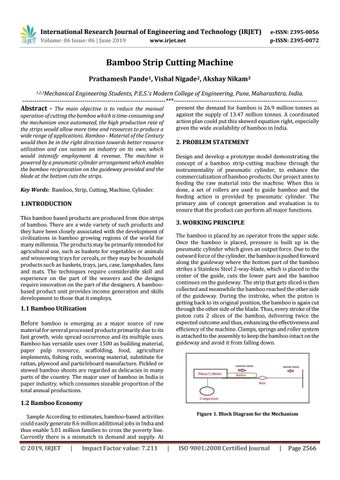
3. WORKING PRINCIPLE The bamboo is placed by an operator from the upper side. Once the bamboo is placed, pressure is built up in the pneumatic cylinder which gives an output force. Due to the outward force of the cylinder, the bamboo is pushed forward along the guideway where the bottom part of the bamboo strikes a Stainless Steel 2-way-blade, which is placed in the center of the guide, cuts the lower part and the bamboo continues on the guideway. The strip that gets sliced is then collected and meanwhile the bamboo reached the other side of the guideway. During the instroke, when the piston is getting back to its original position, the bamboo is again cut through the other side of the blade. Thus, every stroke of the piston cuts 2 slices of the bamboo, delivering twice the expected outcome and thus, enhancing the effectiveness and efficiency of the machine. Clamps, springs and roller system is attached to the assembly to keep the bamboo intact on the guideway and avoid it from falling down.
1.1 Bamboo Utilization Before bamboo is emerging as a major source of raw material for several processed products primarily due to its fast growth, wide spread occurrence and its multiple uses. Bamboo has versatile uses over 1500 as building material, paper pulp resource, scaffolding, food, agriculture implements, fishing rods, weaving material, substitute for rattan, plywood and particleboard manufacture. Pickled or stewed bamboo shoots are regarded as delicacies in many parts of the country. The major user of bamboo in India is paper industry, which consumes sizeable proportion of the total annual productions.
1.2 Bamboo Economy Figure 1. Block Diagram for the Mechanism
Sample According to estimates, bamboo-based activities could easily generate 8.6 million additional jobs in India and thus enable 5.01 million families to cross the poverty line. Currently there is a mismatch in demand and supply. At
Š 2019, IRJET
|
Impact Factor value: 7.211
|
ISO 9001:2008 Certified Journal
|
Page 2566