International Research Journal of Engineering and Technology (IRJET)
e-ISSN: 2395-0056
Volume: 06 Issue: 06 | June 2019
p-ISSN: 2395-0072
www.irjet.net
Multifinishing of Cotton using reduced Graphene Oxide R.H. Deshpande1, Dr. A I Wasif2, Kaushal Shah3 1Deshpande
R. H, Asstt. Prof. Textile & Engg. Inst. Ichalkaranji, M.S, India Wasif A.I, Prof. Textile & Engg. Inst. Ichalkaranji, M.S, India 3Shah Kaushal, Textile & Engg. Inst. Ichalkaranji, M.S, India
2Dr.
--------------------------------------------------------------------------------***------------------------------------------------------------------------------Abstract - Graphene is worth evaluating for anti-microbial purity reduce graphene oxide purchased from Ad-Nano and UV protection due to its outstanding physical and Technologies Private Ltd, Karnataka, India. Bleached and chemical properties. Graphene, which has abundant scoured (100%) Cotton fabric (200 GSM) supplied from availability in nature, is currently under research phase for its Swadeshi Bleaching and Dyeing mill Pvt. Ltd. Ichalkaranji, functional application in the field of textile. The sp2 hybridized India Titanium dioxide (TiO2) was purchased from Balaji 1-atom-thick planar sheet has been under consideration for its Chemical, Kolhapur, India. unique properties of strong cytotoxicity towards bacteria. In 1.2 Preparation of Antimicrobial and UV protection this work, reduced graphene oxide was applied on the cotton finish textile substrate and the evaluation of anti-microbial and UV protection finish is carried by a standard test of American The rGO is mixed with distilled water followed by probe Association of Textile Chemist and Colorists (AATCC). The sonication for 30 minutes at room temperature for getting following work also contains SEM and FTIR results of reduced dispersed aqueous rGO solution. The dispersed rGO was then graphene oxide. mixed with TiO2 solution followed by magnetic stirring at 50 rpm at different proportion. Application of the finish on Key Words: Reduced Graphene Oxide (rGO), Graphene Cotton was carried out by using padding, drying and curing Oxide (GO), Titanium dioxide (TiO2), AATCC 100:2004, technique. The padding expression was 80%, drying ASTM D6544. temperature was 80oC and curing temperature was 120oC 1.INTRODUCTION for 3 minutes. Graphite oxide was first prepared by Oxford chemist Benjamin C. Brodie in 1859, by treating graphite with a mixture of potassium chlorate and fuming nitric acid. He reported the synthesis of "paper-like foils" with 0.05 mm thickness. In 1957 Hummers and Offeman developed a safer, quicker, and a more efficient process called Hummers' method, using a mixture of sulfuric acid (H2SO4), sodium nitrate (NaNO3), and potassium permanganate (KMnO4), which is still widely used, often with some modifications. Largest monolayer graphene oxide with highly intact carbon framework and minimal residual impurity concentrations can be synthesized in inert containers using highly pure reactants and solvents. Graphene is the new material of the future that will revolution in all sectors including the textile sector, both from the technical point of view and form the design of the intelligent cloth, various textile finishes and many more. In the last few years, the popularity of graphene in highperformance conductive textile as the fabric increases because of its outstanding features. The bulk material disperses in basic solutions to yield monomolecular sheets, known as graphene oxide by analogy to graphene, the singlelayer form of graphite. Graphene oxide sheets have been used to prepare strong paper-like materials, membranes, thin films, and composite materials.
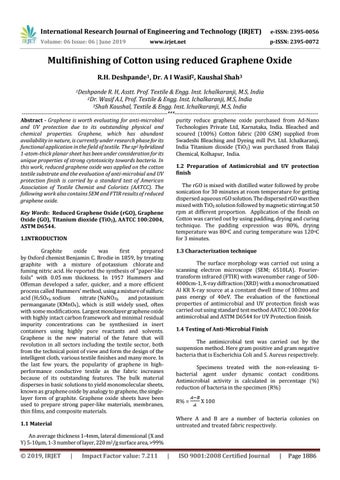
1.3 Characterization technique The surface morphology was carried out using a scanning electron microscope (SEM; 6510LA). Fouriertransform infrared (FTIR) with wavenumber range of 5004000cm-1, X-ray diffraction (XRD) with a monochromatized AI KR X-ray source at a constant dwell time of 100ms and pass energy of 40eV. The evaluation of the functional properties of antimicrobial and UV protection finish was carried out using standard test method AATCC 100:2004 for antimicrobial and ASTM D6544 for UV Protection finish. 1.4 Testing of Anti-Microbial Finish The antimicrobial test was carried out by the suspension method. Here gram positive and gram negative bacteria that is Escherichia Coli and S. Aureus respectively. Specimens treated with the non-releasing tibacterial agent under dynamic contact conditions. Antimicrobial activity is calculated in percentage (%) reduction of bacteria in the specimen (R%) R% =
X 100
Where A and B are a number of bacteria colonies on untreated and treated fabric respectively.
1.1 Material An average thickness 1-4mm, lateral dimensional (X and Y) 5-10Âľm, 1-3 number of layer, 220 m2/g surface area, >99%
Š 2019, IRJET
|
Impact Factor value: 7.211
|
ISO 9001:2008 Certified Journal
|
Page 1886