International Research Journal of Engineering and Technology (IRJET)
e-ISSN: 2395-0056
Volume: 06 Issue: 06 | June 2019
p-ISSN: 2395-0072
www.irjet.net
SIGNIFICANCE OF SHEAR WALL IN MULTISTORY BUILDING WITH SEISMIC ANALYSIS USING ETABS Mounika Y1, Thasleem H2, N Basavaraja3, Rajashekhar Holagundi4, Pushpalatha R Gadag5 1,2,3,4Students,
Department of Civil Engineering, RYMEC, Ballari Professor, Department of Civil Engineering, RYMEC, Ballari ---------------------------------------------------------------------***--------------------------------------------------------------------5Assistant
Abstract - : In the past decades shear wall is one of the most
appropriate structural components in multi storied building. Shear wall contributes large stiffness and strength to the building in the direction of its orientation during earthquake which is often neglected during the design of multi storied building. Shear wall is one of the most commonly used lateral load resisting system in raised building. Shear wall significantly reduces lateral sway and thereby reduces damage to structure. When the buildings are tall and consist of heavy components such as beams, columns, slabs of heavy materials and have congestion due to their large size based on the materials used and to overcome this we use shear wall which reduces the size by replacing materials such as stones, bricks etc by reinforced concrete, which is strong in nature as compared to framed structures. For modelling, analysis and design of shear walls in multi-storeyed building AUTO CADD and E-TABS were used
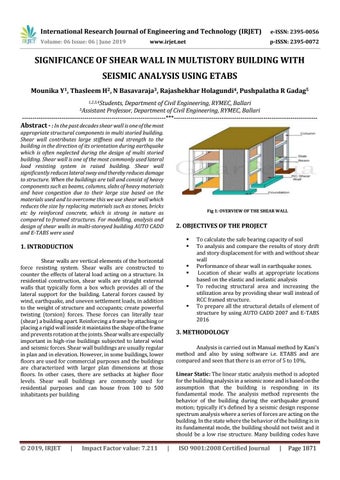
Fig 1: OVERVIEW OF THE SHEAR WALL
2. OBJECTIVES OF THE PROJECT
1. INTRODUCTION Shear walls are vertical elements of the horizontal force resisting system. Shear walls are constructed to counter the effects of lateral load acting on a structure. In residential construction, shear walls are straight external walls that typically form a box which provides all of the lateral support for the building. Lateral forces caused by wind, earthquake, and uneven settlement loads, in addition to the weight of structure and occupants; create powerful twisting (torsion) forces. These forces can literally tear (shear) a building apart. Reinforcing a frame by attaching or placing a rigid wall inside it maintains the shape of the frame and prevents rotation at the joints. Shear walls are especially important in high-rise buildings subjected to lateral wind and seismic forces. Shear wall buildings are usually regular in plan and in elevation. However, in some buildings, lower floors are used for commercial purposes and the buildings are characterized with larger plan dimensions at those floors. In other cases, there are setbacks at higher floor levels. Shear wall buildings are commonly used for residential purposes and can house from 100 to 500 inhabitants per building
© 2019, IRJET
|
Impact Factor value: 7.211
To calculate the safe bearing capacity of soil To analysis and compare the results of story drift and story displacement for with and without shear wall Performance of shear wall in earthquake zones. Location of shear walls at appropriate locations based on the elastic and inelastic analysis To reducing structural area and increasing the utilization area by providing shear wall instead of RCC framed structure. To prepare all the structural details of element of structure by using AUTO CADD 2007 and E-TABS 2016
3. METHODOLOGY Analysis is carried out in Manual method by Kani’s method and also by using software i.e. ETABS and are compared and seen that there is an error of 5 to 10%, Linear Static: The linear static analysis method is adopted for the building analysis in a seismic zone and is based on the assumption that the building is responding in its fundamental mode. The analysis method represents the behavior of the building during the earthquake ground motion; typically it’s defined by a seismic design response spectrum analysis where a series of forces are acting on the building. In the state where the behavior of the building is in its fundamental mode, the building should not twist and it should be a low rise structure. Many building codes have
|
ISO 9001:2008 Certified Journal
|
Page 1871