International Research Journal of Engineering and Technology (IRJET)
e-ISSN: 2395-0056
Volume: 06 Issue: 06 | June 2019
p-ISSN: 2395-0072
www.irjet.net
Thermal Stress Analysis of Rail Wheel Keerthan Prabhu1, M S Aditya2, Ramesh C G3 1Student,
Department of Mechanical Engineering, Sir MVIT Department of Mechanical Engineering, Sir MVIT 3Professor, Department of Mechanical Engineering, Sir MVIT, Bengaluru, Karnataka, India ---------------------------------------------------------------------***--------------------------------------------------------------------2Student,
Abstract - Nucleation and growth of fatigue cracks occur in
moves to the right and causes the outside pad to contact the disc. Braking force is generated by friction between the disc pads as they are squeezed against the disc rotor. When the disk temperature is increased by friction heat during braking, the heat often causes dimensional instability of the disk, permanently modifying the runout or disk thickness variation of a disk. Since disc brakes do not use friction between the lining and rotor to increase the braking power as drum brakes, they are less likely to cause a pull. The friction surface is constantly exposed to the air, ensuring good heat dissipation, minimizing brake fade. It also allows for self- cleaning as dust and water are thrown off, reducing friction differences.
railway wheel stems from different factors such as wheel-rail rolling contact, thermal loads between wheel-rail and wheel brake block induced in braking process. Also, increasing speed and axle loads of wheels aggravates these factors. These cracks will reduce wheel life and even in severe cases it may leads to derailment of rail. Thermal stresses are usually generated when the brakes are applied, that is the brake pads are pressed against the brake disc. Consequently, this compel mechanical and thermal analysis of wheels and the prediction of crack behavior under thermo-mechanical loads. The solid modeling of rail wheel has been carried out using CATIA and the meshing was performed with HYPERMESH. Thermal analysis was carried out to analyze whether the wheel has sufficient strength to sustain the thermal loads, generated due to application of brake, using Optistruct solver. It has been observed that maximum stress of 236.5 MPa induced in the rail wheel and it is within the permissible limit of 355 MPa. Key Words: Wheel, Friction, Disc Brake, Failure, residual stresses, Thermal Crack
1. INTRODUCTION Rail transport commenced in mid-16th century in Germany in the form of horse-powered funiculars and wagon ways. Modern rail transport commenced with the British development of the steam locomotives in the early 19th century. Railways are a safe land transport system when compared to other forms of transport. Railway transport is capable of high levels of passenger and cargo utilization and energy efficient.
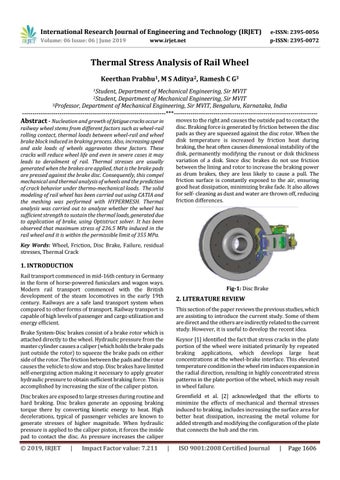
Fig-1: Disc Brake
2. LITERATURE REVIEW This section of the paper reviews the previous studies, which are assisting to introduce the current study. Some of them are direct and the others are indirectly related to the current study. However, it is useful to develop the recent idea.
Brake System-Disc brakes consist of a brake rotor which is attached directly to the wheel. Hydraulic pressure from the master cylinder causes a caliper (which holds the brake pads just outside the rotor) to squeeze the brake pads on either side of the rotor. The friction between the pads and the rotor causes the vehicle to slow and stop. Disc brakes have limited self-energizing action making it necessary to apply greater hydraulic pressure to obtain sufficient braking force. This is accomplished by increasing the size of the caliper piston.
Keysor [1] identified the fact that stress cracks in the plate portion of the wheel were initiated primarily by repeated braking applications, which develops large heat concentrations at the wheel-brake interface. This elevated temperature condition in the wheel rim induces expansion in the radial direction, resulting in highly concentrated stress patterns in the plate portion of the wheel, which may result in wheel failure. Greenfield et al. [2] acknowledged that the efforts to minimize the effects of mechanical and thermal stresses induced to braking, includes increasing the surface area for better heat dissipation, increasing the metal volume for added strength and modifying the configuration of the plate that connects the hub and the rim.
Disc brakes are exposed to large stresses during routine and hard braking. Disc brakes generate an opposing braking torque there by converting kinetic energy to heat. High decelerations, typical of passenger vehicles are known to generate stresses of higher magnitude. When hydraulic pressure is applied to the caliper piston, it forces the inside pad to contact the disc. As pressure increases the caliper
Š 2019, IRJET
|
Impact Factor value: 7.211
|
ISO 9001:2008 Certified Journal
|
Page 1606