International Research Journal of Engineering and Technology (IRJET)
e-ISSN: 2395-0056
Volume: 06 Issue: 06 | June 2019
p-ISSN: 2395-0072
www.irjet.net
Design of an Interstage Structure in Launch Vehicle: Isogrid Construction Athulya Sabu1, Resmi SS2, Anitta Jose3 1Mtech
Student, Dept. of Civil Engineering, Amal Jyothi College of Engineering, Koovapally 2Scientist/Engineer SE, SED, VSSC, ISRO 3Assistant Professor, Dept. of Civil Engineering, Amal Jyothi College of Engineering, Koovapally ---------------------------------------------------------------------***----------------------------------------------------------------------
Abstract - Light alloy materials are used in launch vehicle
structures due to its high specific strength and high specific stiffness. Availability, ease of fabrication, low cost makes aluminum alloys a major construction material in launch vehicle structures. There are primary and secondary structures in launch vehicles. Interstage structure is a primary structure in launch vehicles which is located in between the liquid and solid propellant tanks. The interstage is subjected to various forces imposed by launch vehicles, and must be designed to withstand these loads. Various types of construction such as monocoque, waffle, isogrid, closely stiffened and sandwich constructions are used for interstage structure. Isogrid is a lattice of ribs forming pockets of contiguous repetitive equilateral triangular pattern for integral stiffening of skin. The isogrid structure has the advantage to withstand both compressive and bending loads and also offers lower weight and high structural efficiency. Isogrid structure is the best choice for achieving the payload gain in launch vehicles. The main aim of the study is to design a cylindrical interstage structure using isogrid construction. The structure is designed for combination of axial force and bending moment. Stability of the structure is arrived through FE analysis and a comparison with design standards were utilized to arrive at an optimum design. Key Words: Isogrid, Interstage, Monocoque, Buckling, Cylindrical shell, Cutout
1. INTRODUCTION Launch vehicles are built as an assemblage of several stages, which may be solid, liquid, cryogenic etc depending on the propulsion systems, employed. Launch vehicle structures are classified as primary and secondary structures. Interstage structure is a primary structure in launch vehicle which is located in between the liquid and solid propellant tanks. Interstage structure is configured as a cylindrical structure with isogrid construction having a diameter of 4000mm and a height of 2750mm which has to accommodate the dome profile of the two propellant tanks with which it interfaces. It is connected to the tanks through bolted joints at the fore and aft end. Different types of construction via. monocoque, closely stiffened, sandwich, waffle and isogrid structures are used for the realization of cylindrical strcutures. Monocoque is a structure consisting of skin without any reinforcement stiffeners. The monocoque structure has the lowest buckling © 2019, IRJET
|
Impact Factor value: 7.211
|
strength compared to other techniques. The monocoque structure fails due to local or skin instability failure. In integrally stiffened construction, the skin and the stiffeners act as an integral unit without the provisions for any kind of connections. These modes of integral stiffening can be achieved by the use of an isogrid structure which consists of a skin stiffened integrally with repetitive arrangement of triangular stiffening ribs oriented in 60° pattern. Isogrid structure finds its applications mainly in aerospace structures due to its lower weight, lower construction cost and high efficiency in load carrying capacity.
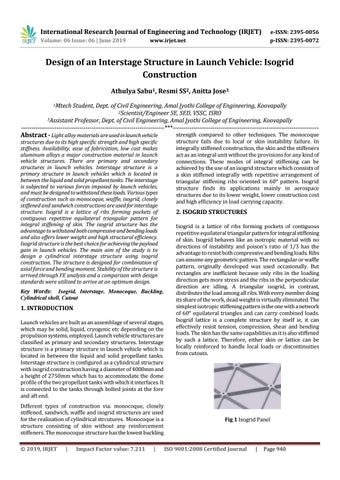
2. ISOGRID STRUCTURES Isogrid is a lattice of ribs forming pockets of contiguous repetitive equilateral triangular pattern for integral stiffening of skin. Isogrid behaves like an isotropic material with no directions of instability and poison's ratio of 1/3 has the advantage to resist both compressive and bending loads. Ribs can assume any geometric pattern. The rectangular or waffle pattern, originally developed was used occasionally. But rectangles are inefficient because only ribs in the loading direction gets more stress and the ribs in the perpendicular direction are idling. A triangular isogrid, in contrast, distributes the load among all ribs. With every member doing its share of the work, dead weight is virtually eliminated. The simplest isotropic stiffening pattern is the one with a network of 60ᵒ equilateral triangles and can carry combined loads. Isogrid lattice is a complete structure by itself ie, it can effectively resist tension, compression, shear and bending loads. The skin has the same capabilities as it is also stiffened by such a lattice. Therefore, either skin or lattice can be locally reinforced to handle local loads or discontinuities from cutouts.
Fig 1 Isogrid Panel
ISO 9001:2008 Certified Journal
|
Page 940