International Research Journal of Engineering and Technology (IRJET)
e-ISSN: 2395-0056
Volume: 06 Issue: 06 | June 2019
p-ISSN: 2395-0072
www.irjet.net
Power Quality Assessment of Photovoltaic System Nitin Choudhary1, Nishant2, Onkar Singh3 1M.Tech
Scholar Professor. EEE Department, Arni University, Himachal Pradesh, India ---------------------------------------------------------------------***---------------------------------------------------------------------2,3Assistant
Abstract - Techniques to harness light and heat from sun
output. Location of the MPP is not known, but can be located, either through calculation models or by search algorithms. Therefore Maximum Power Point Tracking (MPPT) techniques are needed to maintain the PV array’s operating point at its MPP. Many MPPT techniques are used for this purpose, Perturb and Observe (P&O) methods, Incremental Conductance (IC) methods, Artificial Neural Network method, Fuzzy Logic method etc. These techniques vary between them in many aspects, including simplicity, convergence speed, hardware implementation, sensors required, cost, range of effectiveness and need for parameterization. The P&O and IC techniques, as well as variants thereof, are the most widely used.
are evolving day by day. In order to increase the performance of solar energy one must have complete knowledge about solar devices and their optimization techniques. Different types of maximum power point tracking techniques for photovoltaic systems have been developed to maximize the production of energy. In this paper a grid connected PV system with MPPT is designed and is simulated using simulink. Key Words: MPPT, PV System, P&O.
1. INTRODUCTION Solar energy is an important source of renewable energy. Development of clean and affordable solar energy will have huge benefits. System which is designed to supply usable solar power by means of Photovoltaics is known as Photovoltaic system or Solar power system. It consists of Solar panels to absorb sun light and convert it to electricity, Solar inverters are then used to chance it to AC from DC and other electrical components to set up working system. Photovoltaic system range from small, rooftopmounted or building-integrated systems with capacities from a few kilowatts to several tens of kilowatts, to large utility-scale power stations of hundreds of megawatts. These days, many PV systems are grid-connected. Off-grid or stand-alone systems only account for a small portion. PV systems are being used in a variety of applications. These applications may be grouped into two categories: “utility interactive systems” and “stand-alone systems”. Stand alone applications includes water pumping, domestic and street lighting, electric vehicles, military and space applications while off-grid configurations includes hybrid systems, power plants etc.
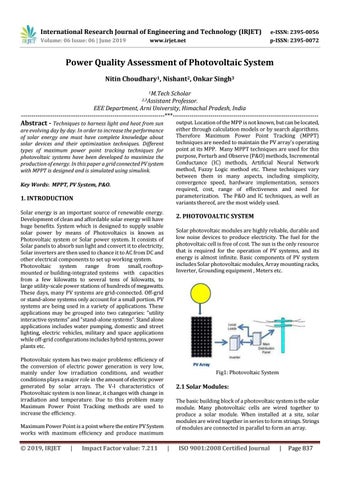
2. PHOTOVOALTIC SYSTEM Solar photovoltaic modules are highly reliable, durable and low noise devices to produce electricity. The fuel for the photovoltaic cell is free of cost. The sun is the only resource that is required for the operation of PV systems, and its energy is almost infinite. Basic components of PV system includes Solar photovoltaic modules, Array mounting racks, Inverter, Grounding equipment , Meters etc.
Photovoltaic system has two major problems: efficiency of the conversion of electric power generation is very low, mainly under low irradiation conditions, and weather conditions plays a major role in the amount of electric power generated by solar arrays. The V-I characteristics of Photovoltaic system is non linear, it changes with change in irradiation and temperature. Due to this problem many Maximum Power Point Tracking methods are used to increase the efficiency.
Fig1: Photovoltaic System
2.1 Solar Modules: The basic building block of a photovoltaic system is the solar module. Many photovoltaic cells are wired together to produce a solar module. When installed at a site, solar modules are wired together in series to form strings. Strings of modules are connected in parallel to form an array.
Maximum Power Point is a point where the entire PV System works with maximum efficiency and produce maximum
© 2019, IRJET
|
Impact Factor value: 7.211
|
ISO 9001:2008 Certified Journal
|
Page 837