International Research Journal of Engineering and Technology (IRJET)
e-ISSN: 2395-0056
Volume: 06 Issue: 05 | May 2019
p-ISSN: 2395-0072
www.irjet.net
UTILIZATION OF WASTE PLASTIC IN MANUFACTURE OF PLASTIC SOIL BRICKS M Pushpa1, Madhankumar Malladad 2, Shantasagar Komar3, Vidyashree Bendalagatti 4, Prof. D S Maganur 5 1,2,3,4UG
Student, Dept of Civil Engineering, S T J Institute of Technology Ranebennur, KA, India Dept of Civil Engineering, S T J Institute of Technology Ranebennur, KA, India ---------------------------------------------------------------------***--------------------------------------------------------------------5Proffesor,
Abstract - There has been a considerable imbalance between the availability of conventional building materials and their demand in the recent past. On the other hand the laterite quarry waste is abundantly available and the disposal of waste plastics (PET, PP,etc.) is a biggest challenge, as repeated recycling of PET bottles pose a potential danger of being transformed to a carcinogenic material and only a small proportion of PET bottles are being recycled. In this work an attempt has been made to manufacture the bricks by using waste plastics in range of 60 to 80% by weight of laterite quarry waste and 60/70 grade bitumen was added in range of 2 to 5% by weight of soil in molten form and this bitumen- plastic resin was mixed with laterite quarry waste to manufacture the bricks. The bricks manufactured possess the properties such as neat and even finishing, with negligible water absorption and satisfactory compressive strength in comparison with laterite stone to satisfy the increasing demand of conventional building materials.
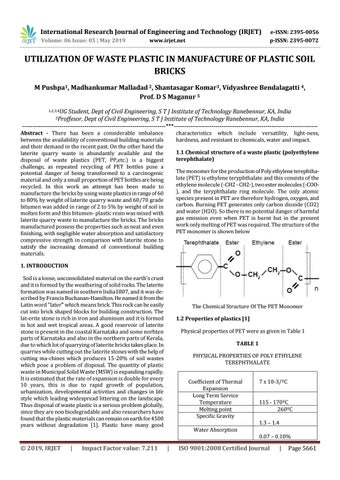
characteristics which include versatility, light-ness, hardness, and resistant to chemicals, water and impact. 1.1 Chemical structure of a waste plastic (polyethylene terephthalate) The monomer for the production of Poly ethylene terephthalate (PET) is ethylene teryphthalate and this consists of the ethylene molecule (-CH2 - CH2-), two ester molecules (-COO), and the teryphthalate ring molecule. The only atomic species present in PET are therefore hydrogen, oxygen, and carbon. Burning PET generates only carbon dioxide (CO2) and water (H2O). So there is no potential danger of harmful gas emission even when PET is burnt but in the present work only melting of PET was required. The structure of the PET monomer is shown below
1. INTRODUCTION Soil is a loose, unconsolidated material on the earth’s crust and it is formed by the weathering of solid rocks. The laterite formation was named in southern India1807, and it was described by Francis Buchanan-Hamilton. He named it from the Latin word “later” which means brick. This rock can be easily cut into brick shaped blocks for building construction. The lat-erite stone is rich in iron and aluminum and it is formed in hot and wet tropical areas. A good reservoir of laterite stone is present in the coastal Karnataka and some norhten parts of Karnataka and also in the northern parts of Kerala, due to which lot of quarrying of laterite bricks takes place. In quarries while cutting out the laterite stones with the help of cutting ma-chines which produces 15-20% of soil wastes which pose a problem of disposal. The quantity of plastic waste in Municipal Solid Waste (MSW) is expanding rapidly. It is estimated that the rate of expansion is double for every 10 years, this is due to rapid growth of population, urbanization, developmental activities and changes in life style which leading widespread littering on the landscape. Thus disposal of waste plastic is a serious problem globally, since they are non biodegradable and also researchers have found that the plastic materials can remain on earth for 4500 years without degradation [1]. Plastic have many good
© 2019, IRJET
|
Impact Factor value: 7.211
The Chemical Structure Of The PET Monomer 1.2 Properties of plastics [1] Physical properties of PET were as given in Table 1 TABLE 1 PHYSICAL PROPERTIES OF POLY ETHYLENE TEREPHTHALATE Coefficient of Thermal Expansion Long Term Service Temperature Melting point Specific Gravity
7 x 10⁻³/ºC 115 - 170ºC 260ºC 1.3 – 1.4
Water Absorption
|
0.07 – 0.10%
ISO 9001:2008 Certified Journal
|
Page 5661