International Research Journal of Engineering and Technology (IRJET)
e-ISSN: 2395-0056
Volume: 06 Issue: 03 | Mar 2019
p-ISSN: 2395-0072
www.irjet.net
O-RING INSERTION BY AUTOMATION Jeevanantham.G1, Sathiesh.V2, Velarasan.M.A3, Ravikumar.M4
Student, Mechanical, Bannari Amman Institute of Technology, Erode, Tamilnadu. Mechanical, Bannari Amman Institute of Technology, Erode, Tamilnadu 3 Assistant Professor, Mechanical, Bannari Amman Institute of Technology, Erode, Tamilnadu 4 Professor and Head, Mechanical, Bannari Amman Institute of Technology, Erode, Tamilnadu 1
2Student,
---------------------------------------------------------------------***--------------------------------------------------------------------2.1. O-Ring Pick and place Abstract - This paper focuses on the objective of inserting
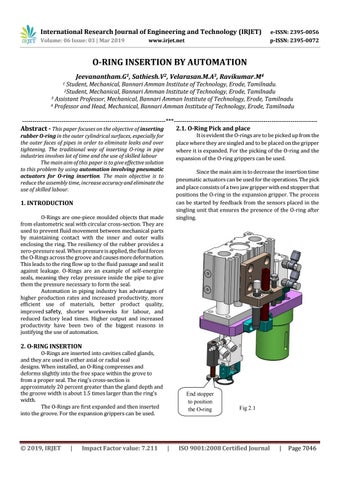
It is evident the O-rings are to be picked up from the place where they are singled and to be placed on the gripper where it is expanded. For the picking of the O-ring and the expansion of the O-ring grippers can be used.
rubber O-ring in the outer cylindrical surfaces, especially for the outer faces of pipes in order to eliminate leaks and over tightening. The traditional way of inserting O-ring in pipe industries involves lot of time and the use of skilled labour The main aim of this paper is to give effective solution to this problem by using automation involving pneumatic actuators for O-ring insertion. The main objective is to reduce the assembly time, increase accuracy and eliminate the use of skilled labour.
Since the main aim is to decrease the insertion time pneumatic actuators can be used for the operations. The pick and place consists of a two jaw gripper with end stopper that positions the O-ring in the expansion gripper. The process can be started by feedback from the sensors placed in the singling unit that ensures the presence of the O-ring after singling.
1. INTRODUCTION O-Rings are one-piece moulded objects that made from elastometric seal with circular cross-section. They are used to prevent fluid movement between mechanical parts by maintaining contact with the inner and outer walls enclosing the ring. The resiliency of the rubber provides a zero-pressure seal. When pressure is applied, the fluid forces the O-Rings across the groove and causes more deformation. This leads to the ring flow up to the fluid passage and seal it against leakage. O-Rings are an example of self-energize seals, meaning they relay pressure inside the pipe to give them the pressure necessary to form the seal. Automation in piping industry has advantages of higher production rates and increased productivity, more efficient use of materials, better product quality, improved safety, shorter workweeks for labour, and reduced factory lead times. Higher output and increased productivity have been two of the biggest reasons in justifying the use of automation.
2. O-RING INSERTION O-Rings are inserted into cavities called glands, and they are used in either axial or radial seal designs. When installed, an O-Ring compresses and deforms slightly into the free space within the grove to from a proper seal. The ring's cross-section is approximately 20 percent greater than the gland depth and the groove width is about 1.5 times larger than the ring's width. The O-Rings are first expanded and then inserted into the groove. For the expansion grippers can be used.
Š 2019, IRJET
|
Impact Factor value: 7.211
End stopper to position the O-ring
|
Fig 2.1
ISO 9001:2008 Certified Journal
|
Page 7046