International Research Journal of Engineering and Technology (IRJET)
e-ISSN: 2395-0056
Volume: 06 Issue: 03 | Mar 2019
p-ISSN: 2395-0072
www.irjet.net
INSET FEED COMPACT MILLIMETER WAVE MICROSTRIP PATCH ANTENNA AT 28GHz FOR FUTURE 5G APPLICATIONS N.VENKATA CHAITANYA1, M. SAI POORNIMA2, P.LAKSHMI PRAHELIKA3, R.MONIKA4, T.LIKITHA ROZY5 1Asst.
Professor, M. Tech, Department of Electronics and Communication Engineering, Vignan’s Institute of Engineering for Women 2,3,4,5Department of Electronics and Communication Engineering, Vignan’s Institute of Engineering for Women, Visakhapatnam-46, India ----------------------------------------------------------------------***--------------------------------------------------------------------Abstract – The main objective of this paper is to design and simulate the microstrip patch antenna which operates at 28GHz for advanced 5G communication. The designed antenna achieves a high gain of 8.00dB at a centre frequency of 27.91 GHz, a very wide bandwidth of 582MHz with a maximum reflection coefficient of -34.05dB. The feeding technique for the transmission line used is Inset feed. In this the substrate used is Rogers RT Duroid 5880 which has a low dielectric constant of 2.2 and a height of 0.254 mm. The proposed antenna dimensions were calculated and simulated results have been displayed and analyzed using High Frequency Structure Simulator (HFSS).
1.1 Microstrip Patch Antenna Microstrip patch antennas attracted considerable amount of attention of researchers due to demand of its large variety of applications and are considered as most common types of antennas due to their obvious advantages of light weight, low cost, low profile, planar configuration, ease for fabrication, suitable for arrays and easy integration with microwave monolithic integrate circuits (MMIC). The applications in present day mobile communication systems usually require smaller antenna size in order to meet the miniaturization requirements of mobile units. The typical range for dielectric constant of the substrate is 2.2 < εr <12. These antennas are simple to design, easy to modify according to needs. Microstrip patch antenna having finite ground plane. Microstrip antennas are often used where thickness and conformability to the host surfaces are the key requirements. Since patch antennas can be directly printed onto a circuit board, these are becoming popular in the mobile market.
Key Words: Microstrip, 5G, Millimetre-wave, 28GHz, HFSS, VSWR, Reflection coefficient, Antenna Gain, Inset feed. 1. INTRODUCTION The importance of technology in our daily lives is undeniable. This is due to the fact that in today’s dynamic world, life without a technology is worthless. As seen now-a-days, the telecommunication industry is booming. More and more users are getting their devices connected to the network causing the need of enormous capacity and faster speed in the upcoming years. As technology continues to advance with the competence of 5G, a lot of industries will be enhanced such as smart cities, smart transportation. The small cell technology of 5G can be integrated into the existence macro cells of 4G. The 5G technology uses a high frequency band at 28GHz which provides large broadcasting of data in Gbps. The high data rate and low latency of 5G are envisioned as opening up new applications in the near future. One is practical virtual reality and augmented reality. Another is fast machine-to-machine interaction in the internet of things. For example, computers in vehicles on a road could continuously communicate with each other and with the road by 5G.
© 2019, IRJET
|
Impact Factor value: 7.211
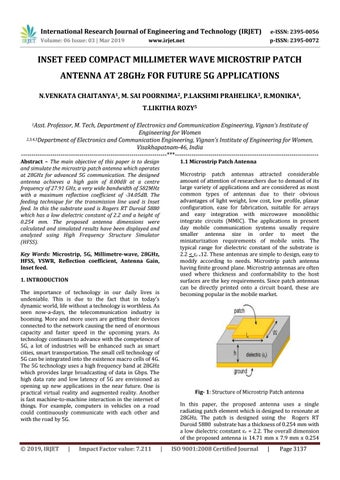
Fig- 1: Structure of Microstrip Patch antenna In this paper, the proposed antenna uses a single radiating patch element which is designed to resonate at 28GHz. The patch is designed using the Rogers RT Duroid 5880 substrate has a thickness of 0.254 mm with a low dielectric constant ɛr = 2.2. The overall dimension of the proposed antenna is 14.71 mm x 7.9 mm x 0.254
|
ISO 9001:2008 Certified Journal
|
Page 3137