International Research Journal of Engineering and Technology (IRJET)
e-ISSN: 2395-0056
Volume: 06 Issue: 03 | Mar 2019
p-ISSN: 2395-0072
www.irjet.net
Energy Conservation and Generation through Biodegradable Solid Waste- A Compact Bio-Gas Plant Mr.Rushabh R. Mandavgade1, Professor, Mr. Arif khan2 1M-tech,
NUVA College of Engg. & Tech., Nagpur, Maharashtra, India NUVA College of Engg. & Tech., Nagpur, Maharashtra, India ---------------------------------------------------------------------***--------------------------------------------------------------------2principle,
ABSTRACT- This paper evaluates the use of renewable source of energy i.e. biogas and suitability of a compact biogas system as a decentralized treatment option for the organic decomposition and fraction of market and household solid waste. For the research, a plant was installed and operated to evaluate its performance when fed with used Tea Powder of our canteen. The system proved to be effective interims of the reduction of waste volume and organic load. The performance of the digester considering the gas production was found to be good. The operation and maintenance was also easy as compared to that of the conventional biogas plant.
in recent years but generally in urban areas people do not use this due to space required and its unhygienic appearance. Overcoming all these, our team has developed a small scale but fully operational biogas system i.e. compact biogas plant designed for decomposition of solid waste in year 2013. It uses organic solid waste rather than manure as feedstock. Although biogas technology has been known in Africa for decades for the treatment of animal manure, its application for organic domestic waste has only been introduced recently.
INTRODUCTION:-
DESIGN AND TECHNOLOGY:-
In today’s fast moving world the resources are getting depleted due to their overuse though there rapid progress and development in all aspects. As there is scarcity of petroleum and coal and other such non-renewable energy sources, there is a strong need to look for new sources of energy i.e. renewable Energy sources like solar, wind, hydro, tidal, nuclear and biomass energy.Bio-gas is also renewable energy resources but it is distinct from other renewable energies because of its characteristics of using, controlling and collecting the domestic organic waste and at the same time producing by-products like fertilizer and water for use of agricultural irrigation. A compact bio-gas plant which uses waste food rather than cow dung or manure as feed stock to supply bio-gas for cooking. This plant is sufficiently compact to be used by urban households. In economically developing countries the solid waste management is gaining importance as it threats to public health and environmental quality. The household waste mostly consists of biodegradable organic material. As the most common practice is to dispose of the waste in the streets or in open dumps leads to pollution of ground and surface water leading to its contamination and contributes to the breeding of insects and rodent vector spreading diseases and epidemics.
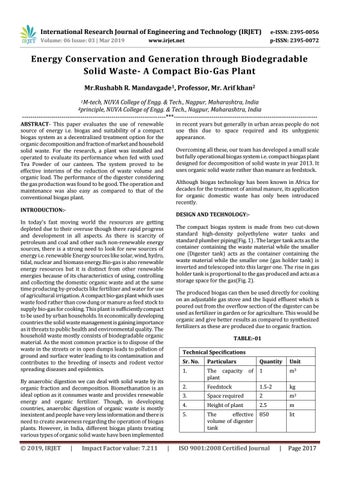
The compact biogas system is made from two cut-down standard high-density polyethylene water tanks and standard plumber piping(Fig. 1) . The larger tank acts as the container containing the waste material while the smaller one (Digester tank) acts as the container containing the waste material while the smaller one (gas holder tank) is inverted and telescoped into this larger one. The rise in gas holder tank is proportional to the gas produced and acts as a storage space for the gas(Fig. 2). The produced biogas can then be used directly for cooking on an adjustable gas stove and the liquid effluent which is poured out from the overflow section of the digester can be used as fertilizer in garden or for agriculture. This would be organic and give better results as compared to synthesized fertilizers as these are produced due to organic fraction. TABLE:-01 Technical Specifications
By anaerobic digestion we can deal with solid waste by its organic fraction and decomposition. Biomethanation is an ideal option as it consumes waste and provides renewable energy and organic fertilizer. Though, in developing countries, anaerobic digestion of organic waste is mostly inexistent and people have very less information and there is need to create awareness regarding the operation of biogas plants. However, in India, different biogas plants treating various types of organic solid waste have been implemented
Š 2019, IRJET
|
Impact Factor value: 7.211
|
Sr. No.
Particulars
Quantity
Unit
1.
The capacity plant
1
m3
2.
Feedstock
1.5-2
kg
3.
Space required
2
m3
4.
Height of plant
2.5
m
5.
The effective volume of digester tank
850
lit
of
ISO 9001:2008 Certified Journal
|
Page 2017