International Research Journal of Engineering and Technology (IRJET)
e-ISSN: 2395-0056
Volume: 05 Issue: 05 | May 2018
p-ISSN: 2395-0072
www.irjet.net
Experimental and Metallurgical investigation on laser welding of dissimilar materials Saumil R. Bhatt1, Dhaval K. Soni2 1Post
Graduate Scholar, Department of Advanced Manufacturing Systems, U.V. Patel College of Engineering, Ganpat University, Mehsana, Gujarat, India 2Assistant Professor, Mechatronics Engineering Department, U.V. Patel College of Engineering, Ganpat University, Mehsana, Gujarat, India. ---------------------------------------------------------------------***--------------------------------------------------------------------Abstract - Laser welding is technique to join multiple pieces of metal through the use of a laser. The laser beam provides a concentrated heat source allowing for narrow, deep welds and high welding rates. Laser welding is used in high volume applications using automation in the automotive industry. It is based on keyhole or penetration mode welding. It is useful for welding of carbon steels, HSLA steels, Stainless steel, Aluminum and titanium. It is very useful for high quality welds. Here, in my dissertation work fiber laser is used for practical experiments. 1kW fiber laser is used to weld 2 mm thick SS 304 and Mild steel sheet plates. The full factorial method is used to find out total number of experiments. SS 304 and MS sheets are widely used in Dairy, Automotive, Chemical tanks and pipe manufacturing, Boiler and vessel manufacturing, Heat exchanger equipment , Power plant equipments because of it’s high tensile strength, steel is quite strong in quality , thus these sheets can withstand high temperature and load also.
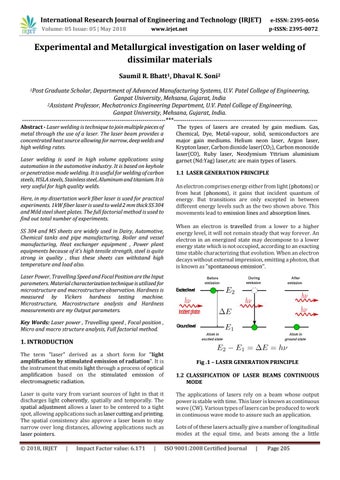
The types of lasers are created by gain medium. Gas, Chemical, Dye, Metal-vapour, solid, semiconductors are major gain mediums. Helium neon laser, Argon laser, Krypton laser, Carbon dioxide laser(CO2), Carbon monoxide laser(CO), Ruby laser, Neodymium Yttrium aluminium garnet (Nd:Yag) laser,etc are main types of lasers. 1.1 LASER GENERATION PRINCIPLE An electron comprises energy either from light (photons) or from heat (phonons), it gains that incident quantum of energy. But transitions are only excepted in between different energy levels such as the two shown above. This movements lead to emission lines and absorption lines. When an electron is travelled from a lower to a higher energy level, it will not remain steady that way forever. An electron in an energized state may decompose to a lower energy state which is not occupied, according to an exacting time stable characterizing that evolution. When an electron decays without external impression, emitting a photon, that is known as "spontaneous emission".
Laser Power, Travelling Speed and Focal Position are the Input parameters. Material characterization technique is utilized for microstructure and macrostructure observation. Hardness is measured by Vickers hardness testing machine. Microstructure, Macrostructure analysis and Hardness measurements are my Output parameters. Key Words: Laser power , Travelling speed , Focal position , Micro and macro structure analysis, Full factorial method.
1. INTRODUCTION The term "laser" derived as a short form for "light amplification by stimulated emission of radiation". It is the instrument that emits light through a process of optical amplification based on the stimulated emission of electromagnetic radiation. Laser is quite vary from variant sources of light in that it discharges light coherently, spatially and temporally. The spatial adjustment allows a laser to be centered to a tight spot, allowing applications such as laser cutting and printing. The spatial consistency also approve a laser beam to stay narrow over long distances, allowing applications such as laser pointers. © 2018, IRJET
|
Impact Factor value: 6.171
|
Fig .1 – LASER GENERATION PRINCIPLE 1.2 CLASSIFICATION OF LASER BEAMS CONTINUOUS MODE The applications of lasers rely on a beam whose output power is stable with time. This laser is known as continuous wave (CW). Various types of lasers can be produced to work in continuous wave mode to assure such an application. Lots of of these lasers actually give a number of longitudinal modes at the equal time, and beats among the a little ISO 9001:2008 Certified Journal
|
Page 205