International Research Journal of Engineering and Technology (IRJET)
e-ISSN: 2395-0056
Volume: 05 Issue: 11 | Nov 2018
p-ISSN: 2395-0072
www.irjet.net
SMART MATERIALS: ELECTRORHEOLOGICAL FLUIDS Amit Appasaheb Patil1, Rahul Ramesh Joshi2 1Professor,
Department of Textile Plant Engineering Textile and Engineering Institute, Ichalkaranji, MH, India Department of Textile Plant Engineering Textile and Engineering Institute, Ichalkaranji, MH, India -----------------------------------------------------------------------***-------------------------------------------------------------------2Professor,
Abstract:- A research is never ending process. The instable demand in the international market place for high performance structural and Mechanical systems for the aerospace, defence and advanced manufacturing industries has triggered the evolution of advanced composite materials. With world’s technological revolutionary era, we come across various smart materials which can be successfully implemented into new practices for the fulfilment of human as well as technology requirements. Radical improvements of industrial processes cannot be achieved solely by increasing the efficiency of traditional production techniques and tools, but requires new solutions, employing novel ideas. One promising and novel technique exists which is based on the electrorheological effect present in the electrorheological fluids. This paper focuses on microstructure behavior & properties of ER fluids along with preparation & applications in engineering field so as to focus the evolution of new areas in which ER fluids can be used, which will become a new horizon for the new generation.
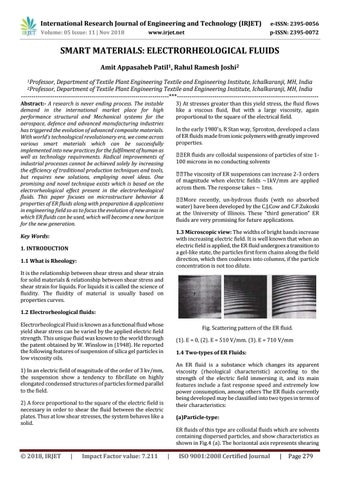
3) At stresses greater than this yield stress, the fluid flows like a viscous fluid, But with a large viscosity, again proportional to the square of the electrical field. In the early 1980's, R Stan way, Sproston, developed a class of ER fluids made from ionic polymers with greatly improved properties. ER fluids are colloidal suspensions of particles of size 1100 microns in no conducting solvents The viscosity of ER suspensions can increase 2-3 orders of magnitude when electric fields ~1kV/mm are applied across them. The response takes ~ 1ms. More recently, un-hydrous fluids (with no absorbed water) have been developed by the C.J.Cow and C.F.Zukoski at the University of Illinois. These "third generation" ER fluids are very promising for future applications. 1.3 Microscopic view: The widths of bright bands increase with increasing electric field. It is well known that when an electric field is applied, the ER fluid undergoes a transition to a gel-like state, the particles first form chains along the field direction, which then coalesces into columns, if the particle concentration is not too dilute.
Key Words: 1. INTRODUCTION 1.1 What is Rheology: It is the relationship between shear stress and shear strain for solid materials & relationship between shear stress and shear strain for liquids. For liquids it is called the science of fluidity. The fluidity of material is usually based on properties curves. 1.2 Electrorheological fluids: Electrorheological Fluid is known as a functional fluid whose yield shear stress can be varied by the applied electric field strength. This unique fluid was known to the world through the patent obtained by W. Winslow in (1948). He reported the following features of suspension of silica gel particles in low viscosity oils.
Fig. Scattering pattern of the ER fluid. (1). E = 0, (2). E = 510 V/mm. (3). E = 710 V/mm 1.4 Two-types of ER Fluids: An ER fluid is a substance which changes its apparent viscosity (rheological characteristic) according to the strength of the electric field immersing it, and its main features include a fast response speed and extremely low power consumption, among others The ER fluids currently being developed may be classified into two types in terms of their characteristics:
1) In an electric field of magnitude of the order of 3 kv/mm, the suspension show a tendency to fibrillate on highly elongated condensed structures of particles formed parallel to the field. 2) A force proportional to the square of the electric field is necessary in order to shear the fluid between the electric plates. Thus at low shear stresses, the system behaves like a solid.
(a)Particle-type: ER fluids of this type are colloidal fluids which are solvents containing dispersed particles, and show characteristics as shown in Fig.4 (a). The horizontal axis represents shearing
Š 2018, IRJET
|
Impact Factor value: 7.211
|
ISO 9001:2008 Certified Journal
|
Page 279