International Research Journal of Engineering and Technology (IRJET)
e-ISSN: 2395 -0056
Volume: 03 Issue: 05 | May-2016
p-ISSN: 2395-0072
www.irjet.net
On the Quasi-Hyperbolic Kac-Moody Algebra QHA7(2) Uma Maheswari. A1, Krishnaveni. S2 1Department of Mathematics
Quaid-E-Millath Government College for Women (Autonomous), Chennai Tamil Nadu, India 2Department of Mathematics M.O.P Vaishnav College for Women (Autonomous), Chennai Tamil Nadu, India ---------------------------------------------------------------------***---------------------------------------------------------------------
whose associated symmetrizable and indecomposable
Abstract - In this paper, for a special class of indefinite
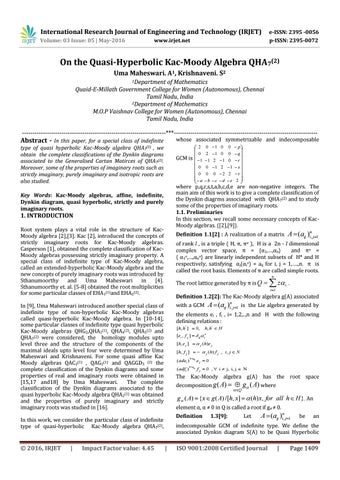
2 0 1 0 0 p 0 2 1 0 0 q GCM is 1 1 2 1 0 r 0 0 1 2 1 s 0 0 0 2 2 t a b c d e 2
type of quasi hyperbolic Kac-Moody algebra QHA7(2) , we obtain the complete classifications of the Dynkin diagrams associated to the Generalised Cartan Matirces of QHA 7(2). Moreover, some of the properties of imaginary roots such as strictly imaginary, purely imaginary and isotropic roots are also studied.
where p,q,r,s,t,a,b,c,d,e are non-negative integers. The main aim of this work is to give a complete classification of the Dynkin diagrms associated with QHA7(2) and to study some of the properties of imaginary roots. 1.1. Preliminaries In this section, we recall some necessary concepts of KacMoody algebras. ([2],[9]).
Key Words: Kac-Moody algebras, affine, indefinite, Dynkin diagram, quasi hyperbolic, strictly and purely imaginary roots.
1. INTRODUCTION Root system plays a vital role in the structure of KacMoody algebra [2],[3]. Kac [2], introduced the concepts of strictly imaginary roots for Kac-Moody algebras. Casperson [1], obtained the complete classification of KacMoody algebras possessing strictly imaginary property. A special class of indefinite type of Kac-Moody algebra, called an extended-hyperbolic Kac-Moody algebra and the new concepts of purely imaginary roots was introduced by Sthanumoorthy and Uma Maheswari in [4]. Sthanumoorthy et. al. [5-8] obtained the root multiplicities for some particular classes of EHA1(1)and EHA2(2).
Definition 1.1[2] : A realization of a matrix A (aij )i , j 1 n
of rank l , is a triple ( H, π, πv ), H is a 2n - l dimensional complex vector space, π = {α1,…,αn} and πv = { α1v,…,αnv} are linearly independent subsets of H* and H respectively, satisfying αj(αiv) = aij for i, j = 1,….,n. π is called the root basis. Elements of π are called simple roots. The root lattice generated by π is Q
Impact Factor value: 4.45
i
Definition 1.2[2]: The Kac-Moody algebra g(A) associated with a GCM A (aij )i , j 1 is the Lie algebra generated by n
the elements ei , fi , i= 1,2,..,n and H with the following defining relations : [h, h ' ] 0,
h, h ' H
[ei , f j ] ij iv [h, e j ] j (h)e j [h, f j ] j (h) f j , i, j N 1 aij
ej 0
1 aij
f j 0 , i j, i, j N
(adei ) (adfi )
The Kac-Moody algebra g(A) has the root space decomposition g ( A) g ( A) where Q
g ( A) {x g ( A) /[h, x] (h) x, for all h H }. An element α, α ≠ 0 in Q is called a root if gα ≠ 0. Definition
In this work, we consider the particular class of indefinite type of quasi-hyperbolic Kac-Moody algebra QHA7(2),
|
z . i 1
In [9], Uma Maheswari introduced another special class of indefinite type of non-hyperbolic Kac-Moody algebras called quasi-hyperbolic Kac-Moody algebra. In [10-14], some particular classes of indefinite type quasi hyperbolic Kac-Moody algebras QHG2,QHA2(1), QHA4(2), QHA5(2) and QHA7(2) were considered, the homology modules upto level three and the structure of the components of the maximal ideals upto level four were determined by Uma Maheswari and Krishnaveni. For some quasi affine Kac Moody algebras QAC2(1) , QAG2(1) and QAGGD3 (2) the complete classification of the Dynkin diagrams and some properties of real and imaginary roots were obtained in [15,17 and18] by Uma Maheswari. The complete classification of the Dynkin diagrams associated to the quasi hyperbolic Kac-Moody algebra QHA2(1) was obtained and the properties of purely imaginary and strictly imaginary roots was studied in [16].
© 2016, IRJET
n
1.3[9]:
Let
A (aij )in, j1
be
an
indecomposable GCM of indefinite type. We define the associated Dynkin diagram S(A) to be Quasi Hyperbolic
|
ISO 9001:2008 Certified Journal
|
Page 1409
International Research Journal of Engineering and Technology (IRJET)
e-ISSN: 2395 -0056
Volume: 03 Issue: 05 | May-2016
p-ISSN: 2395-0072
www.irjet.net
(QH) type if S(A) has a proper connected subdiagram of hyperbolic type with (n-1) vertices. The GCM A is of QH type if S(A) is of QH type. In this case, we say that the KacMoody algebra g(A) is of QH type. Definition 1.4[2]: A root α∈Δ is called real, if there exists a w W such that w(α) is a simple root, and a root which is not real is called an imaginary root. An imaginary root γ is said to be strictly imaginary if for every real root α , either α + γ or α – γ is a root. An imaginary root α is called an isotropic if (α , α) = 0. Definition 1.5[1]: A generalized Cartan matrix A has the property SIM (more briefly: A ∈ SIM) if
The number of ways, the sixth vertex can be joined to any one of the five vertices in A7 (2) is 9+9+9+9 = 36. Consider the diagram (1): Hyperbolic: Possibilities of are __ , , Number: 3 Quasi Hyperbolic: Nil Not Quasi Hyperbolic: Possibilities of : Number : 6
Δsim (A) Δim (A).
Consider the diagram (2): Hyperbolic: Possibilities of is __ Number: 1 Quasi Hyperbolic: Possibilities of are , Number: 2 Not Quasi Hyperbolic:
Definition 1.6[4]: Let α∈Δ+im is said to be purely imaginary if for any β∈Δ+im, α+β∈Δ+im. A GCM A satisfies the purely imaginary property if ( A) ( A) . If A satisfies the purely imaginary property then the KacMoody algebra g(A) has the purely imaginary property. pim
im
2. DYNKIN DIAGRAMS ASSOCIATED WITH
THE INDEFINITE TYPE OF QUASI HYPERBOLIC KAC-MOODY ALGEBRA QHA7(2)
Number: 6 Consider the diagram (3): Hyperbolic: Number: Nil Quasi Hyperbolic: Possibilities of : ___
In this section, we prove the classification theorem wherein connected, non isomorphic Dynkin diagrams associated with QHA7(2) are completely classified. Next, we study some of the properties of roots for specific families in the class QHA7(2). Theorem 2.1: ( Classification Theorem ) : There are 88 connected, non isomorphic Dynkin diagrams associated with the GCM of the indefinite type of quasi hyperbolic Kac-Moody algebra QHA7 (2). Proof: The Dynkin diagrams of the indefinite type of KacMoody algebra QHA7 (2) is obtained by adding a sixth vertex, which is connected to the Dynkin diagram of the affine Kac-Moody algebra A7 (2) by , where can be any one of the nine possibilities:
Number: 1 Not Quasi Hyperbolic: Number: 8 Consider the diagram (4): Hyperbolic: Possibilities of : __ Number: 1 Quasi Hyperbolic: Number: Nil Not Quasi Hyperbolic:
Case (i): An edge is joined from the sixth vertex to any one of the five vertices in A7 (2). This can be obtained in the following possible ways.
1
1 3(1) 4
6 1 2
5
12
Case ( ii ) : Two edges are added from the sixth vertex to any two of the vertices of the Dynkin diagram of A7 (2) . This can be obtained in the following possible ways.
3 4
2
3 (2)4
5
6
1
Number: 8 Therefore in this case, we get 3 connected, non isomorphic quasi hyperbolic type 5 6 diagrams, 5 hyperbolic 3 of 4 Dynkin type [19] and 28 Dynkin diagrams are not quasi hyperbolic type2 in QHA7 (2).
6
3
5 2
(3)
© 2016, IRJET
|
4
5 6
(4)
Impact Factor value: 4.45
|
ISO 9001:2008 Certified Journal
|
Page 1410
6
International Research Journal of Engineering and Technology (IRJET)
e-ISSN: 2395 -0056
Volume: 03 Issue: 05 | May-2016
p-ISSN: 2395-0072
1
www.irjet.net
1 3
6
5
4 2
4
3
6
(5)
5
(6)
2
6 1
(7)
3 2 1
(8)
5
4 6
(9)
3
6
1 Table 4:
3
4
5
2 1
6
(10)
2
4
5
(11)
3
4
5
2 The number of ways, the sixth vertex can be joined to any two of the five vertices in A7 (2) is 567. The following tables, shows the nature and also the number of quasi hyperbolic type of Dynkin diagrams: Table 1:
All the resulting Dynkin diagrams of the diagrams (9), (10) and (11) are not of quasi hyperbolic type. From the above tables, we get 31 connected, non isomorphic quasi hyperbolic type of Dynkin diagrams in QHA7 (2). Case (iii): When three edges are joined from the sixth vertex to any three vertices of the Dynkin diagram A 7 (2), we get the following possible forms.
6
1 3
6
4
1
5
2
(12)
Table 2:
4
3
2
5
(13)
6 6 1
1 2
3 3
4
5
3
4
5
2
(14)
(15)
Table 3:
© 2016, IRJET
|
Impact Factor value: 4.45
|
ISO 9001:2008 Certified Journal
|
Page 1411
International Research Journal of Engineering and Technology (IRJET)
e-ISSN: 2395 -0056
Volume: 03 Issue: 05 | May-2016
p-ISSN: 2395-0072
1 2
Table 7:
6
6
3
www.irjet.net
5
4
1 4
3
(16)
(17)
2
5
6 1 3
4
All the resulting Dynkin diagrams corresponds to (12), (15), (16) and (17) are not of quasi hyperbolic type. From the above table, we get 45 connected, non isomorphic quasi hyperbolic type of Dynkin diagrams in QHA7 (2). Case (iv): Let the four edges be joined from the sixth vertex to any four vertices of the Dynkin diagram of A7 (2), The total number of ways, the sixth vertex can be joined to any four of the other five vertices in A7 (2) is 94× 5= 6561.
5
2
(18) The total number of ways, the sixth vertex can be joined to any three of the other five vertices in A7 (2) is 93× 7= 5103. Table 5:
Among these, the edges connecting the vertices between 6 to 1, 6 to 2 , 6 to 4 by __ and vary the edge between 6 to 5 by , we get 9 connected, non isomorphic quasi hyperbolic type of Dynkin diagrams in QHA7 (2). Case (v): When the sixth vertex is added to all the five vertices of the Dynkin diagram A7 (2).
6 Table 6:
1 (19)
3
4
5
The total number of ways, the sixth vertex can be joined to 2 all the five vertices in A7 (2) is 95 = 59049. All the resulting Dynkin diagrams corresponding to (19) are not of quasi hyperbolic type. Therefore, from the above five cases we get a total of (3 + 31 + 45 + 9) = 88 connected, non isomorphic quasi hyperbolic type of Dynkin diagrams in QHA7(2). Properties of imaginary roots: Proposition 2.2: Consider the indefinite type of quasi hyperbolic Kac-Moody algebra QHA7(2), whose associated symmetrizable and indecomposable GCM is
© 2016, IRJET
|
Impact Factor value: 4.45
|
ISO 9001:2008 Certified Journal
|
Page 1412
International Research Journal of Engineering and Technology (IRJET)
e-ISSN: 2395 -0056
Volume: 03 Issue: 05 | May-2016
www.irjet.net
p-ISSN: 2395-0072
1 0 0 D 0 0 0
0 0 0 0 0 0 1 2 0 1 0 1 0 0 0 0 0 1 0 2 1 0 1 1 2 1 0 1 0 0 0 0 0 and B 0 0 1 0 0 1 1 0 0 1 2 0 0 0 1 0 0 0 2 0 1 1 / 2 0 0 0 0 1 2 1 1 0 1 1 / 2
2 0 1 0 0 p 0 2 1 0 0 q 1 1 2 1 0 r A 0 0 1 2 1 s 0 0 0 2 2 t a b c d e 2
where p,q,r,s,t,a,b,c,d,e are non-negative integers. Then the Kac-Moody algebra g(A) corresponding to QHA7(2) has the following properties: (i) The imaginary roots of g(A) satisfy the purely imaginary property. (ii) The imaginary roots of g(A) satisfy the strictly imaginary property. Proof: (i) Since A is a connected, symmetrizable and indecomposable GCM, by using corollary 3.11 in
Here (α1,α1) =2, (α2,α2) =2, (α3,α3) = 2, (α4,α4) = 2, (α5,α5) = 1, (α6,α6) = 2, (α1,α2) = (α2,α1) = 0,(α1,α3) =(α3,α1) = -1, (α1,α4) = (α4,α1) = 0, (α1,α5) = (α5,α1) = 0, (α1,α6) = (α6,α1) = -1, (α2,α3) = (α3,α2) = -1, (α2,α4) = (α4,α2) =0,(α2,α5) = (α5,α2)= 0, (α2,α6) = (α6,α2)= -1, (α3,α4) =(α4,α3) = -1, (α3,α5) =(α5,α3) = 0, (α4,α5) =(α5,α4) = -1, (α3,α6) = (α6,α3)= 0,(α4,α6) = (α6,α4) = -1,(α5,α6) = (α6,α5) = ½. Let β = α1+α2+α3+α4+α5+α6, then (β, β) = - 4 < 0 ,Therefore β is an imaginary root. For every real root α, we find that β + α is also a root. Therefore β is a strictly imaginary root. Let γ = α4+α5+α6 then (γ, γ) = 0, Hence β is an isotropic root. Let β + γ = α1+ α2+α3+2α4+2α5+2α6 then (β + γ, β + γ) < 0.Hence γ a purely imaginary root. Example 2: Consider the indefinite quasi-hyperbolic KacMoody algebra QHA7(2) whose associated symmetrizable and indecomposable GCM
[4], we get, ( A) ( A) . Hence the KacMoody algebra g(A) corresponding to QHA7(2) has purely imaginary property. (ii) Since A is symmetrizable and indecomposable GCM, A satisfies the required condition given in the Theorem (23) in [1]. Hence the Kac-Moody algebra g(A) corresponding to QHA7(2) has strictly imaginary property. We give the decomposition of the symmetrizable GCM for a general family in QHA7(2) : For the indefinite type of quasi-hyperbolic Kac- Moody algebra QHA7(2), the associated symmetrizable and indecomposable GCM is pim
2 0 1 0 0 p 0 2 1 0 0 q 1 1 2 1 0 r A 0 0 1 2 1 s 0 0 0 2 2 t a b c d e 2
im
2 0 1 0 0 1 0 2 1 1 0 2 1 1 2 1 0 0 . A 0 0 1 2 1 1 0 0 0 1 2 0 1 2 0 1 0 2
Since A is symmetrizable, A=DB where
where p,q,r,s,t,a,b,c,d,e are non-
1 0 0 0 0 0 2 0 1 0 0 1 0 1 0 0 0 0 0 2 1 0 0 2 0 0 1 0 0 0 1 1 2 1 0 0 and B D 0 0 0 1 0 0 0 0 1 2 1 1 0 0 0 0 2 0 0 0 0 1 1 0 0 0 0 0 0 1 1 2 0 1 0 2
negative integers. Since A is symmetrizable, A can be expressed as A=DB where 0 p 1 0 0 0 0 0 2 0 1 0 0 q 0 1 0 0 0 0 0 2 1 0 0 0 1 0 0 0 1 1 2 1 0 r and B D 0 0 0 1 0 0 0 0 1 2 1 s 0 0 0 0 2 0 0 0 0 1 1 t / 2 0 0 0 0 0 a / p p q r s t / 2 2 p / a
Here (α1,α1) =2, (α2,α2) =2, (α3,α3) = 2, (α4,α4) = 2, (α5,α5) = 1, (α6,α6) = 2, (α1,α2) = (α2,α1) = 0,(α1,α3) =(α3,α1) = -1, (α1,α4) = (α4,α1) = 0, (α1,α5) = (α5,α1) = 0, (α1,α6) = (α6,α1) = -1, (α2,α3) = (α3,α2) = -1, (α2,α4) = (α4,α2) =0,(α2,α5) = (α5,α2)= 0, (α2,α6) = (α6,α2)= -1, (α3,α4) =(α4,α3) = -1, (α3,α5) =(α5,α3) = 0, (α4,α5) =(α5,α4) = -1, (α3,α6) = (α6,α3)= 0,(α4,α6) = (α6,α4) = -1,(α5,α6) = (α6,α5) = ½. Let β = α1+α2+α3+α4+α5+α6, then (β, β) = - 5 < 0 , Therefore β is an imaginary root. For every real root α, we find that β + α is also a root. Hence β is called a strictly imaginary root. Let γ = α2+α3+α4+α5+α6 then (γ, γ) = -3 < 0, then γ is an another imaginary root. Now let β + γ = α1+ 2α2+2α3+2α4+2α5+2α6 then (β + γ, β + γ) = -10 < 0.Hence β is also a purely imaginary root.
with the conditions , b=qa/p, c = ra/p, d= sa/p, e = ta/2p. Example 1: Consider the indefinite quasi-hyperbolic KacMoody algebra QHA7(2) whose associated symmetrizable and indecomposable GCM 2 0 1 0 0 1 0 2 1 0 0 1 1 1 2 1 0 0 . A 0 0 1 2 1 1 0 0 0 2 2 1 1 1 0 1 2 2
Since A is symmetrizable, A=DB where
© 2016, IRJET
|
Impact Factor value: 4.45
|
ISO 9001:2008 Certified Journal
|
Page 1413
International Research Journal of Engineering and Technology (IRJET)
e-ISSN: 2395 -0056
Volume: 03 Issue: 05 | May-2016
p-ISSN: 2395-0072
www.irjet.net
International Journal of Pure and Applied Mathematics, vol. 102(1), 2015, pp. 23-38. [15] Uma Maheswari A., “In Insight into QAC2(1) : Dynkin diagrams and properties of roots,” International Research Journal of Engineering and Technology (IRJET), vol. 03(01), 2016, pp. 874-889. [16] Uma Maheswari A. and Krishnaveni S., “A Study on the Root Systems and Dynkin diagrams associated with QHA2(1),” International Research Journal of Engineering and Technology (IRJET), vol. 03(02), 2016, pp. 307-314. [17] Uma Maheswari A., “Root system and Dynkin diagram for the Genreral class of Indefinite Quasi Affine KacMoody Algebras QAG2(1),” International Journal of Engineering Innovation & Research, vol. 5, Issue 1, 2016, pp. 59-65. [18] Uma Maheswari A., “Quasi Affine Generalised KacMoody Algebras QAGGD3(2) : Dynkin diagrams and root multiplicities for a class of QAGGD3(2),” Indian Journal of Science and Technology, vol. 9(21), 2016, pp. 1-6. [19] Wan Zhe-Xian, Introduction to Kac–Moody Algebra, World Scientific Publishing Co. Pvt. Ltd., Singapore, 1991.
3. CONCLUSIONS In this paper, the complete classification of the Dynkin diagrams is obtained for the indefinite type of quasihyperbolic Kac-Moody algebra QHA7(2). We can extend this work further to compute the root multiplicities for QHA7(2).
REFERENCES David Casperson, “Strictly Imaginary Roots of KacMoody algebra,” Journal of Algebra, vol. 168, 1994, pp. 90-122. [2] Kac V.G., Infinite Dimensional Lie Algebra, 3rd ed., Cambridge University Press, Cambridge, 1990. [3] Moody R.V, “A new class of Lie algebras,” J. Algebra, vol. 10, 1968, pp. 211-230. [4] Sthanumoorthy N. and Uma Maheswari A., “Purely Imaginary Roots of Kac-Moody algebras,” Communications in Algebra, vol. 24(2), 1996, pp. 677-693. [5] Sthanumoorthy N. and Uma Maheswari A., “Root multiplicities of extended hyperbolic Kac-Moody algebras,” Communications in Algebra, vol. 24(14), 1996, pp. 4495- 4512. [6] Sthanumoorthy N., Lilly P.L. and Uma Maheswari A., “Root multiplicities of some classes of extendedhyperbolic Kac-Moody and extended-hyperbolic generalized Kac-Moody algebras,” Contemporary Mathematics AMS, vol. 343, 2004, pp. 315-347. [7] Sthanumoorthy N. Uma Maheswari A. and Lilly P.L., “Extended-Hyperbolic Kac-Moody EHA2(2) Algebras structure and Root Multiplicities,” Communications in Algebra, vol 32(6), 2004, pp. 2457-2476. [8] Sthanumoorthy N. and Uma Maheswari A., “Structure and Root Multiplicities for Two classes of Extended Hyperbolic Kac-Moody Algebras EHA1(1) and EHA2(2) for all cases,” Communications in Algebra, vol. 40, 2012, pp. 632-665. [9] Uma Maheswari A., “Imaginary Roots and Dynkin Diagrams of Quasi Hyberbolic Kac-Moody Algebras,” International Journal of Mathematics and Computer Applications Research, vol. 4(2), 2014, pp. 19-28. [10] Uma Maheswari A. and Krishnaveni S., “A study on the Structure of a class of indefinite non-hyperbolic KacMoody Algebras QHG2,” International Journal of Mathematics and Computer Applications Research, vol. 4(4), 2014, 97-110. [11] Uma Maheswari A. and Krishnaveni S. “On the Structure of Indefinite Quasi-Hyperbolic Kac-Moody Algebras QHA2(1),” International Journal of Algebra, vol. 8(11), 2014, pp. 517-528. [12] Uma Maheswari A. and Krishnaveni S., “Structure of the Quasi-Hyperbolic Kac-Moody Algebra QHA4(2),” International Mathematical Forum, vol. 9(31), 2014, 1495-1507. [13] Uma Maheswari A. and Krishnaveni S., “A Study on the Structure of Indefinite Quasi-Hyperbolic Kac-Moody Algebras QHA7(2),” International Journal of Mathematical Sciences, vol. 34(2), 2014, pp. 16391648. [14] Uma Maheswari A. and Krishnaveni S., “A Study on the Structure of Quasi-Hyperbolic Algebras QHA5(2),” [1]
© 2016, IRJET
|
Impact Factor value: 4.45
|
ISO 9001:2008 Certified Journal
|
Page 1414