International Research Journal of Engineering and Technology (IRJET) Volume: 03 Issue: 09 | Sep-2016
e-ISSN: 2395 -0056
www.irjet.net
p-ISSN: 2395-0072
A study on encryption algorithm for pilot signal transmission Dr. Senthil Kumar M 1, Ms.Suganya S 2
1Associate professor,Department of CSE,Valliammai Engineering College,Tamilnadu,India 2PG Scholar,Department of CSE,Valliammai Engineering College,Tamilnadu ,India
Abstract-Pilot signal is an wireless transmission between various nodes. while transmitting a signal from sender to receiver it need to be encrypted in other form to avoid eavesdropping by adversaries. Algorithms used to encrypt the signal or information may be symmentric key encryption or assymmentric key encryption algorithms.This paper provides a comparative study between various algorithms and also to choose best among them for wireless environment. Keywords :-Pilot signals, eavesdropping , adversaries,Symmentric , assymentric etc.
INTRODUCTION
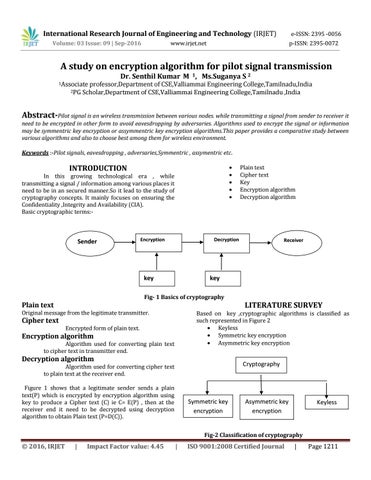
In this growing technological era , while transmitting a signal / information among various places it need to be in an secured manner.So it lead to the study of cryptography concepts. It mainly focuses on ensuring the Confidentiality ,Integrity and Availability (CIA). Basic cryptographic terms:-
Sender
Decryption
Encryption
key
Receiver
key
Fig- 1 Basics of cryptography
Plain text
Plain text Cipher text Key Encryption algorithm Decryption algorithm
Original message from the legitimate transmitter.
LITERATURE SURVEY
Based on key ,cryptographic algorithms is classified as such represented in Figure 2 Keyless Symmetric key encryption Asymmetric key encryption
Cipher text
Encrypted form of plain text.
Encryption algorithm
Algorithm used for converting plain text to cipher text in transmitter end.
Decryption algorithm
Cryptography
Algorithm used for converting cipher text to plain text at the receiver end.
Figure 1 shows that a legitimate sender sends a plain text(P) which is encrypted by encryption algorithm using key to produce a Cipher text (C) ie C= E(P) , then at the receiver end it need to be decrypted using decryption algorithm to obtain Plain text (P=D(C)).
Symmetric key encryption
Asymmetric key encryption
Keyless
Fig-2 Classification of cryptography
© 2016, IRJET
|
Impact Factor value: 4.45
|
ISO 9001:2008 Certified Journal
|
Page 1211
International Research Journal of Engineering and Technology (IRJET) Volume: 03 Issue: 09 | Sep-2016
www.irjet.net
e-ISSN: 2395 -0056 p-ISSN: 2395-0072
Symmetric key encryption :In this both the encryption as well as decryption process uses a same key .This is also called as private key encryption. Some of them uses symmetric key techniques are DES,RC4 etc.
Initial Permutation Plain text
Asymmetric key encryption:-
Encryption as well as decryption process uses a different key for its processing eg. If sender uses a public key for encryption then at the receiver end uses a private key for it decryption process . This is also called as public key cryptography.Asymmetric key techniques followed in RSA ,
Round 1
Keyless
Round 2
In this symmetric key encryption , it is done in two ways they are Block cipher Stream cipher
Round N .
It doesn’t have key, instead it performs hash function by using XOR operation. SHA-1 etc. .
Swap values
Block Cipher :-
Block cipher allows a single block of bits to process at a time to produce corresponding output. Example of block cipher is DES.DES is abbreviated as Data Encryption Standard .It allows the plain text of 64 bits and key size of 56 bits along with 8 parity bits.It performs three phases is clearly stated in Figure 3.They are Initial permutation with plain text of 64 bit size and key input(permuted) and it follows for 16 rounds. Swap the value with the permuted input. Perform inverse initial permutation .
© 2016, IRJET
|
Impact Factor value: 4.45
Inverse initial permutation Fig-3 DES Operations
Stream cipher:-
Stream cipher is also a symmetric type of encryption in which allows only one bit to process at a time .RC4 algorithm uses stream cipher process .It allows s box to generate key and decryption also done with the available key value in s-box. Figure 4 shows that key is generated from the array in random manner and performs randomized process to avoid redundancy and perform XOR operation with the original information (plain text).
|
ISO 9001:2008 Certified Journal
|
Page 1212
International Research Journal of Engineering and Technology (IRJET) Volume: 03 Issue: 09 | Sep-2016
www.irjet.net
e-ISSN: 2395 -0056 p-ISSN: 2395-0072
Figure 5 shows that plain text of any size is split into various blocks which is provided with 512 bits to form a Message digest.
S BOX
Comparative study of algorithms: Monika Agrawal et al. 2012 gives a detailed study of the popular symmetric key encryption algorithms such as DES, TRIPLE DES, AES, and Blowfish. Symmetric Key algorithms run faster and the memory requirement of S is also lesser than Asymmetric encryption algorithms. Further, the security aspect of Symmetric key encryption is superior than Asymmetric key encryption
RANDOMIZATION
XOR
Plain/cipher textPlain/ cipher text Fig- 4 RC4 operations
PUBLIC KEY CRYPTOGRAPHY:These cryptosystems uses different keys for encryption and decryption. If sender uses a public key for encryption at the receiver end they use a private key for decryption.RSA algorithm is one of the public key cryptography process . It accepts only plain text and cipher text between 0 to n-1 where nis less than 2^1024.
Factors Plain text size Key size Rounds
DES 64
RC4
RSA 0 to n-1
SHA
56
0 to n-1
160
Merits
Avalanc he effect
256-byte array Until XORed output obtains Simple for implementati on
Demeri ts
Complex process
not used for highly classified data.
Vulnerab le to chosen ciphertex t attack
16
80 1 Simplicit y
Hashing algorithms:It is neither an symmentric key encryption nor assymentricalgorithm , since it is an one way function where no decryption algorithm. It mainly uses for verification and validation process based on checksum value. It involves a single operation ie XOR.SHA (Secure Hash Algorithm) it process the plain text of variable-length input (up to 2^64 bitslong), and reducing to to 160-bit encrypted output. It involves 80 rounds.
Buffer value of N bits
Splitting N bits into blocks consists of 512 bits
CONCLUSION It concludes that while transmitting pilot signal we need to use an secure encryption algorithm for that we need to know above algorithms and its features separately and also comparative study of them. In this wireless transmission we need to minimize its complexity , fast as well as secure transmission must ensured.
Message Digest Fig- 5 SHA operations
© 2016, IRJET
|
Impact Factor value: 4.45
Input of any length maps to an output of fixed length (160 bits) weak against collisio n attacks .
|
ISO 9001:2008 Certified Journal
|
Page 1213
International Research Journal of Engineering and Technology (IRJET) Volume: 03 Issue: 09 | Sep-2016
www.irjet.net
e-ISSN: 2395 -0056 p-ISSN: 2395-0072
REFERENCES [1] W. Stallings, Cryptography and Network Security: Principles and Practice, 3rd ed. Upper Saddle River, NJ, USA: Prentice Hall, 2003. [2] C. E. Shannon, “Communication theory of secrecy systems,” Bell Syst. Tech. J., vol. 28, no. 4, pp. 656–715, Oct. 1949. [3]Dasgupta, Sanjoy et al. Algorithms. New York: McGrawHill Companies, Inc., 2008. [4] Schneier, Bruce. Applied Cryptography, Second Edition. Protocols, algorithms, and source code in C. New York: John Wiley & Sons, Inc., 1996. [5] Secure Hash Standard (SHS), FIPS PUB 180-3, 2008. [6] National Bureau of Standards, “ Data Encryption Standard,” FIPS Publication 46, 1977. [7] Simar Preet Singh, and Raman Maini “COMPARISON OF DATA ENCRYPTION ALGORITHMS” International Journal of Computer Science and Communication Vol. 2, No. 1, JanuaryJune 2011, pp. 125-127 [8]Monika Agrawal, Pradeep Mishra,” A Comparative Survey on Symmetric Key Encryption Techniques”, International Journal on Computer Science and Engineering (IJCSE), Vol. 4 No. 05 May 2012, PP877-882.S
© 2016, IRJET
|
Impact Factor value: 4.45
|
ISO 9001:2008 Certified Journal
|
Page 1214