International Research Journal of Engineering and Technology (IRJET)
e-ISSN: 2395 -0056
Volume: 03 Issue: 09 | Sep-2016
p-ISSN: 2395-0072
www.irjet.net
Big data for managing human resources: The haves and the have nots. Tanaya Acharekar, Avinash Palghadmal Soft skills trainer, Pune, India. Principle QA Engineer, Calsoft Pvt Ltd, Pune, India. ---------------------------------------------------------------------***---------------------------------------------------------------------
Abstract - Big data is here to stay. From predicting an
athlete’s vulnerability to injury to predicting traffic, big data plays a role in every person’s life. For businesses, it has illuminated the ‘blind areas’ and helped them take well informed decisions thereby reducing huge risk and costs. The world is becoming increasingly data driven and the HR department too is trying to catch up with the rest. As human capital is the biggest contributor to the sustainable economic value of the organization, investing in HR is priority. The paper brings out the benefits and limitations of the use of big data in managing people.
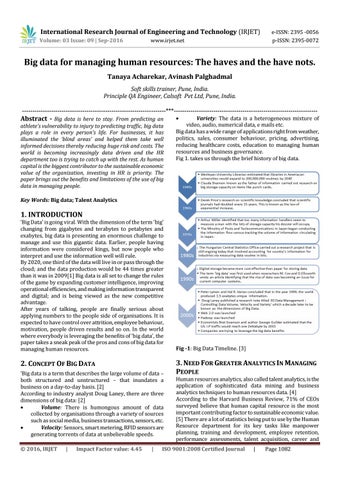
Variety: The data is a heterogeneous mixture of video, audio, numerical data, e mails etc. Big data has a wide range of applications right from weather, politics, sales, consumer behaviour, pricing, advertising, reducing healthcare costs, education to managing human resources and business governance. Fig 1. takes us through the brief history of big data.
Key Words: Big data; Talent Analytics
1. INTRODUCTION ‘Big Data’ is going viral. With the dimension of the term ‘big’ changing from gigabytes and terabytes to petabytes and exabytes, big data is presenting an enormous challenge to manage and use this gigantic data. Earlier, people having information were considered kings, but now people who interpret and use the information well will rule. By 2020, one third of the data will live in or pass through the cloud; and the data production would be 44 times greater than it was in 2009[1] Big data is all set to change the rules of the game by expanding customer intelligence, improving operational efficiencies, and making information transparent and digital; and is being viewed as the new competitive advantage. After years of talking, people are finally serious about applying numbers to the people side of organisations. It is expected to have control over attrition, employee behaviour, motivation, people driven results and so on. In the world where everybody is leveraging the benefits of ‘big data’, the paper takes a sneak peak of the pros and cons of big data for managing human resources.
2. CONCEPT OF BIG DATA ‘Big data is a term that describes the large volume of data – both structured and unstructured – that inundates a business on a day-to-day basis. [2] According to industry analyst Doug Laney, there are three dimensions of big data: [2] Volume: There is humongous amount of data collected by organisations through a variety of sources such as social media, business transactions, sensors, etc. Velocity: Sensors, smart metering, RFID sensors are generating torrents of data at unbelievable speeds. © 2016, IRJET
|
Impact Factor value: 4.45
|
Fig -1: Big Data Timeline. [3]
3. NEED FOR GREATER ANALYTICS IN MANAGING PEOPLE Human resources analytics, also called talent analytics, is the application of sophisticated data mining and business analytics techniques to human resources data. [4] According to the Harvard Business Review, 71% of CEOs surveyed believe that human capital resource is the most important contributing factor to sustainable economic value. [5] There are a lot of statistics being put to use by the Human Resource department for its key tasks like manpower planning, training and development, employee retention, performance assessments, talent acquisition, career and
ISO 9001:2008 Certified Journal
|
Page 1082