International Research Journal of Engineering and Technology (IRJET)
e-ISSN: 2395 -0056
Volume: 03 Issue: 09 | Sep -2016
p-ISSN: 2395-0072
www.irjet.net
The Effect of Centralized technique to detect HELLO FLOOD Attack in WSN Prabhjot kaur1, Jasmeet Singh Gurm2 1Prabhjot kaur
Research scholor Department of computer science and Engineering RIMT university, Fatehgarh Sahib, Punjab, india 2Jasmeet Singh Gurm
Assistant professor
Department of computer science and Engineering RIMT university, Fatehgarh Sahib, Punjab, india
---------------------------------------------------------------------***---------------------------------------------------------------------
Abstract - Wireless sensor networks are made up of nodes.
transmitted data is then displayed to the framework by base station association.we must done clustering in wireless sonsor networks for creation of groups and Leach protocol is also used.
From a few to several hundreds,where each node is connected to one sensors. Nodes communicate with each others wirelessly. The lifetime of battery of nodes in wireless sensor network are limited. Attacks like black hole and worm hole are very harmfull to the network. In wireless sensor networks leach protocol is used for overcome the hello flood attack. LEACH is the first network protocol that uses hierarchical routing for wireless sensor networks to increase the life time of network. This protocol is used for clustering of the nodes. Many protocols which use HELLO packets make the naive assumption that receiving such a packet means the sender is within radio range and is therefore a neighbor. The main goal of oue work is to detect the malicious node. In the proposed work ,to detect the malicious cluster head which has the intention of causing the Hello Flood attack we have presented the modified centralized IDS scheme in the wireless sensor network. This study presents the detection and prevention of hello flood attacks by use cenetralized technique in wireless sensor networks.
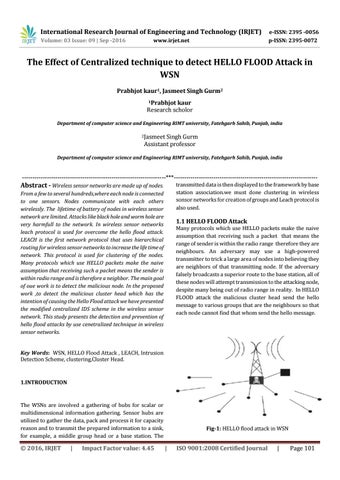
1.1 HELLO FLOOD Attack Many protocols which use HELLO packets make the naive assumption that receiving such a packet that means the range of sender is within the radio range therefore they are neighbours. An adversary may use a high-powered transmitter to trick a large area of nodes into believing they are neighbors of that transmitting node. If the adversary falsely broadcasts a superior route to the base station, all of these nodes will attempt transmission to the attacking node, despite many being out of radio range in reality. In HELLO FLOOD attack the malicious cluster head send the hello message to various groups that are the neighbours so that each node cannot find that whom send the hello message.
Key Words: WSN, HELLO Flood Attack , LEACH, Intrusion Detection Scheme, clustering,Cluster Head.
1.INTRODUCTION
The WSNs are involved a gathering of hubs for scalar or multidimensional information gathering. Sensor hubs are utilized to gather the data, pack and process it for capacity reason and to transmit the prepared information to a sink, for example, a middle group head or a base station. The
© 2016, IRJET
|
Impact Factor value: 4.45
Fig-1: HELLO flood attack in WSN
|
ISO 9001:2008 Certified Journal
|
Page 101
International Research Journal of Engineering and Technology (IRJET)
e-ISSN: 2395 -0056
Volume: 03 Issue: 09 | Sep -2016
p-ISSN: 2395-0072
www.irjet.net
HELLO Flood detection is implemented and the results are analyzed which proves that it requires less computational power, hence is suitable for sensor networks.
2. LITERATURE SURVEY In 2007Avinash Srinivasan and jie wu[1] uses metrics with an emphasis on the former and address the Denial-ofBroadcast Message attacks (DoBM) in networks of sensor. A novel treebased model called the k-Parent Flooding Tree Model (k-FTM) and present algorithms for the construction of k-FTM. This model has reliability close to blind flooding and detection rate close to a static tree and also presented various methods with algorithms for constructing k-FTM.
In 2015 N. Dharini, Ranjith Balakrishnan and A. Pravin Renold [15] use Conventional hierarchical routing protocols were not created considering security, they are helpless against Denial of Service (DoS) attacks. This scheme will increase the detection ratio thereby achieving energy saving. By effectively detecting and isolating the intruders from the network, the network’s lifetime is also enhanced.
In 2010 Ghossoon M. Waleed[3] used anomaly detection to detect TCP SYN flood attack based on payload and useless area in Hypertext Transfer Protocol (HTTP). The results show that the proposed detection method can save TCP SYN Flood in the network through the payload.
In 2015 Thenmozhi Ra,KarthikeyanPa,Vijayakumar V b ,Keerthana M a and Amudhavel J c [16] use a technique that are useful in preventing the server from shutdown. The paper focuses on the protection of server and reduces the loss to the organization and also provide the parameters such as Reliability, Fault tolerance, Minimized Response time, Throughput.
In 2011 Najla Badie Ibraheem Al-Dabagh and Ismael Ali Ali[4] handles the popular DoS attack called TCP-SYN flood attack, and presents the design and implementation of an temporal Immune system for Syn flood Detection, abbreviated by AISD, based on the Dendritic Cell Algorithm (DCA). Results of the experiments showed the precision of intrusion detection process to the ratio of 100%, with a checked response speed.
In 2015 Pham Thi Ngoc Diep and Chai Kiat Yeo [17] propose a detection scheme for flooding attack that piggybacks on an existing encounter record (ER)-based scheme of detecting blackhole attack. Result shows that flooding adversaries who send too many messages or replicas can be detected. The piggyback is also used to incorporate two schemes into a single robust misbehavior detection system that can detect multiple attacks (blackhole, greyhole and flooding) with little additional overhead.
In 2012 Zhiqiang Chen, Wushau Wen and Da Yu [5] focus in denial of services (DOS) flooding attacks by the use of SIP messages in IMS and provide a detection approach using the non-parameter cumulative sum (CUSUM) algorithm that can efficientienly detect such kind of DOS attacks and also evaluate the performance of proposed algorithm using open IMS core platform.
In 2015 Faouzi Hidoussi, Homero Toral-Cruz proposed a scheme in which a new centralized intrusion detection system is proposed by the authors to detect selective forwarding and black hole attacks in cluster-based wireless sensors networks. The main idea is the use of a centralized detection approach, where the base station decides on potential intrusions based on control packets sent from the cluster heads. The proposed intrusion detection technique is simple and energy efficient, it is thus suitable for sensor nodes with resource constrained. The simulation results have confirmed the expected performance of the proposed IDS in terms of security and energy efficiency.
In 2013 Meenakshi Patel, Sanjey Sharma and Divya Sharma [9] proposed a new method based on AODV behavioral metrics save and check MANET flooding attacks. In this method they used the PDER, CO and PMIR as metrics to prediction of flooding attacks. This method will be implementing on NS-3 test bed and also discuss flood attack and their attack of the network.Used a solution for finding and prevention of Flooding attacks.
In 2015 Christian Cervantes, Diego Poplade, Michele Nogueira and Aldri Santos [18] uses an intrusion detection system, called INTI (Intrusion detection of SiNkhole attacks on 6LoWPAN for InterneT of ThIngs), to find sinkhole attacks on the routing services in IoT. Results show the INTI performance and its effectiveness in terms of attack detection rate, number of false positives and negatives and
In 2014 Shikha Magotra and Krishan Kumar [11] proposed a non-cryptographic solution for HELLO flood attack detection ,in which the no. of times the test packet is transmitted is greatly reduced. The simulation results showed detection of adversary nodes with minimal communication overhead as the number of test packets sent for detection is reduced from 20-35 to 10-14 (approx.). A new security framework for
© 2016, IRJET
|
Impact Factor value: 4.45
|
ISO 9001:2008 Certified Journal
|
Page 102
International Research Journal of Engineering and Technology (IRJET)
e-ISSN: 2395 -0056
Volume: 03 Issue: 09 | Sep -2016
p-ISSN: 2395-0072
www.irjet.net
also shows that INTI achives a sinkhole detection rate up to 92% on fixed scenario and 75% in mobile scenario.
3. RESULTS In proposed work, we may detect Hello Flood attack using centralized intrusion detection system. Following are the screenshots of the related work:Fig.5- Again cluster head send conrrol packet to base station
4. CONCLUSION The performance of the network will be analysed against hello flood attacks and the proposed scheme will be implemented in NS2.35 in future. In the proposed work ,to detect the malicious cluster head which has the intention of causing the Hello Flood attack we have presented the modified centralized IDS scheme in the wireless sensor network.
Fig.2- Creation of nodes and selection of cluster head and base station
REFERENCES [1] Faouzi Hidoussi, Homero Toral-Cruz, “Centralized IDS Based on Misuse Detection for Cluster- Based Wireless Sensors Networks” Springer Science+Business Media New York 2015 [2] Christian Cervantes, Diego Poplade, Michele Nogueira and Aldri Santos, “Detection of Sinkhole Attacks for Supporting Secure Routing on 6LoWPAN for Internet of Things”,2015
Fig.3- Base Station will detect the malicious cluster head
[3] Pham Thi Ngoc Diep and Chai Kiat Yeo, “Detecting Flooding Attack in Delay Tolerant Networks by Piggybacking Encounter Records”,2015 [4] Thenmozhi Ra ,Karthikeyan Pa,Vijayakumar V b ,Keerthana M a and Amudhavel J c , “Backtracking Performance Analysis of Internet Protocol for DDoS Flooding Detection” International Conference on Circuit, Power and Computing Technologies [ICCPCT] , 2015 [5] N. Dharini, Ranjith Balakrishnan and A. Pravin Renold, “Distributed Detection of Flooding and Gray Hole Attacks in Wireless Sensor Network” 2015 International Conference on Smart Technologies and Management for Computing, Communication, Controls, Energy and Materials (ICSTM), 6-8 MAY,2015
Fig.4- Again selection of cluster head
© 2016, IRJET
|
Impact Factor value: 4.45
|
ISO 9001:2008 Certified Journal
|
Page 103
International Research Journal of Engineering and Technology (IRJET)
e-ISSN: 2395 -0056
Volume: 03 Issue: 09 | Sep -2016
p-ISSN: 2395-0072
www.irjet.net
[6] Reihaneh Haji Mahdizdeh Zargar, Mohammad Hossein Yaghmaee Moghaddam, “An Entropy-based VoIP Flooding Attacks Detection and Prevention System” 4th international conference on computer and knowledge engeneering(ICCKE)
[7] Shikha Magotra and Krishan Kumar, “Detection of HELLO flood Attack on LEACH Protocol”,2014 [8] Meenakshi Patel, Sanjey Sharma and Divya Sharma, “Detection and Prevention of Flooding Attack Using SVM” International Conference on Communication Systems and Network Technologies,2013 [9] Zhiqiang Chen, Wushau Wen and Da Yu , “Detection SIP Flooding Attacks on IP multimedia subsystem(IMS),,workshoponcomputing,networking and communications,2012 [10] Najla Badie Ibraheem Al-Dabagh and Ismael Ali Ali, “Design and Implementation of Artificial Immune System for Detecting Flooding Attack”,2011 [11] Ghossoon M. Waleed, “TCP SYN Flood Detection based on Payload Analysis” IEEE Student Conference on Research and Development,13-14 DEC,2010 [12] Avinash Srinivasan and jie wu, “A Novel k-Parent Flooding Tree for Secure and Reliable Broadcasting in Sensor Networks” IEEE Communications Society subject matter experts for publication in the ICC,,2007
© 2016, IRJET
|
Impact Factor value: 4.45
|
ISO 9001:2008 Certified Journal
|
Page 104