International Research Journal of Engineering and Technology (IRJET)
e-ISSN: 2395 -0056
Volume: 03 Issue: 09 | Sep -2016
p-ISSN: 2395-0072
www.irjet.net
LOGO DETECTION AND RECOGNITION USING CONTEXT DEPENDENCY FOR IMAGE Smita A. Patil[1] , Dr. T. B. Mohite-Patil[2] 1ME (E & TC) student, D. Y. Patil college of Engg. & Tech. Kolhapur, Maharashtra, India. 2 Dr. D.Y.Pratistan’s College of Engineering Salokhenagar, Kolhapur.India.
Abstract- In this paper, we present recognize the fake logos by matching the fake logo with original one with respect to their pixel intensities. The matched interest point are denoted by geometrical lines between the two images representing the same pixel intensity. The method context dependent and similarity is denoted as CDS method. This methodology is implemented on MATLAB and performance is computed by using precision and recall rate calculations
Keywords— Key-points extraction, Computation of
1) Pre-processing: Consists of processes aimed at the geometric and radiometric correction, enhancement or standardization of imagery to improve our ability to interpret qualitatively and quantitatively image components. Read Image
Module Database Image
1 Pre-processing
Feature Extraction
Feature Extraction
Interest Point Recognition
Interest Point Recognition
context, Logo matching and recognition.
1
INTRODUCTION
Logo is a key visual feature for readers to distinguish the origin or ownership of a document along with other features such as title and seal. In the applications of automatic document image processing, the main focus of logo detection is to find and extract logos with high speed and reliability. Logo analysis in document images involves two main steps: (1) detecting the probable logo from a document image; (2) classifying the detected logo candidate segment into one of the learned logos in the database. The first step is referred to as logo detection, while the second is usually called logo recognition. From the machine learning point of view, logo recognition is considered a multi-class classification task since each logo category is considered a separate target class.
Logo matching
atc
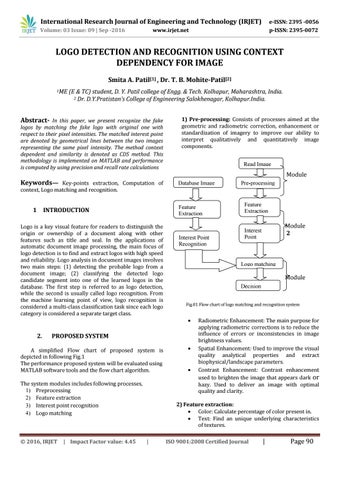
The system modules includes following processes, 1) Preprocessing 2) Feature extraction 3) Interest point recognition 4) Logo matching
© 2016, IRJET
| Impact Factor value: 4.45
Module
Fig.01 Flow chart of logo matching and recognition system
PROPOSED SYSTEM
A simplified Flow chart of proposed system is depicted in following Fig.1 The performance proposed system will be evaluated using MATLAB software tools and the flow chart algorithm.
3
Decision
2.
Module 2
Radiometric Enhancement: The main purpose for applying radiometric corrections is to reduce the influence of errors or inconsistencies in image brightness values. Spatial Enhancement: Used to improve the visual quality analytical properties and extract biophysical/landscape parameters. Contrast Enhancement: Contrast enhancement used to brighten the image that appears dark or hazy. Used to deliver an image with optimal quality and clarity.
2) Feature extraction: Color: Calculate percentage of color present in. Text: Find an unique underlying characteristics of textures. |
ISO 9001:2008 Certified Journal
|
Page 90
International Research Journal of Engineering and Technology (IRJET)
e-ISSN: 2395 -0056
Volume: 03 Issue: 09 | Sep -2016
p-ISSN: 2395-0072
www.irjet.net
Edge: Edges correspond to large discontinuities in the image. 3) Interest point recognition: Intersection point between two or more edge segments. The context and orientation of the interest points are considered. Context refers to the 2D spatial coordinates and orientation refers to the angle of the interest points. Interest point recognition is based on edges and curvature of the logo images. 4) Logo matching: Detect the same feature points independently in both logo images, reliable matching of a corresponding point. Localization is used to find exact point. The result of above system will be checked & displayed by developing Simulation /GUI, or both.
Fig. 02 Input image
3. Simulation and results: Given a query logo instance and a database of detected logos, our goal of logo matching is to compute an effective ranked list for logos in the database. By constructing the list of best matching logos, we effectively retrieve the set of documents from the same organizational entities. 2) Edge Detection: Edge detection method especially due to its two thresholding. Canny's method uses two thresholds to detect strong and weak edges, and includes the weak edges in the output only if they are connected to strong edges. 3) Logo Persistence: The presence of a logo is corroborated if the edge persist from frame to frame. To this effect, a given percentage of the edge pixels comprised in the mask region at time t-1 should survive at time t. 4) Thresholding: The time-averaged edge field is binarized via hysteresis thresholding method. First strong edges are obtained with a high threshold value, and then weak edges are included provided they are connected to strong edges. 5) Morphological Operations: Apply closing to merge neighboring pixel groups, hole filling to prevent deformation of logo mask after opening, and finally opening to remove noise in the background. 6) Shape Constraints: TV logos possess typical shape characteristics the basic ones being the limited ranges of their area and aspect ratio. These constraints are used to eliminate improbable shapes. Furthermore logos should be sufficiently distanced from frame boundaries. 7) Logo Mask Stability: The final check consists in the stability of the logo which means that the candidate mask should not change beyond a tolerance in area, in its coordinates and in the size of the bounding box throughout the logo search sequence.
© 2016, IRJET
| Impact Factor value: 4.45
|
Fig. 03 Filter RGB image
Fig.04 Input image key points
ISO 9001:2008 Certified Journal
|
Page 91
International Research Journal of Engineering and Technology (IRJET)
e-ISSN: 2395 -0056
Volume: 03 Issue: 09 | Sep -2016
p-ISSN: 2395-0072
www.irjet.net
4 . CONCLUSION Identify original documents using image processing techniques is introduced logo detection and localization on new class of similarities, which is based on context. It is suitable to detect similarities and differences between both near and duplicate logos by intensity matching. The solution is proved to be highly effective and responds to the requirements of logo detection and recognition in real world images.
REFERENCES [1]
A. Smeulders, M. Worring, S. Santini, A. Gupta, and R. Jain, “Content based image retrieval at the end of the early years,” IEEE Trans. Pattern Anal. Mach. Intell., vol. 22, no. 12, pp. 1349–1380, Dec. 2000
[2]
A. D. Bagdanov, L. Ballan, M. Bertini, and A. Del Bimbo, “Trademark matching and retrieval in sports video databases,” in Proc. ACM Int. Workshop Multimedia Inf. Retr., Augsburg, Germany, 2007, pp. 79–86.
[3]
A. Joly and O. Buisson, “Logo retrieval with a contrario visual query expansion,” in Proc. ACM Multimedia, Beijing, China, 2009, pp. 581–584.
[4]
K. Gao, S. Lin, Y. Zhang, S. Tang, and D. Zhang, “Logo detection based on spatial-spectral saliency and partial spatial context,” in Proc. IEEE Int. Conf. Multimedia Expo, 2009, pp. 322–329.
[5]
H. Sahbi, J.-Y. Audibert, and R. Kerivan, “Contextdependent kernels for object classification,” IEEE Trans. Pattern Anal. Mach. Intell., vol. 33, no. 4, pp. 699–708, Apr. 2011.
[6]
Y. Kalantidis, L. G. Pueyo, M. Trevisiol, R. van Zwol, and Y. Avrithis, “Scalable triangulation-based logo recognition,” in Proc. ACM Int. Conf. Multimedia Retr., Trento, Italy,2011,pp.1–7.
Fig. 05 Matched features from logo
Fig. 06 Match image.
BIOGRAPHIES Dr. Mohite-Patil T. B. is currently working as a Principal of Dr. D. Y. Patil Pratisthan’s College of Engineering Salokhe-Nagar Kolhapur. He has published about 30 papers in national and international journals. He has filed about six patents in various fields. He has designed and developed educational kits for power electronics and Industrial Electronics. His fields of interest are Power electronics; Digital signal processing and control systems. He has completed his post graduate diploma in business management, post graduation in control system, Ph. D. in
Fig. 07 GUI logo detection and recognition
© 2016, IRJET
| Impact Factor value: 4.45
|
ISO 9001:2008 Certified Journal
|
Page 92
International Research Journal of Engineering and Technology (IRJET)
e-ISSN: 2395 -0056
Volume: 03 Issue: 09 | Sep -2016
p-ISSN: 2395-0072
www.irjet.net
the field of Electronics and persuing law degree from Shivaji University Kolhapur. Presently he is guiding Ph. D. students from various Universities.
Miss Patil Smita A. is currently working as an Assistant Professor in the dept. of Electronics & TeleCommunition in , D.Y.Patil Technical Campus, Talsande, Kolhapur. She has published about 10 papers in national and international journals. Her fields of interest are Image processing etc. She has completed her graduation and appearing post graduation in Electronics & TeleCommunition.
© 2016, IRJET
| Impact Factor value: 4.45
|
ISO 9001:2008 Certified Journal
|
Page 93