International Research Journal of Engineering and Technology (IRJET) Volume: 03 Issue: 07 | July-2016
www.irjet.net
e-ISSN: 2395 -0056 p-ISSN: 2395-0072
the proper definition of the loading conditions. A telescopic jack subjected side load, hoop stress & radial pressure is analyzed with the finite element package ANSYS. Good agreement is found between the results obtained by ANSYS and Theoretical calculation. Hoop stress, pressure, compressive stress & side load have significant impact on the design of the hydraulic cylinder.
REFERENCES
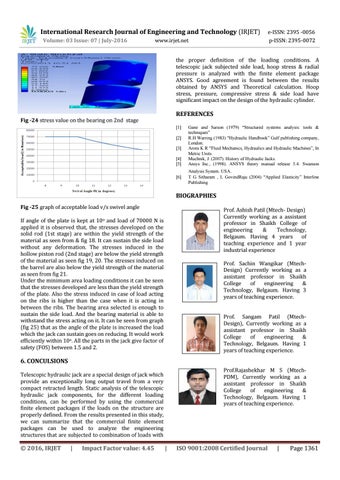
Fig -24 stress value on the bearing on 2nd stage
[1] [2] [3] [4] [5] [6]
Gane and Sarson (1979) “Structured systems analysis: tools & techniques” R.H Warring (1983) “Hydraulic Handbook” Gulf publishing company, London. Arora K R “Fluid Mechanics, Hydraulics and Hydraulic Machines”, In Metric Units Muchnik, J. (2007). History of Hydraulic Jacks. Ansys Inc., (1998). ANSYS theory manual release 5.4. Swanson Analysis System. USA. T G Sitharam , L GovindRaju (2004) “Applied Elasticity” Interline Publishing
BIOGRAPHIES Fig -25 graph of acceptable load v/s swivel angle
Prof. Ashish Patil (Mtech- Design) Currently working as a assistant professor in Shaikh College of engineering & Technology, Belgaum. Having 4 years of teaching experience and 1 year industrial experience
If angle of the plate is kept at 10o and load of 70000 N is applied it is observed that, the stresses developed on the solid rod (1st stage) are within the yield strength of the material as seen from & fig 18. It can sustain the side load without any deformation. The stresses induced in the hollow piston rod (2nd stage) are below the yield strength of the material as seen fig 19, 20. The stresses induced on the barrel are also below the yield strength of the material as seen from fig 21. Under the minimum area loading conditions it can be seen that the stresses developed are less than the yield strength of the plate. Also the stress induced in case of load acting on the ribs is higher than the case when it is acting in between the ribs. The bearing area selected is enough to sustain the side load. And the bearing material is able to withstand the stress acting on it. It can be seen from graph (fig 25) that as the angle of the plate is increased the load which the jack can sustain goes on reducing. It would work efficiently within 10o. All the parts in the jack give factor of safety (FOS) between 1.5 and 2.
Prof. Sachin Wangikar (MtechDesign) Currently working as a assistant professor in Shaikh College of engineering & Technology, Belgaum. Having 3 years of teaching experience. Prof. Sangam Patil (MtechDesign), Currently working as a assistant professor in Shaikh College of engineering & Technology, Belgaum. Having 1 years of teaching experience.
6. CONCULSIONS Prof.Rajashekhar M S (MtechPDM), Currently working as a assistant professor in Shaikh College of engineering & Technology, Belgaum. Having 1 years of teaching experience.
Telescopic hydraulic jack are a special design of jack which provide an exceptionally long output travel from a very compact retracted length. Static analysis of the telescopic hydraulic jack components, for the different loading conditions, can be performed by using the commercial finite element packages if the loads on the structure are properly defined. From the results presented in this study, we can summarize that the commercial finite element packages can be used to analyze the engineering structures that are subjected to combination of loads with
© 2016, IRJET
|
Impact Factor value: 4.45
|
ISO 9001:2008 Certified Journal
|
Page 1361