International Research Journal of Engineering and Technology (IRJET)
e-ISSN: 2395 -0056
Volume: 03 Issue: 02 | Feb-2016
p-ISSN: 2395-0072
www.irjet.net
“Design Optimization of Roller Chain Link Plate used in Sugar Industry” Barge P.R.1, Gaikwad M.U.2 1
PG Student, Mechanical Engineering Department, DGI FOI, Maharashtra, India Mechanical Engineering Department, DGI FOI, Maharashtra, India
2 Asst.Professor,
---------------------------------------------------------------------***---------------------------------------------------------------------
Abstract - Chain Link assembly is extensively used in the
paper will see the system in terms of chain link plate optimization and operation for improvements.
sugar industry. It was determined that maximum amount of weight of chain conveyor is covered by the roller chain link plate Finite Element Analysis (FEA) has used to conduct shape optimization and weight optimization of roller chain outer link plate. We have concentrated on outer link plate and weight reduction of link plate by changing the shape of outer link plate. The aim of this paper is design optimization of roller chain link plate. In this paper the analytical and numerical methods are used for optimization of roller chain link plate. Also the experimentation has done to check validation of the work. The advantage of this paper is that it saves 72gm of weight per link plate and 1.2 kg per meter length of chain.
2. LITERATURE REVIEW Chain Design optimization has been a hot area of research where several patents are filed. The key paper and patents filed regarding chain design are discussed here. Payet P.R, ” Process and Conveyer Device for Feeding Sugar Cane in a Mill Train”, U. S. Patent # 3, 120, 173, 1964. [1]Initial work on conveyer device includes improving the sugar cane conveying process at required speed in a mill train. The purpose of the invention was to produce a device enabling very high conveying speeds.
Key Words: Roller chain, Link plate, FEA analysis, design optimization, UTM.
White D.C. and Fraboni H. J. “Roller Chain Sprockets Oriented to Minimize Strand Length Variation”, United States Patent # 6213905, 2001[2] suggested an arrangement of a roller chain and sprocket drive which utilizes sprockets having randomized radial seating positions, with the sprockets arranged within the drive to be in an orientation with each other to provide favorable dynamics to the roller chain and sprocket drive. This also helps in minimization of strand variation which does exist out of phase for sprockets.
1.INTRODUCTION Failure of chain is perennial problem in industries which causes huge losses to these industries along with its dependents and in turn economical growth of the state. So, roller chain is the most important element of the industrial processes.
Some patents related to roller chain conveyors are also filed for improving its performance and endurance. Hodlewsky W.G. ,”Conveyor Chain Assembly”, U.S. Patent # 4,858,753, 1989.[3] designed a conveyor chain in which hinge pin joining the links can be inserted and held in place without the necessity of forming a head on the pin thereby reducing the labor and cost required in the assembly of the chain links. Seymour T. H. ”Chain and Sprocket Combination”, U.S. Patent # 5,127,884, 1992.[4] suggested chain and sprocket combination that reduces wear and allows for an increasing in the speed of operations of the devices that use chain and sprockets.
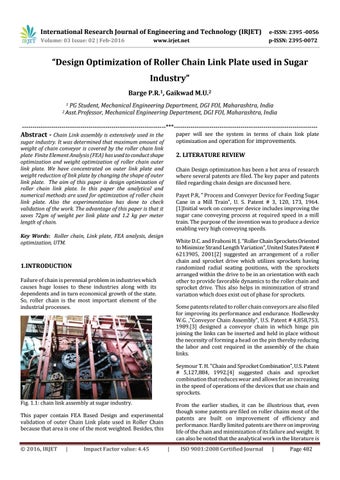
Fig. 1.1: chain link assembly at sugar industry.
From the earlier studies, it can be illustrious that, even though some patents are filed on roller chains most of the patents are built on improvement of efficiency and performance. Hardly limited patents are there on improving life of the chain and minimization of its failure and weight. It can also be noted that the analytical work in the literature is
This paper contain FEA Based Design and experimental validation of outer Chain Link plate used in Roller Chain because that area is one of the most weighted. Besides, this © 2016, IRJET
|
Impact Factor value: 4.45
|
ISO 9001:2008 Certified Journal
|
Page 482