International Research Journal of Engineering and Technology (IRJET)
e-ISSN: 2395 -0056
Volume: 03 Issue: 12 | Dec -2016
p-ISSN: 2395-0072
www.irjet.net
An Eye for a Blind : Assistive Technology Sonal Mali1, Srushti Padade2, Swapnali Mote3, Revati Omkar4 Dept. of Computer Engineering, NBN Sinhgad School of Engineering, Ambegoan(Bk), Pune, Maharashtra, India. ---------------------------------------------------------------------***---------------------------------------------------------------------
Abstract - This paper putforths the ideas for visually
1.2 Project Aim
impaired people in order to help blinds live a better life. The main component of this project is a device on to which we will mount the sensors. In this we will consider 4 different modules. Live tracking is implemented with the help of an Android phone and with the GPS system. Fall detection which will inform his relatives if he falls down anywhere, an alert will be sent. Scene detection is used to identify the area where the person is standing. Obstacle detection is used to identify the objects which may be placed right in front of the person. We will use infrared sensors in order to identify the objects.
This project is aimed at: (i) Obstacle detection (ii) Live Tracking (iii) Scene detection (iv) Fall Detection. Most of the disabled are poor and orphan and in order to make it feasible for them the price of the stick should be as low as possible. The primary objective of this work is to design a small and easy to use device for visually impaired person to travel independently and also to inform the family member if a sudden mishap takes place.
Key Words: Infrared Sensor, Image Processing, Video Surveillance, Accelerometer, Cloud, Distance measure, HSV Colour model.
1. INTRODUCTION In recent years the number of Visually Impaired people is growing due to various accidents taking place. Most of the population belonging to this group is orphans or poor and hence they crave for amenities which they do not get. The inventions so made for such people being expensive are not apt for the people belonging to financially weak class. Visually impaired people are solely dependent on other person to commute from one place to another.Visually impaired people have a setback of not being independent to travel or move from one place to another. Simply walking down a crowded street may prove to be a great difficulty for them. Therefore they need constant support to help. Even inside their house, visually impaired people have to learn about every obstacle present such as tables, chairs and shelves.
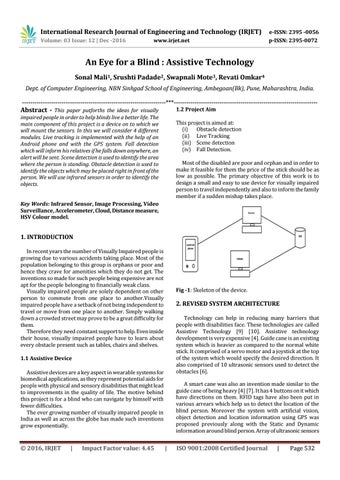
Fig -1: Skeleton of the device.
2. REVISED SYSTEM ARCHITECTURE Technology can help in reducing many barriers that people with disabilities face. These technologies are called Assistive Technology [9] [10]. Assistive technology development is very expensive [4]. Guide cane is an existing system which is heavier as compared to the normal white stick. It comprised of a servo motor and a joystick at the top of the system which would specify the desired direction. It also comprised of 10 ultrasonic sensors used to detect the obstacles [6].
1.1 Assistive Device Assistive devices are a key aspect in wearable systems for biomedical applications, as they represent potential aids for people with physical and sensory disabilities that might lead to improvements in the quality of life. The motive behind this project is for a blind who can navigate by himself with fewer difficulties. The ever growing number of visually impaired people in India as well as across the globe has made such inventions grow exponentially.
© 2016, IRJET
|
Impact Factor value: 4.45
A smart cane was also an invention made similar to the guide cane of being heavy [4] [7]. It has 4 buttons on it which have directions on them. RFID tags have also been put in various arrears which help us to detect the location of the blind person. Moreover the system with artificial vision, object detection and location information using GPS was proposed previously along with the Static and Dynamic information around blind person. Array of ultrasonic sensors
|
ISO 9001:2008 Certified Journal
|
Page 532
International Research Journal of Engineering and Technology (IRJET)
e-ISSN: 2395 -0056
Volume: 03 Issue: 12 | Dec -2016
p-ISSN: 2395-0072
www.irjet.net
and standalone GPS receiver with magnetometer has been interfaced with Arduino board was also used.
going to capture the images of the area and store it into the training data set which then will be compared to the picture that has been recently captured and accordingly the system would identify the area.
A stick equipped with a torch on the top, a horn for traffic, vibrating sensors, automatic high intensity LED’s which are used for the Night. Ultrasonic sensor having a range of 20-350cm. On the other side infrared are also used which help them to detect small obstacles. Infrared having 210cm range [9] [7].
2.4 Fall Detection The Phone has a built in Accelerometer which helps to calculate the coordinates of all the 3-axis. It will also send a notification to the registered number if a mishap takes place or a fall is detected.
The system was so designed on hollow stick having button sensors. The stick helps checking the medical condition of the person by calculating or checking the high pulse rate or low blood pressure [8].
2. SYSTEM DESCRIPTION This system comprises of an Android application where the visually impairer’s relative would fill a Username and a Password. Once Sign Up is done the data is asked for. This data will be Family member’s name, Contact number, Email Id. The Data so obtained then gets stored into the Database from where it will retrieve all the information when needed.
Fig -1: Architecture of the System.
3. HARDWARE REQUIREMENTS 3.1 Infrared Sensors (IR) They are used to sense the Obstacles. In the system we have 3 sensors. Values of each sensor are obtained and then an average of the 3 is taken. This average so calculated is then further calculated to get a threshold value.
Fig -1: Obstacle detection using IR Sensors.
3.2 Analog to Digital Convertor (ADC)
2.1 Obstacle Detection
Analog to Digital convertors are used to convert analog signal to the digital signal. The data that is received by the system is in the analog form and they are processed in order to obtain the digital values. When the values from sensors are obtained a threshold is calculated. This value would lie in between 0-255. If it lies in between 0-127 then it is considered to be low whereas if it is on the upper side that is 129-255 then it is considered as high if 128 is considered as a threshold value.
The system is equipped with infrared sensors which help to detect an obstacle, outdoor or indoor. There are 3 sensors. Every sensor has a value and then the averages of all the values are calculated. Further the threshold value is estimated. With the help of TTS (Text to Speech) feature of Android phone the visually impaired person is notified. 2.2 Live Tracking The location of the visually impaired person is constantly traced and detected with the help of Latitude and Longitudes that are calculated using the built in GPS system in the Smart Phones.
3.3 Microcontroller It is a single chip that comprises of the Processor, volatile and non-volatile memory, I/O control unit and time. It basically is used to control the system. It monitors all the values produced and perform operations accordingly.
2.3 Scene Detection Camera of the android phone will be ON throughout. Image processing takes place in Scene detection. We are
© 2016, IRJET
|
Impact Factor value: 4.45
3.4 Accelerometer
|
ISO 9001:2008 Certified Journal
|
Page 533
International Research Journal of Engineering and Technology (IRJET)
e-ISSN: 2395 -0056
Volume: 03 Issue: 12 | Dec -2016
p-ISSN: 2395-0072
www.irjet.net
International Journal of Computer Science Issues(IJCSI), vol. 8, issue 4, no 2, July 2011. [5] Bruno Aguiar, Tiago Rocha, Joana Silva and In Essouse, “Accelerometer-based fall detection for smartphones”, IEEE 2014. [6] Sudeep Gupta, Ilika Sharma, Aishwarya Tiwari and Gaurav Chitranshi, “Advanced Guide Cane for the Visually Impaired People”, 1st International Conference On Next Generation Computing Technologies (NGCT), 2015. [7] Nishant Banat, James, Asish Harsola, “Navigation aiding stick for the visually impaired”, IEEE, 2015. [8] Prasun Shrivastava, “Medico stick: An ease to Blind & Deaf”, IEEE sponsored 2nd International Conference on Eletronics and Communication system (ICECS), 2015. [9] Ayat Nada, Mahmoud Fakhr, Ahmed Seddik, “Assistive Infrared Sensor Based Smart Stick for Blind People”, Science and Information Conference 2015 July 28-30, 2015 | London, UK, 2015. [10] Joselin Villanueva and René Farcy, “Optical device indicating a safe free path toBlind people”, IEEE transactions on instrumentation and measurement, Vol. 61, No. 1, January 2012.
Accelerometer is built in into the Phones. It helps to detect the fall in a sequential order.
4. SOFTWARE REQUIREMENTS (i) Glassfish Server (ii) JDK 1.6 and above (iii) IDE Eclipse ADT (iv) NetBeans 7.1 and above (v) AWT or Swing
5. CONCLUSIONS Therefore we conclude that fall detection, obstacle detection, live tracking and scene detection can be detected using assistive technologies. Various obstacles such as the wall, pit holes, vertical rods, and many more are used for drawing the secured zone of the IR sensor. The IR sensors provide with the path that is enough wide for the visually impaired person to pass by those obstacles and the instruction are been provided using the TTS feature of the mobile phones. In the proposed system the various combinations of the working modules makes the system more reliable with respect to the real time issues of the visually impaired person and also provides an assurance to the guardian about the position of the user making a dual feedback system having independent navigation and making it more secure and safe. Smartphone usage help the user to grab an immediate response to the fall event, and using the TTS feature alarms the neighbouring people, so the impaired person can receive an instant help along with the notifying his guardian.
ACKNOWLEDGEMENT We are grateful to our project guide Prof. P. P. Jorvekar Madam for the guidance, inspiration and constructive suggestions that helpful us in the preparation of this project.
REFERENCES Shashank Chaurasia, K.V.N. Kavitha “An Electronic Walking Stick for Blinds”, S.A. Engineering College, Chennai, IEEE ICICES 2014.M. Young, The Technical Writer’s Handbook. Mill Valley, CA: University Science, 1989. [2] G. Gayathri, M. Vishnupriya, R. Nandhini, Ms. M. Banupriya, “Smart Walking Stick for Visually Impaired”, International journal of engineering and computer science, 2014. [3] Osama Bader Al-Barrm, “3D Ultrasonic Stick for Blind”, International Journal of Latest Trends in Engineering and Technology (IJLTET), 2014. [4] M. Wahab, A. Talib, H. Kadir, A. Johari, “Smart Cane: Assistive Cane for Visually-Impaired People”, [1]
© 2016, IRJET
|
Impact Factor value: 4.45
|
ISO 9001:2008 Certified Journal
|
Page 534