International Research Journal of Engineering and Technology (IRJET)
e-ISSN: 2395 -0056
Volume: 03 Issue: 11 | Nov -2016
p-ISSN: 2395-0072
www.irjet.net
Assistive Domotic System: Survey on the Development of Home Automation System via Raspberry Pi and Voice Assistive Technology. Shashank Saurav1, Chitranshu Soni2, Pooja Kumari3, Omkar Sinnarkar4 Department Of Computer Engineering Dhole Patil College of Engineering, Wagholi, Pune, Maharashtra, India ---------------------------------------------------------------------***--------------------------------------------------------------------2. SYSTEM OVERVIEW Abstract - Assistive Domotic System is intended to control all lights and electrical appliances in our home or office using voice commands. This system is based on the voice which is helpful in providing the support for the busy person and mainly for the elderly and disabled person. This technology is growing rapidly and accepted in developing areas and in small town too. Usage of voice services is the most open and easier way of providing remote service access or enabling applications to communicate with each other. It provides many benefits like, it increases comfort and it also provides greater security and safety. It is also beneficial for controlling and monitoring the environment. We are using Raspberry Pi 3 as a controller for all this activity i.e. for our Assistive Domotic System.
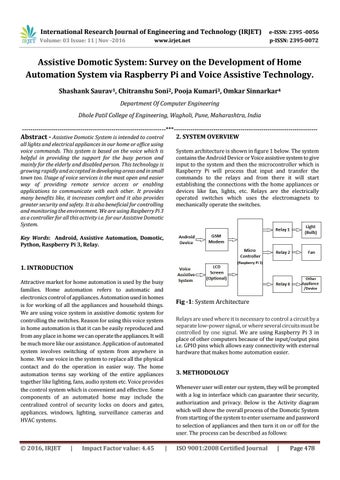
System architecture is shown in figure 1 below. The system contains the Android Device or Voice assistive system to give input to the system and then the microcontroller which is Raspberry Pi will process that input and transfer the commands to the relays and from there it will start establishing the connections with the home appliances or devices like fan, lights, etc. Relays are the electrically operated switches which uses the electromagnets to mechanically operate the switches.
Key Words: Android, Assistive Automation, Domotic, Python, Raspberry Pi 3, Relay.
1. INTRODUCTION Attractive market for home automation is used by the busy families. Home automation refers to automatic and electronics control of appliances. Automation used in homes is for working of all the appliances and household things. We are using voice system in assistive domotic system for controlling the switches. Reason for using this voice system in home automation is that it can be easily reproduced and from any place in home we can operate the appliances. It will be much more like our assistance. Application of automated system involves switching of system from anywhere in home. We use voice in the system to replace all the physical contact and do the operation in easier way. The home automation terms say working of the entire appliances together like lighting, fans, audio system etc. Voice provides the control system which is convenient and effective. Some components of an automated home may include the centralized control of security locks on doors and gates, appliances, windows, lighting, surveillance cameras and HVAC systems.
© 2016, IRJET
|
Impact Factor value: 4.45
Fig -1: System Architecture Relays are used where it is necessary to control a circuit by a separate low-power signal, or where several circuits must be controlled by one signal. We are using Raspberry Pi 3 in place of other computers because of the input/output pins i.e. GPIO pins which allows easy connectivity with external hardware that makes home automation easier.
3. METHODOLOGY Whenever user will enter our system, they will be prompted with a log in interface which can guarantee their security, authorization and privacy. Below is the Activity diagram which will show the overall process of the Domotic System from starting of the system to enter username and password to selection of appliances and then turn it on or off for the user. The process can be described as follows:
|
ISO 9001:2008 Certified Journal
|
Page 478
International Research Journal of Engineering and Technology (IRJET)
e-ISSN: 2395 -0056
Volume: 03 Issue: 11 | Nov -2016
p-ISSN: 2395-0072
www.irjet.net
Fig -3: Raspberry Pi 3 Model B It is a third generation Raspberry Pi. It replaced the Raspberry Pi Model B in February 2016. Fig -2: Activity Diagram
4.2 USB Microphone
i) User enters into the system to check the status of the appliances. ii) User enters the username for authentication. iii) User enters the password for verification. iv) User clicks the login button to check the username and password. If the user identification is valid then user can access the account. Else logins fail or invalid login. v) If the UID is valid user can check the status of various home appliances. vi) The user selects the appliances. If the appliances selected by user are valid status then the system will display the options of menu of home appliances. vii) Now user enters the values to select the appliances of their requirement. viii) Now the application displays the result and also updates the status. ix) All for the new required appliances the procedure continues from step no (vi).
It is an audio transmitting and amplifying device which is designed to plug into computer’s USB port.
Fig -4: Microphone Module Here, the system captures the voice using sampling rate fs. After that to meet Nyquist sampling criteria, an anti-aliasing filter is used to block all the frequencies above the Nyquist frequency (Fn).
4. HARDWARES The major hardware components that can be used in this domotic system are:
fs = 2Fn The input voice which is in the wave form passes through the low pass filter. The signal is then amplified to analog to digital converter (ADC). The Butterworth low pass filter can be used as an anti-aliasing filter. After that, in the microcontroller, data is converted to digital format using ADC and then this data is compressed using Differential Pulse Code Modulation (DPCM) algorithm. Then the
4.1 Raspberry Pi It is a low cost credit sized computer that can be plugged into any display device like monitor or TV. Here, we are using this microcontroller for our domotic system. Specifically we are using Raspberry Pi 3 Model B for our Domotic System.
© 2016, IRJET
|
Impact Factor value: 4.45
|
ISO 9001:2008 Certified Journal
|
Page 479
International Research Journal of Engineering and Technology (IRJET)
e-ISSN: 2395 -0056
Volume: 03 Issue: 11 | Nov -2016
p-ISSN: 2395-0072
www.irjet.net
for the people and also heating and cooling of our houses consumes approx 50% of cost of energy every year that makes HVAC regulation to a great extent. With the automation of HVAC we can minimize the heat when a room of home is unoccupied, and we can also increase and decrease times based on our scheduled.
compressed data is sent serially from the microcontroller to the RF module.
4.3 Other Hardware Components The raspberry pi and microphone were the two main hardware components for the Assistive Domotic System. The other components which can be used in this system are SD card, Ethernet Cable, USB cable, speakers, transistors, diodes, 9V battery, etc.
6.3 Lawn Irrigation System Sprinkler control system play major role in providing water regulation with local weather data through real time communication. The automated sprinkler control system adjusts the saturation level and also can disable the watering which was scheduled. The system takes care of dry condition and supply sufficient amount of nourishment with overwatering.
5. SOFTWARES The software section can be divided into two parts, one for the android Smartphone and other for our microcontroller i.e. for programming in raspberry pi. Our android Smartphone will contain an application to control the appliances directly via Smartphone. For this, we need Eclipse software development kit which is a computer programming environment and an android emulation system. For the microcontroller part which is our main part, we can use a Linux or Rasbian based operating system in which the programming will be done by using python programming language. If we want to include the display device for our domotic system and also want to connect through the internet then PHP and Hypertext Mark-up Language (HTML) can be used.
6.4 Security System Home security is the primary goal of assistive domotic system. Various kinds of devices such as ismartAlarm, which offers various kinds of features which includes doors and window sensor. CCTV camera for monitoring, motion detectors, video camera etc.
7. ADVANTAGES By using this application we have the ability to control the various appliances and lighting and fan control system by using just a single tap of our finger on our technological device. It also allows us to turn on or off the switches at a specific time. This also helps us to increase the security and safety of our home. It is also one of the greatest benefits of assistive domotic system is to using automated door locks for security and safety of homes. If we forget to lock the door in a rush in the morning so only through automated system we can lock our doors with just our tap of fingers. With the help of assistive domotic system we can easily see and notify what is happening inside our homes. The purpose of security camera is to increase the safety of our family by recording clips and detecting and monitoring our home.
6. APPLICATIONS There are many applications of Assistive Domotic System. Some of them are as follows:
6.1 Lighting Control The lighting control system comes and play major role in smart home automation system also called smart lighting control system. Smart lighting system of home automation allows us to control wall switches. Nowadays its capabilities are widespread. If you want to turn off or on the light at specific time that is scheduling the time then decide which specific rooms should be irradiated by light at certain times, set the levels of light to turn on or off which should be emitted, and choose how particular kinds of light react through motion sensitivity, and is affordable and easy to use with its plug and play simplicity.
Also by applying assistive domotic system we can easily adjust the thermostat from our working place from the few hours before moving to home. It saves energy of the device and is also cost effective. By arriving of smart assistive domotic system in such a busy scheduled you can now be able to save your time by just sitting at your home place and are able to adjust the appliances to turn on or off the switch and door locks. By the enhancement of assistive domotic system we can save our monthly utility bill. We don’t need to spend money for household appliances. We can
6.2 HVAC Regulations As the cost of petroleum and fuel rise and its sustainability and availability of the resources becomes the major concern
© 2016, IRJET
|
Impact Factor value: 4.45
|
ISO 9001:2008 Certified Journal
|
Page 480
International Research Journal of Engineering and Technology (IRJET)
e-ISSN: 2395 -0056
Volume: 03 Issue: 11 | Nov -2016
p-ISSN: 2395-0072
www.irjet.net
(2010) Home Automated Living website. [Cited 2010 14th Oct].Available: http://www.homeautomatedliving.com/default.htm [6] Raspberry Pi website: https://www.raspberrypi.org/products/raspberry-pi3-model-b/ [7] Digital Image processing by S.Jayaraman, McGraw Hills Publication. [8] Stuart Russell and Peter Norvig (1995), “Artificial Intelligence: A Modern Approach," Third edition, Pearson, 2003.
also save gas cost, as no one forces you to stop at home in order to turn on or off the gas. We can also take part in economy contribution by ensuring that we are only using that much of energy and resources that are necessary and important while we are at home.
[5]
8. CONCLUSIONS AND FUTURE WORK Assistive Domotic System or in simple words the home automation system has been implemented successfully. This system will not only help the normal home owners but also it will help the elder people and disabled people. It can be used anywhere in the small home based environment. Here, we used android Smartphone in which a graphical user interface is provided for the touch inputs through which you can switch on or off the appliances and an alternate option which is an assistive system through which you can operate & control any appliances in your home or office through your voice or speech. For more reliable system for the future use several improvements can be introduced. Such as in the system more security can be added like fingerprint and eye retina scan. Infrared (IR) transmitter can also be included for the support of different protocols. A timer can also be added for the scheduled turn on or off of the appliances. Furthermore commands can be added to this system for extending its use. Therefore, this system will provide a flexible implementation for many applications with low cost and can be furthermore modified according to the user.
REFERENCES Ms. S. Brilly Sangeetha, M. Tharaniya soundhari, “Intelligent Interface Based Speech Recognition for Home Automation using Android Application”, IEEE Sponsored 2nd International Conference on Innovations in Information Embedded and Communication Systems ICIIECS’15. [2] Nicholas Mulhern, Neil McCaffrey, Nicholas Beretta, Eugene Chabot PhD, Ying Sun PhD, “Designing Android Applications using Voice Controlled Commands - For Hands free interaction with Common Household Devices”, 39th Annual Northeast Bioengineering Conference 2013. [3] M. Mahadi Abdul Jamil, M. Shukri Ahmad,“A Pilot Study: Development of Home Automation System via Raspberry Pi”, 2015 2nd International Conference on Biomedical Engineering (ICoBE), 30-31 March 2015, Penang. [4] Humaid AlShu’eili, Gourab Sen Gupta, Subhas Mukhopadhyay, “Voice Recognition Based Wireless Home Automation System”, 2011 4th International Conference on Mechatronics (ICOM), 17-19 May 2011, Kuala Lumpur, Malaysia. [1]
© 2016, IRJET
|
Impact Factor value: 4.45
|
ISO 9001:2008 Certified Journal
|
Page 481