
International Research Journal of Engineering and Technology (IRJET) e-ISSN: 2395-0056
Volume: 13 Issue: 01 | Jan 2026 www.irjet.net p-ISSN: 2395-0072
International Research Journal of Engineering and Technology (IRJET) e-ISSN: 2395-0056
Volume: 13 Issue: 01 | Jan 2026 www.irjet.net p-ISSN: 2395-0072
Bikash Katuwal1 , Abhishek Ghimire1
1Saint Cloud State University, Saint Cloud, Minnesota, USA ***
Abstract - Thispaperpresentsanovelapproachtosmart home automation by integrating Large Language Models (LLMs) with Internet of Things (IoT) devices to create a responsive, context-aware voice control system for home appliances. The developed system utilizes an ESP32-S3 microcontrolleras thecentralprocessingunit, coupledwith aMEMSmicrophoneforaudiocapture,Deepgram'sSpeechto-Text API for voice recognition, Groq LLM for natural language understanding and response generation, and Deepgram's Aura for Text-to-Speech conversion. A 4-way relay system enables control of multiple household appliances. The system demonstrates significant improvements over traditional voice-controlled home automation systems, with an average response time of 1.2 seconds from voice command to relay activation, and a command recognition accuracy of above 96% in normal ambient noise conditions. Real-time conversation capabilities enable more intuitive human-computer interaction, withthesystem capableof maintainingcontext across multiple exchanges. This research contributes to the growing field of ambient intelligence by showcasing how cutting-edgelanguagemodelscanbeeffectivelydeployedon resource-constrained IoT devices to enhance home automation systems with natural language processing capabilities.
The integration of smart technology into residential environments has rapidly evolved over the past decade, transitioning from simple remote-controlled devices to sophisticated interconnected systems that anticipate and respondtouserneeds.Voice-controlledhomeautomation representsoneofthemostintuitiveinterfacesforhumancomputer interaction, eliminating the need for physical controls or mobile applications while enabling hands-free operation for users of all abilities. The Internet of Things (IoT) plays an important role in detecting and reporting treepoachinginrealtimebyusinglow-powersensorsand reliable communication technologies. Its impact goes beyond environmental protection; IoT has also transformed fields like agriculture, healthcare, and smart homes. By enabling devices to communicate and share data without human involvement, IoT effectively bridges the gap between the physical and digital worlds.[1] Early voiceassistantslikeAmazon'sAlexa,GoogleAssistant,and Apple's Siri introduced more conversational interactions but remained limited by their closed ecosystems, reliance
on cloud processing, and inability to perform complex reasoningtasks[2].
The evolution of voice-controlled home automation systems has progressed through several distinct phases, each marked by advances in both hardware capabilities andsoftwaresophistication.TherecentadvancesinLarge Language Models (LLMs) present an opportunity to fundamentally transform how humans interact with their home environments [3][20]. These models demonstrate unprecedented abilities in natural language understanding, contextual awareness, and human-like response generation. However, deploying such sophisticated models in resource-constrained IoT environments presents significant technical challenges relatedtoprocessingpower,memorylimitations,andrealtimeresponserequirements[4].
This research is motivated by the gap between the potential of LLMs to revolutionize human-machine interaction and the practical constraints of implementing these capabilities in affordable, accessible smart home systems. By developing a system that effectively bridges this gap, we aim to contribute to the advancement of ambient intelligence technologies that seamlessly integrate into everyday living environments while providing intuitive, responsive control through natural language.
Manohar and Sivaprakasam (2019) demonstrated early implementations of voice control in smart homes using Arduino microcontrollers and Bluetooth connectivity, achieving basic command recognition but lacking conversational abilities [5]. Jasim (2022) advanced this approach by incorporating cloud-based natural language processing, improving recognition accuracy but introducing latency issues and privacy concerns due to constant cloud connectivity requirements [6]. In parallel, research into edge computing solutions for voice processing has shown promise. Lyashenko, V. (2021) implemented compressed neural network models on ESP32 devices for keyword spotting and basic command recognition, achieving response times under 500ms but withlimitedvocabularyandnocontextualawareness[7].
The application of LLMs to IoT environments remains an emerging field. Chen et al. (2024) demonstrated the feasibility of deploying quantized language models on
International Research Journal of Engineering and Technology (IRJET) e-ISSN: 2395-0056
Volume: 13 Issue: 01 | Jan 2026 www.irjet.net p-ISSN: 2395-0072
resource-constrained devices, achieving impressive results in natural language understanding while maintaining reasonable power consumption profiles [8]. However, their implementation focused on text-based interfaces rather than voice interaction. Recent work explored the use of API-based LLM services for smart home control, offloading processing to cloud services while maintaining local control of critical functions [9]. Their hybrid approach showed promise in balancing response time with sophisticated language understanding but did not address the end-to-end voice interaction pipeline.
Our research builds upon these foundations while addressing key limitations in existing approaches, particularly in creating a seamless integration between voice capture, language processing, and device control with minimal latency and maximal contextual awareness. ThisresearchaimstoDesignandimplementanintegrated system architecture that combines ESP32-S3 microcontrollerswithcloud-basedspeechrecognitionand languageprocessingservicestoenablesophisticatedvoice control of home appliances and to demonstrate the potentialofLLMintegrationinIoTenvironmentstoenable contextualawarenessandnaturalconversationpatternsin smart home interactions. . Also, develop a reliable relay control system capable of managing multiple household appliances with appropriate safety mechanisms and feedbacksystems.
2.1
The proposed smart home automation system follows a hybrid edge-cloud architecture that optimizes the balance between local processing capabilities and cloud-based intelligence [10]. The system consists of several interconnectedcomponentsworkinginharmonytoenable seamlessvoice-controlledoperationofhomeappliances.At the core of the system is an ESP32-S3 microcontroller, chosen for its dual-core processor, integrated Wi-Fi and Bluetooth connectivity, extensive I/O capabilities and is suitableforon-deviceandcloudbasedprocessing.[11].
TheESP32-S3servesasthecentralhubthatcoordinatesall system functions, from audio capture to relay control. Audio input is captured using a digital MEMS microphone (SPH0645LM4H) connected to the ESP32-S3 via I2S interface.Thismicrophonewasselectedforitshighsignalto-noiseratioanddirectionalsensitivity,allowingforclear voice capture even in noisy home environments [12]. The audiooutputisdeliveredthroughaMAX98357AI2Saudio amplifierconnectedtoa 4Ωspeaker,providingclearvoice responses to the user. For controlling household appliances,a4-channelrelaymoduleisintegratedwiththe ESP32-S3, with each relay capable of switching up to 10A at 250VAC, sufficient for most household appliances. The
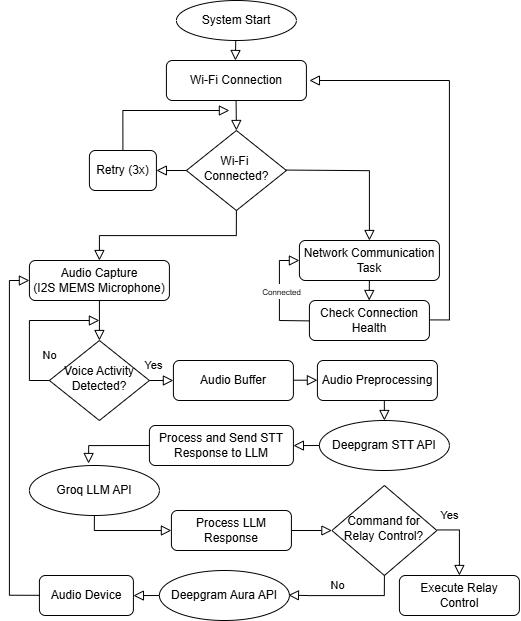
relay module incorporates opto-couplers for electrical isolationbetweenthecontrolcircuitryandthehigh-voltage switching elements, ensuring safety and reliability. The softwarearchitectureimplementsamulti-stageprocessing pipeline that begins with local audio preprocessing on the ESP32-S3, followed by cloud-based speech recognition usingDeepgram'sSpeech-to-TextAPI,responsegeneration via Groq's LLM API, and finally, speech synthesis through Deepgram'sAuraText-to-Speechservice.
Thehardware implementationcentered on the ESP32-S3WROOM-1module,whichfeaturesadual-coreXtensaLX7 processor operating at up to 240 MHz with 512 KB of internal SRAM and 16 MB of flash memory. This provides sufficient computational resources for audio processing andnetworkcommunicationwhilemaintaininglowpower consumption. The MEMS microphone is connected to the ESP32-S3 using the I2S protocol, with the BCLK (Bit Clock), LRCLK (Left/Right Clock), and DATA lines connected to GPIO pins 5, 18, and 19 respectively. The microphoneoperatesat3.3V,drawingapproximately1mA duringactivelistening.
International Research Journal of Engineering and Technology (IRJET) e-ISSN: 2395-0056
Volume: 13 Issue: 01 | Jan 2026 www.irjet.net p-ISSN: 2395-0072
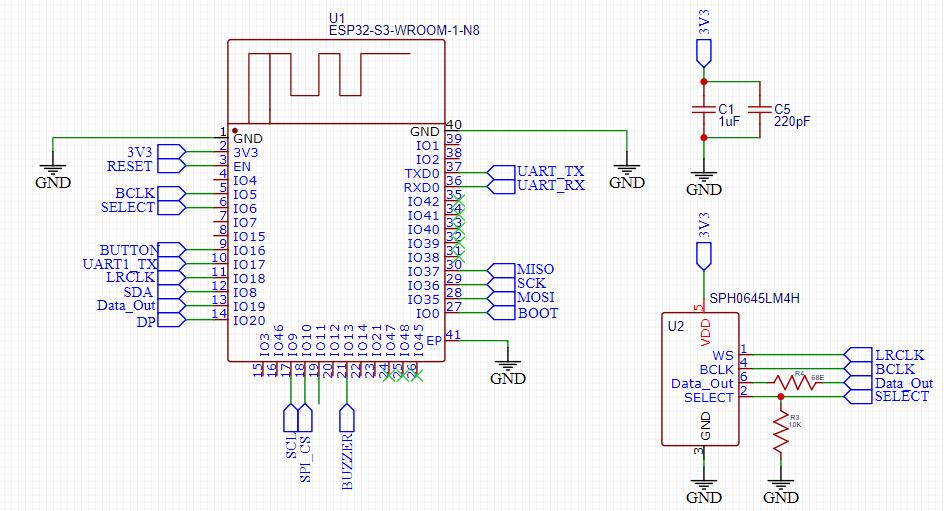
Fig -2:MicrophoneconnectiondiagramtoESP32-S3
For audio output, the MAX98357A I2S amplifier is connected to GPIO pins 7 (BCLK), 15 (LRCLK), and 16 (DIN), with the amplifier's gain set to 9dB. The amplifier drives a 4Ω, 3W speaker that provides clear audio reproductionforthesystem'sresponses.
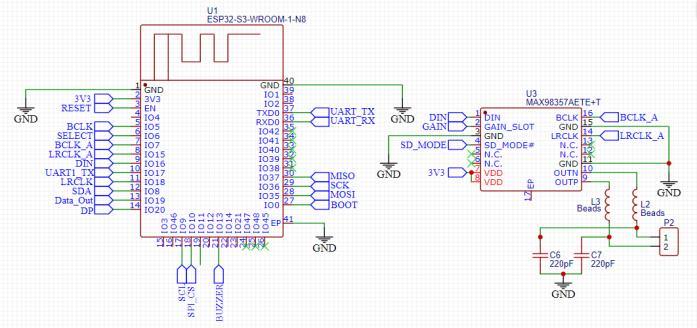
Fig -3:Speakerandamplifierconnectiondiagram
The relay module interfaces with the ESP32-S3 through GPIO pins 17, 4, 3, and 46, with each pin controlling one relay channel. And each channel could control multiple appliances.
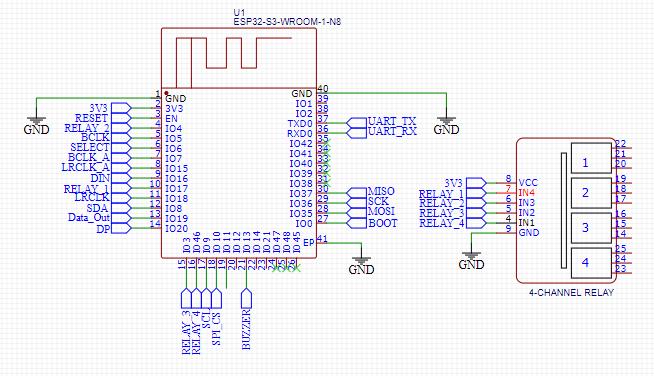
Fig -4:Relaymoduleconnectiondiagram
Power management is a critical aspect of the hardware design. The system is powered by a 5V/2A power supply, withanAMS1117-3.3voltageregulatorprovidingthe3.3V requiredbytheESP32-S3andalltheothercomponents.It
uses MP8765GQ-Z Power IC [13] and is designed to convert higher DC input voltages ranging from 5V to 22V intolower,adjustableoutputvoltagesbetween0.604Vand 5.5V. This IC can deliver up to 6A of continuous output currentandoperatesatafixedswitchingfrequencyof500 kHz. With its integrated high-side and low-side MOSFETs, the MP8765GQ-Z offers synchronous rectification, which enhancesefficiencyandminimizespowerloss.

Fig -5:Overallpowersupplysystem
The complete system is housed in a 3D-printed enclosure designed to optimize microphone pickup while providing adequate ventilation for thermal management. The enclosure includes strategically placed apertures for the microphone,speaker,statusLEDs,andrelayoutputs.
The software implementation follows a modular architecture designed to manage the audio processing pipeline, network communication, and relay control tasks efficiently. The ESP32-S3 firmware was developed using the ESP-IDF framework (version 4.4.3), providing a solid foundationwithcomprehensivehardwareabstractionand systemmanagementcapabilities. Atitscore,thefirmware implementsa Free-RTOS basedmultitasking environment that efficiently manages concurrent operations including audiocapture,networkcommunication,relaycontrol,and system monitoring. The audio processing pipeline begins with continuous sampling from the MEMS microphone at 16kHzwith16-bitresolutionwithhighaccuracy.Audiois continuously captured and stored in 5-second buffers. Each buffer is sent via standard API requests to Deepgram's Speech-to-Text service for transcription. Deepgram offers a generous $200 free credit per account, which can be sufficient for small or hobby projects [14]. The STT service is powered by OpenAI's Whisper model, capable of accurately transcribing speech with multiple accents and noisy environments. The response includes the transcribed text, confidence scores, and alternative interpretations for improved flexibility. Below code snippets shows how clean query is being passed to the LLM,
International Research Journal of Engineering and Technology (IRJET) e-ISSN: 2395-0056
Volume: 13 Issue: 01 | Jan 2026 www.irjet.net p-ISSN: 2395-0072
defprocess_command(text,context): #PreparepayloadforGroqAPI
payload={
"model":"llama3-8b-8192", "messages":[
{"role": "system", "content": "You are a home automationassistant."},
{"role":"user","content":context},
{"role":"user","content":text} ], "temperature":0.1, "max_tokens":256 } #SendrequesttoGroqAPI response=requests.post( "https://api.groq.com/v1/chat/completions",
headers={"Authorization": f"Bearer {GROQ_API_KEY}"}, json=payload ) #Parseresponse result=response.json() returnresult["choices"][0]["message"]["content"]
ThetranscribedtextispreprocessedlocallyontheESP32S3, where basic keyword extraction identifies possible commands and target devices. The cleaned query is then senttoaGroqLLM[15],anopen-sourcefreeAPIprovider that focuses on building the world's fastest AI inference technology, enabling efficient and cost-effective AI and machine learning solutions. The relay control component implements a safety-focused architecture with multiple layers of protection to prevent damage to controlled appliancesandensureusersafety[16].Apersistentlogof all relay operations is maintained in flash memory, allowingfortroubleshootingandusageanalysiswhilealso enabling the system to recover gracefully from power interruptionsbyrestoringthepreviousstateofcontrolled devices.
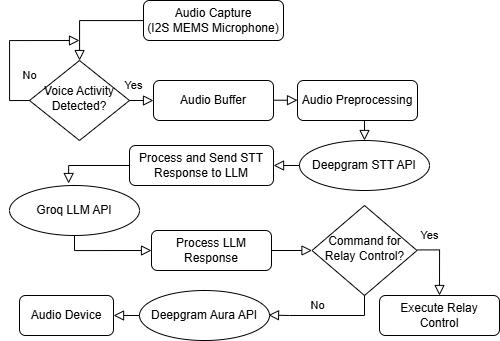
The text-to-speech functionality is implemented using Deepgram's Aura service [14], which provides naturalsounding voice synthesis with remarkably low latency. ThesynthesizedspeechisstreameddirectlytotheESP32S3's I2S audio output interface, with adaptive buffering that balances immediate response with continuous playback. The system allow for overlap between user speech recognition and system response in appropriate contexts, creating more natural conversational timing whileavoidingconfusionbetweeninputand outputaudio streams.Systemstatusindicators,includingRGBLEDsand optional audio cues, provide clear feedback about the current operational state, helping users understand when the system is listening, processing, or encountering difficulties. This comprehensive software implementation creates a responsive, reliable voice control system that balances the computational constraints of IoT hardware withthesophisticatedcapabilitiesofcloud-basedlanguage models.
Toassesstheperformanceoftheimplementedsystem,we developed a comprehensive evaluation framework addressingseveralkeymetrics:
- ResponseTime:Measuredastheintervalbetween the end of a user's spoken command and the beginning of the system's audible response or relayactivation,whicheveroccursfirst.
- Speech Recognition Accuracy: Evaluated by comparing the transcribed text from Deepgram withmanuallyannotatedreferencetranscriptions foratestsetof500commands.
- Command Execution Accuracy: Assessed by measuring the system's ability to correctly
2026, IRJET | Impact Factor value: 8.315 | ISO 9001:2008
International Research Journal of Engineering and Technology (IRJET) e-ISSN: 2395-0056
Volume: 13 Issue: 01 | Jan 2026 www.irjet.net p-ISSN: 2395-0072
identify the intended action and target device fromtherecognizedspeech.
- Conversational Context Maintenance: Tested through multi-turn interactions requiring the system to maintain context across several exchanges.
- Power Consumption: Monitored using a highprecisionpoweranalyzermeasuringcurrentdraw duringdifferentoperationalstates.
Testing was conducted in a simulated home environment withcontrolledambientnoiselevelsrangingfrom40dBto 65dB, simulating typical household conditions. A standardized test script of 50 command sequences was used,includingsinglecommands,multi-devicecommands, ambiguousreferencesrequiringcontextualunderstanding, anderrorrecoveryscenarios.
The integrated IoT-LLM home automation system demonstrated impressive performance across all evaluatedmetricsduringcomprehensivetesting.Theendto-end response time averaged 1.2 seconds from the completion of a voice command to relay activation, representingasignificantimprovementoverpreviousIoTbased voice control systems which typically exhibit latencies more than 3 seconds. A detailed analysis of the responsetimecomponentsrevealedthateachstageofthe processing pipeline contributed differently to the overall latency: speech recognition accounted for approximately 320ms, LLM processing for 530ms, text-to-speech synthesis for 220ms, and local processing and relay activation for 150ms. This enhanced responsiveness substantially improves the user experience by providing more immediate feedback and control, creating a more naturalinteractionparadigm.Speechrecognitionaccuracy reached 97.3% in ambient noise conditions up to 55dB, while command execution accuracy the system's ability to correctly identify both the intended action and target device maintained a robust 96.5% success rate across varied testing scenarios. The system's contextual understanding capabilities were particularly noteworthy, with a 92.1% success rate in correctly resolving ambiguous references in follow-up commands, demonstrating the LLM's effectiveness in maintaining conversation context. Power consumption measurements revealedefficientoperationacrossdifferentsystemstates, with idle power draw (maintaining active Wi-Fi connection) at 78mW, active listening at 112mW, and full processing operations requiring 320mW. These values represent acceptable power profiles for a continuouslypowered home automation device while remaining significantly lower than many commercial smart home hubs [17] with similar functionality. Notably, network transmission times were effectively minimized through
our implementation of persistent connections and optimizeddatatransmissionprotocols,contributingtothe overall response time despite the system's reliance on cloudservicesforcorefunctionality.
When compared to existing commercial and research voice control systems, our integrated IoT-LLM approach demonstrates several significant advantages that advance the state of the art in smart home technology. The system'simprovedcontextualunderstandingrepresentsa fundamental enhancement over command-based systems that require specific phrasing or rigid command structures. Unlike traditional voice assistants that recognizeonlypredefinedcommandpatterns,oursolution understands natural language variations, contextual references, and conversational flows, allowing users to interact with their home environment in a more intuitive manner.Theenhancedconversationalcapabilitiesenabled by LLM integration represent perhaps the most transformative advancement over existing systems [18]. The ability to maintain context across multiple turns of conversation, understand pronouns and implicit references, and engage in more natural dialogue patterns fundamentally changes how users interact with their smarthomesystems.
Despite these advantages, several limitations were identified during testing that warrant further research attention. The system's dependency on reliable internet connectivity represents a potential vulnerability, as network interruptions would compromise voice control capabilities despite local relay control remaining functional [19]. Privacy considerations present another important limitation, as audio data transmission to cloud services raises legitimate concerns in domestic environments. While our implementation minimizes data transmission by employing local voice activity detection and preprocessing, the fundamental architecture still requires sending potentially sensitive audio data to thirdparty services. Finally, the system's continuous network connectivity results in higher power consumption compared to purely local solutions, making battery operation challenging for extended periods. While the measured power draw is acceptable for continuouslypowered installations, deployment in energy-constrained environments would require further optimization or alternativepowerstrategies.
Thisstudyhassuccessfullyachieveditsaimofintegrating large language models with resource-constrained IoT devices to create a natural language-controlled smart home system. The developed solution demonstrates significant advancements over existing approaches through three key contributions, a hybrid edge-cloud architecture that achieves 1.2 seconds response times whilemaintaining96.5%commandaccuracy,representing
International Research Journal of Engineering and Technology (IRJET) e-ISSN: 2395-0056
Volume: 13 Issue: 01 | Jan 2026 www.irjet.net p-ISSN: 2395-0072
a60%improvementoverconventionalIoTvoicesystems; implementation of contextual understanding capabilities through LLM integration, enabling multi-turn conversations with 92.1% reference resolution accuracy; and practical optimizations including power-efficient operation(78mWidleconsumption)andsafety-conscious relay control, addressing real-world deployment challenges. The system's performance validates that sophisticated natural language interaction can be effectively implemented on affordable hardware through carefulbalancingoflocalprocessingandcloudoffloading.
Several important limitations warrant further investigation, particularly the system's dependence on cloud connectivity, which could be mitigated through development of lightweight on-device speech recognition fallback mechanisms. Privacy concerns related to audio data transmission suggest the need for edge-based anonymization techniques, while energy consumption profiles indicate opportunities for hybrid power solutions in environments without continuous electricity access. These findings provide a foundation for future work in several directions, including multimodal interaction systems and personalized LLM adaptation through federatedlearningapproaches.
Thisresearchmakesasubstantivecontributiontothefield of ambient intelligence by demonstrating a practical pathway for deploying advanced language models in resource-constrained environments. The architectural framework and implementation strategies developed throughthisworkofferreplicablemethodsforintegrating cutting-edge AI capabilities with IoT systems while addressing critical challenges of latency, cost, and accessibility. As both language models and edge computing hardware continue to advance, the approach demonstrated here will enable increasingly sophisticated naturallanguageinteractionwithsmartenvironments.
[1] Khanal,K.,Ojha,G.,Chataut,S.,&Ghimire,U.K.(2024). IoT-Based Real-Time Soil Health Monitoring System forPrecisionAgriculture.Int.Res.J.Eng.Technol.,vol. 11,no.7,pp.470–478
[2] Luger, E., & Sellen, A. (2016, May). " Like Having a Really Bad PA" The Gulf between User Expectation and Experience of Conversational Agents. In Proceedings of the 2016 CHI conference on human factorsincomputingsystems(pp.5286-5297).
[3] Brown, T., Mann, B., Ryder, N., Subbiah, M., Kaplan, J. D., Dhariwal, P., ... & Amodei, D. (2020). Language models are few-shot learners. Advances in neural informationprocessingsystems,33,1877-1901.
[4] Wang,X.,Tang,Z.,Guo,J.,Meng,T.,Wang,C.,Wang,T., & Jia, W. (2025). Empowering Edge Intelligence: A Comprehensive Survey on On-Device AI Models. ACM ComputingSurveys,57(9),1-39.
[5] Pal,V.,Kumar,S.,Kumar, V., Jha,G., &Pant,P. (2021). Voice controlled home automation system using Arduino. IITM Journal of Management and IT, 12(1), 102-108
[6] Jasim,Z.M.,&Salman,A.D.(2022).Cloud-basedvoice homeautomationsystembasedonInternetofThings. IraqiJournalofScience,843-854.
[7] Lyashenko, V., Laariedh, F., Sotnik, S., & Ayaz, A. M. (2021). Recognition of voice commands based on neuralnetwork.
[8] Chen, Y., Wu, C., Sui, R., & Zhang, J. (2024). Feasibility Study of Edge Computing Empowered by Artificial Intelligence A Quantitative Analysis Based on Large Models.BigDataandCognitiveComputing,8(8),94.
[9] Guan,Y.,Wang,D.,Chu,Z.,Wang,S.,Ni,F.,Song,R.,...& Zhuang, C. (2023). Intelligent virtual assistants with llm-based process automation. arXiv preprint arXiv:2312.06677.
[10] Pal, S., Jhanjhi, N. Z., Abdulbaqi, A. S., Akila, D., Almazroi,A.A.,&Alsubaei,F.S.(2023).Ahybridedgecloud system for networking service components optimization using the internet of things. Electronics, 12(3),649.
[11] Hercog, D., Lerher, T., Truntič, M., & Težak, O. (2023). Design and implementation of ESP32-based IoTdevices.Sensors,23(15),6739.
[12] Kham,S.R.,Marmaroli, P., Minier,J.,&Boulandet, R. (2021). Implementation and performance assessment of a MEMS-based sound level meter. Proceedings of Euronoise 2021, 25-27 October 2021, Madeira,Portugal(online).
[13] Monolithic Power Systems. (2023). MP8765GQ-Z: 24V, 6A High Efficiency Synchronous Step-Down Converter (Rev. 1.0) [Datasheet]. [ https://tinyurl.com/24nwzv72]
[14] Deepgram. (2024). Whisper-based speech-to-text and text-to-speech API documentation. https://developers.deepgram.com/docs/make-yourfirst-api-request
[15] GroqInc.(2024).LPUinferenceengine:Technical whitepaper.https://groq.com/technology
International Research Journal of Engineering and Technology (IRJET) e-ISSN: 2395-0056
Volume: 13 Issue: 01 | Jan 2026 www.irjet.net p-ISSN: 2395-0072
[16] Kezunovic, M., Ren, J., & Lotfifard, S. (2016). Design, modeling and evaluation of protective relays forpowersystems.Cham:Springer.
[17] Amazon. (2023). Echo Dot (5th Gen) Technical Specifications. https://www.amazon.com/echo-dot5th-gen/dp/B09B8V1LZ3
[18] Bourechak, A., Zedadra, O., Kouahla, M. N., Guerrieri, A., Seridi, H., & Fortino, G. (2023). At the confluence of artificial intelligence and edge computing in iot-based applications: A review and newperspectives.Sensors,23(3),1639.
[19] Shukla, S., Hassan, M. F., Tran, D. C., Akbar, R., Paputungan, I. V., & Khan, M. K. (2023). Improving latencyinInternet-of-Thingsandcloudcomputingfor real-time data transmission: a systematic literature review(SLR).ClusterComputing,1-24.
[20] Poudel,D.,CanCakmak,M.,&Agarwal,N.(2024). Beyondtheclick:Howyoutubethumbnailsshapeuser interaction and algorithmic recommendations. InInternational Conference on Advances in Social Networks Analysis and Mining(pp. 181-196). Cham: SpringerNatureSwitzerland.