
International Research Journal of Engineering and Technology (IRJET) e-ISSN:2395-0056
Volume: 12 Issue: 09 | Sep 2025 www.irjet.net p-ISSN:2395-0072
International Research Journal of Engineering and Technology (IRJET) e-ISSN:2395-0056
Volume: 12 Issue: 09 | Sep 2025 www.irjet.net p-ISSN:2395-0072
Anshu¹
Department of Civil Engineering, Madan Mohan Malaviya University of Technology Gorakhpur, U.P., India
Abstract- A method used for soil stability, when landslides are a major problem, is building a wall with dirt and nails. A slope can also be strengthened and stabilised by using it. To strengthen the natural ground, the process known as "soil nailing" includes grouting metal bars, sections, or steel reinforcement (such as nails) into the drill holes It is a top to down method of building. In order to stabilise slopes, excavations, etc., it is utilised. To construct retaining walls in cut applications (top-down design), soil nailing has become increasingly popular in the United States. Current state of the resistance factor and soil nail design. By utilising the Federal Highway Administration's (PHWA) most recent nail load and occupancy model, a generic approach for calibrating resistance factors for It is briefly presented the pull-out load and resistance factor design (LRFD) and the tensile failure internal limit conditions of soil nail walls Resistance factor designs for the permanent soil wedge and the anchor's pullout limit site are calibrated against a large design space. For computing resistance factors, Simple models for artificial neural networks (ANNs) have been created. The paper also discusses concerns regarding the impact of outliers in datasets and potential dependencies between variables that may have a significant impact on the calibration results.
Keywords: limits of internal stability, tensile yielding capacity, Setting the resistance factor's calibration, and the load factor Index of target reliability, Reinforced Soil Walls, Steel Reinforcement, and Soil Nails.
Since the late 1960s, engineers and construction professionals in a number of nations, including the US, Europe, and Japan, have used the special efforts and benefits of soil nailing. Geotechnical engineering techniquessuchasfoundationreinforcementofsoilhavea wide range of uses for stabilising excavations and slopes. Advanced composite material reinforced soil is made of dirt and reinforcement. The compressive and tensile strengths of this substance are comparable to those of reinforced cement concrete. Nature contains the
fundamentalconceptsofsoilreinforcement.In1969,Vidal was the first to employ a cutting-edge method of soil fortification. According to Vidal's idea, the soil and the horizontal parts that provide frictional reinforcement. In 1986, retaining walls were built in France utilising this idea.Nowadays,developingnationsfrequentlyadoptslope reinforcement techniques. There has been significant theoreticaldevelopmentinthefieldofreinforcedsoils.Ina railroadwidening projectin France, closeto Versailles, an 18-meter-high sandbank was stabilised for the first time. [25]Therehasbeensignificanttheoreticaldevelopmentin the field of reinforced soils. France and other European countries have a higher prevalence of soil nailing. The earthen wedge wall was initially utilised in Germany in 1975.[1][2]
Over the past 25 years, reinforced soil (RS) walls have been used in India and are being used more frequently in the construction of bridges and roads. Modern materials and technology are required for these applications. Theoretical advancements, design methodologies, and experience acquired in lab settings, full-scale tests, and field applications in the behavior of RS Walls in India and overseas have enabled practising engineers to use their knowledge more broadly. Projects involving roads and bridges use this technique. The release of these recommendations (hence referred to as the "Guidelines") covering design and construction techniques is long overdue,Inordertobenefitbothnewandexistingusers,it is essential to offer consistency in the design and philosophy used by different system manufacturers. It is believedthatthismustbeguaranteed.Minimumstandards and criteria for material acceptance must be met in order to ensure address the long-standing demand for In the realmof roadwayand bridgeengineering,homogeneity in partial load factors and partial material safety factors is important, as well as to achieve a design lifeof100years [3]
International Research Journal of Engineering and Technology (IRJET) e-ISSN:2395-0056
Volume: 12 Issue: 09 | Sep 2025 www.irjet.net p-ISSN:2395-0072
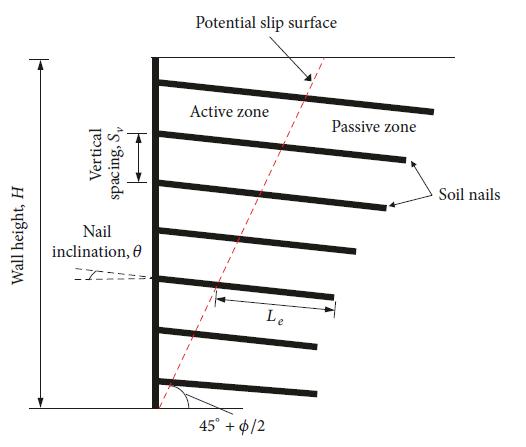
Fig1:Geometryofatypicalsoilnailwall. [4]
Design and implement of systemsofsystemsfor retaining soiland fill that direct to open areas. These rules apply to all bridges, flyovers, railway crossings, and high-fill retaining walls for road embankments. Benefits of resistant soil include increased power for carrying loads with lower compressibility in load. The recommendations do not cover the technical aspects of such applications These recommendations do not include the support for carrying from open spans using RS walls These requirementsdonotapplytoreinforcedsoilconstructions withslopeangleslessthan70degreefromthehorizontal.
Theprocedurescopeincludes,butisnotrestrictedto:
(1) The soil used in its construction, the reinforcementstypeandqualities.
(2) Typesoffacing,fillandreinforcement.
(3) Materialevaluation.
(4) Designtechniques.
(5)Extensive fabrication procedures to meet requirementsRSwallbehaviorandattributes. [3]
According to the idea behind soil nailing, slopes and excavations are stabilized from top to bottom. Soil-nail interactionleadstothegenerationoftensiletensioninsoil nails,which gives soil nails their reinforcing effect against ground deformation. The creation of axial force, which is essentially a tension force, is where the majority of resistances originate. In the past, bending and shear have beenthoughttocontributelittletoresistance.
A slope or excavation becomes more stable as a result of soilnailing.
a)Increasingboththeshearresistanceandtheusualforce influencing the shear plane In the abrasive soil, the plane skidded.
b) In both cohesive and frictional soils, lowering the pushing force along the slip plane. Reinforcement is laid horizontallyor parallel toa graduallyslopein soil nailing. The direction of tensile stress to generate the maximum amountoftensileforce [5].
The following are some of the different kinds of soil nailing:
a) A grouted soil nail is introduced into the hole using either pressure or gravity after nails are initially positionedinthecentreofthedrillhole.
b) Driven nail - These nails are driven immediately followingeachstageofexcavation.
c) Jet Grouted Nails: These composite inclusions are composedofdirtthathasbeengroutedaroundasteelbar in the middle. High frequency nails are then put after vibro-percussiondrivewithhighpressuregrout.
d) Nails that are launched into the ground this technique involves rapidly firing nails into the earth utilizing the launcher for compressed air. This approach is quick, adaptable, and cost-effective. About 320 km/h is the settingspeedforthenails. [5].
International Research Journal of Engineering and Technology (IRJET) e-ISSN:2395-0056
Volume: 12 Issue: 09 | Sep 2025 www.irjet.net p-ISSN:2395-0072
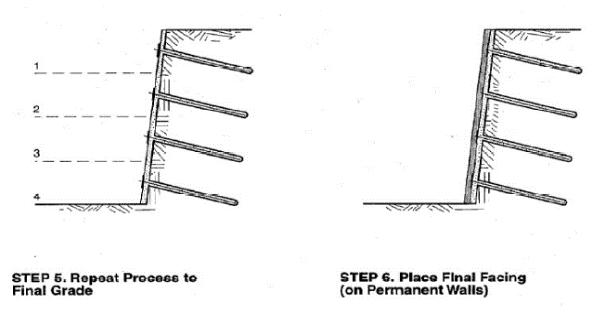
Orderofconstructionforsoilnailing [6]
1.3Main component or element of Soil Nail Wall
(a)ConnectivityElements
(b)ReinforceBars
(c)Grout
(d)Centralizers
(e)Corrosionsecurity
(f)Drainagestructure
(g)Barrageface [7]
Thefollowingisa diagram ofevery major component ofa soilnailwall. :
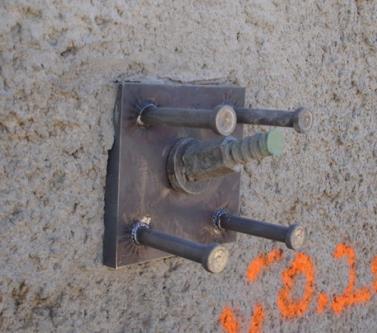
Fig3a:-Solidtendoninaphotographthathasasteelplate, awasher,andnutstudsthatarenotheadedforattachment tothefinalfacing.ThankstoDYWIDAG-System Internationalfortheimage.[7]
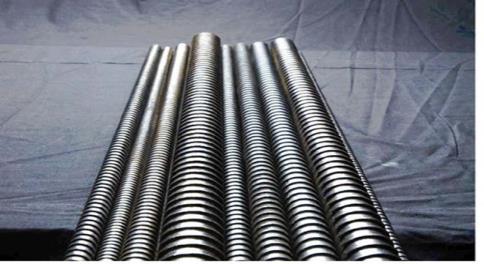
Fig3b:Photo:Solidbarswiththreadswithpermissionof Con-TechSystems,Ltd.[7]
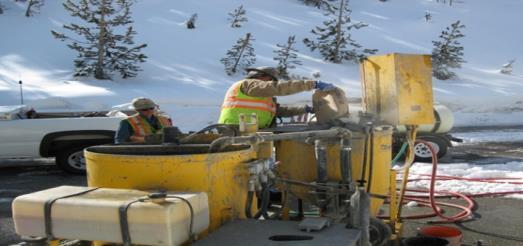
Fig3c:Atypicalgroutingfacility.PictureprovidedbyBarry Siel,FHWA.[7]
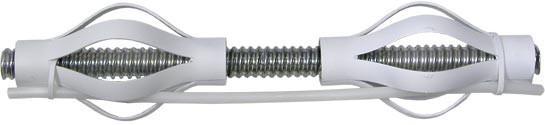
Fig3d:Picture:ThesolidbarisfastenedwithstandardPVC centralizers.(Thecentralizerspacingshownissolelyfor demonstrationpurposes;largerspacingisactually employed.)ThankstoWilliamsFormEngineeringCorp.for thephoto. [7]
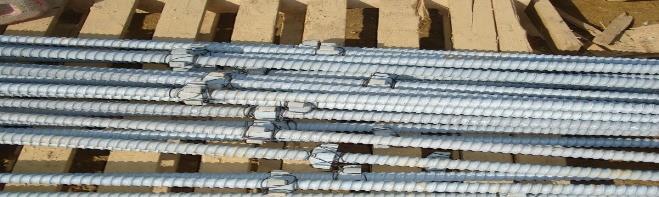
Fig3d:StandardsteelcentralizerswerefittedtotheHBSNs intheimage.ImageprovidedbySchnabelEngineering [7]
© 2025, IRJET | Impact Factor value: 8.315 | ISO 9001:2008 Certified Journal | Page287
International Research Journal of Engineering and Technology (IRJET) e-ISSN:2395-0056
Volume: 12 Issue: 09 | Sep 2025 www.irjet.net p-ISSN:2395-0072
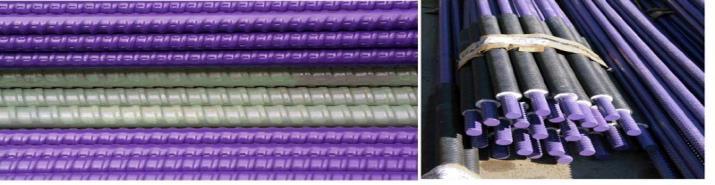
Fig3e:Photo:partialencapsulationbycorrugatedbark (right)andsolidtendonswithagreyorpurpleepoxy covering(left).ThankstoDYWIDAG-SystemsInternational fortheimages [7]
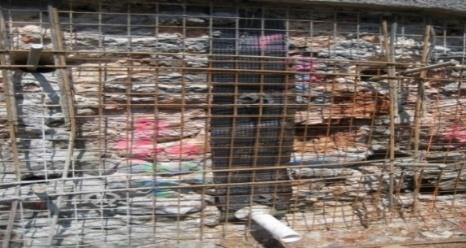
Fig3f: Solidtendonthathasbeenphoto-threadedwitha steelplate,awasher,andanut.studsthatarenotheaded forattachmenttothefinalfacing.ThankstoDYWIDAGSystemInternationalfortheimage.[7]
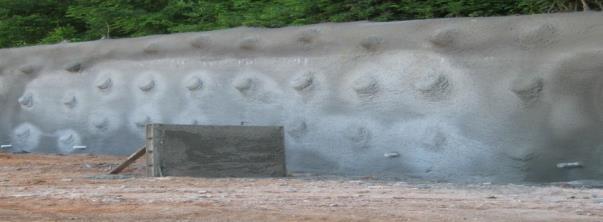
Fig3g:On-siteshotcretetestpanelcuringisshowninthe image.ThankstoSchnabelEngineeringforthephoto.. [7]
Fig3:Maincomponentofsoilnailwall
1.4 Ground Condition
1.4.1 Suited soil
a)Remainingdirtandwornrocks
b)Stiffcohesivesoilsthatareresistanttocreepdistortion, suchasclaysiltandothersoiltypes.
c) Sand and gravel that is dense and has some adhesive qualities.
d)Theelevationofapieceoflandabovethegroundwater table.
1.4.2 Non -Suited
a)Becausetheydon’thaveenoughtimetostandupbefore nailing installation, they should use loose, fine-grained sand.
b) Soils with high moisture content or damp pockets becausetheycompromisestability.
c)Excessive loadsmust be borne bysoils because of their frostsensitivityandexpansivecharacteristics.
d) Rocks that are severely fractured and have voids or openjointsbecausetogroutingissues.
2. MECHANISM OF SOIL NAILING:
Tosupportexcavationinsoilorsoft,wornrock,powerful, inert components called soil wedges are drilled and grouted:
Stresses generated from soil or weathered rock mass deformation contribute primarily to the stabilityofearth-resistantstructures.
Use shear stress (also known as bond stress) along the grout-ground interface to transfer tensileloadstothesurroundingground.
Create resistances that can be anticipated using recognizeddesignprocesses.
To guaranteeadequate, long-term functionality of the system, corrosion prevention must be longlastingandprovable.
Interact structurally with the excavator’s front load testing is done using the recommended procedures.
As per established protocols, routine manufacturing is submitted to QC/QA.[7][10][11][12]
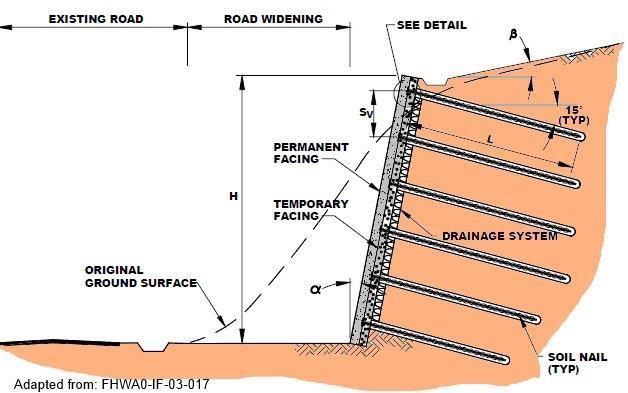
Fig4:Typicalsoilnailwallarrangement[8]
International Research Journal of Engineering and Technology (IRJET) e-ISSN:2395-0056
Volume: 12 Issue: 09 | Sep 2025 www.irjet.net p-ISSN:2395-0072
A dirt nail wall's general construction system entails the following:
a) Divingfortheinitialnails
b) Installinginitial
c) If necessary, add wire mesh or other reinforcement to the first layer of shotcrete thatisputoverthesoil
d) Asoilnailheadplate'ssmoke.
e) Shotcreteconstructioninasecondstage.
f) Toreachthenextearthwedge'slevel,descend, addsomeshotcreteandanotherwedge,etc.
g) Using steps c) through f) repeatedly up until thelastlevelofexcavationisreach.
h) Buildmorepermanentfacingsifnecessary.
In construction, drainage filters and pipelines are frequentlyinstalled.
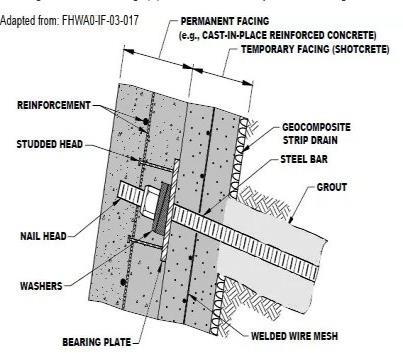
The structure in this paper enables manual users to:
Check structural capacity using AASHTO load factor values “LRFD Bridge Design Specification” (2014)intypicalLRFDequationstyle.
Design soil nail walls using a specially created limit-equilibrium, conventional acceptable stress design (ASD) based computer programme to verify the supposed many in soil nail wall mechanism
Consistofresistancefactorsthatareassociatedto the weight factor in AASHTO (2014) to produce designs that are as conservative as or somewhat more so than designs created using ASD based safetyfactors(FS)asdescribedintoearlieredition ofthisguide.
Include associated permissible boundary states and corresponding resistance components for further earthretaining structures, compatible with, but not identical to those defined in AASHTO (2014), and that are rounded to theclosest0.05. [7] Include resistancecharacteristicsthat are relevant to the bare minimum frequency needed for verificationtesting.
a) Similar to artificial design, LRFD focus on “limitstatedesign”,wheresoundnessorcrash situationistakenintoaccount.
b) Factored load factored toughness, often knownas.
c) Load factors are under control and increase loads, whilst resistance factors decrease toughness.
d) Load and load factor, resistance and resistancefactors.[13]
4.1
Engineering design uncertainty has typically been acceptable stress design (ASD) factors of safety (FS). The allowed “stresses” (or, more generally, resistance) of structural components are determined using the ASD approachbydividingthecomponentsultimatestrengthby FS.Thegeneral designrequirementfortheASDtechnique is:-
∑Qi is the outcome of every joint load operating on a certain structural component under a particular failure scenario.
International Research Journal of Engineering and Technology (IRJET) e-ISSN:2395-0056
Volume: 12 Issue: 09 | Sep 2025 www.irjet.net p-ISSN:2395-0072
Rall is the maximum stress that can be placed on that structuralelement.
Rn is the maximum or ultimate strength of a structural component
FSistheappliedsafetyfactortothatmaximumresistance.
4.2 The LRFD Method (Load & Resistance Factor Design)
IntheAASHTOLRFDBridgeintegratedLRFDapproach
Four categories of limit states are defined in design specifications:
i)Statesofstrengthlimlits
ii)Statesofextremeevents
iii)Statesofservicelimits
iv)Statesfatiguelimits
Strengthboundstatearethosethatpertaintothestrength (usually known as nominal resistance in the LRFD standard, as define later) and stability of structural elementsoverthedesignlifeoftheconstruction.Generally speaking a design equation can be written as follows for eachstrengthlimitstate.
resistances are examples of nominal resistances. The reader should be aware that the terms power (usually usedinASDplatforms)andnominalresistance(oftenused in LRFD platforms) are equal in order to maintain consistency.
The average nominal resistivity of the soil and other naturallyoccurringmaterialsusedinLRFDplatforms.The measurementofclayresistanceisdoneinthegroundorin alab. [7][9]
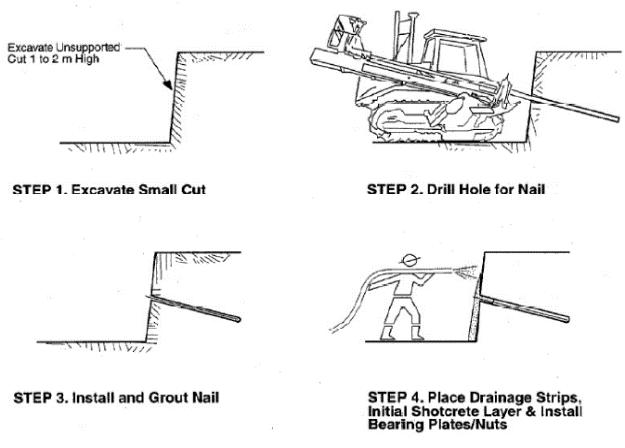
The key steps for building an earthen wedge wall are as follows:[14]
1) Digger
2) Nail-holedrilling
3) Settingupnailsandgrouting
4) Settingupastripdrain
5) Thecreationofnewlevels
6) Constructionoffinalfacing.[14][15]
6.1 Resistance factor:
Therearenumerouswaystocheckforresistanceelement. The most complex calibration methods rely on reliable statistical data and use the right statistical methods, and produce a system-wide level of reliability that is acceptable. However, as stated in NCHRP Report 701, thereare a number of obstaclestocreatinga uniform and comprehensivedatabaseforsoilnails. [16]
Where:-
Rn is nominal struggle of a specific structural element to theassumedstrengthlimitcondition
ØisaRn–relatednon-dimensionalresistancefactor
Qiisthei-thweighttypeinvolvedinthisboundsituation
γiis aQi-relatednon-dimensionalloadfactor
ηiisfactorforweightadjustment
Nisthevarietyofloadtypemustbetakenintoaccountat thelimitstate
Thetendons'yieldstrength,theearth'sshearstrength,the addition resistance of the soil nails, and numerous facing
Inthatstudytherecordofsoilnailloadtestingwasusedto adjust the resistance factor for soil nail pull out. Data inconsistencies,alackofinformationabouttheinstallation processes for soil wedges poor load test paperwork and other shortcomings in the load testing were found. Most importantly, none of the load tests applied enough pressuretomaximisethetestfingernailpulloutresistance. Due to these resistance factors based on reliability was achieved. [7]
It is necessary for structural design to take into account the immediate incidence of several consignment type in load combination. The following load combinations are frequently taken into account for clay wedge design in publicroadprojectsusingtheLRFDstructure
StateofrepairLimit
International Research Journal of Engineering and Technology (IRJET) e-ISSN:2395-0056
Volume: 12 Issue: 09 | Sep 2025 www.irjet.net p-ISSN:2395-0072
StageIpowerLimit
Extreme-Even Limit State I (including the earthquakeload)
There are permanent transitory and peak incident loadsamongtheloadcombinationslistedabove.These loadsassignedloadfactorsare:
Dead loads from structural elements and nonstructuralattachments(DC)
Deadloadsfrom worn surfaceandutilities(DW), while sustaining a connection abutment or the road;anddeadloadsfromutilities.
Vertical forces brought on by the dead load from earthfill(EV)
Earthpressureload(EH)
Earthsurchargeload(ES) [7][9]
Thefollowingformulasforreinforcedconcretedesignare usedtoestimatethebendingresistances
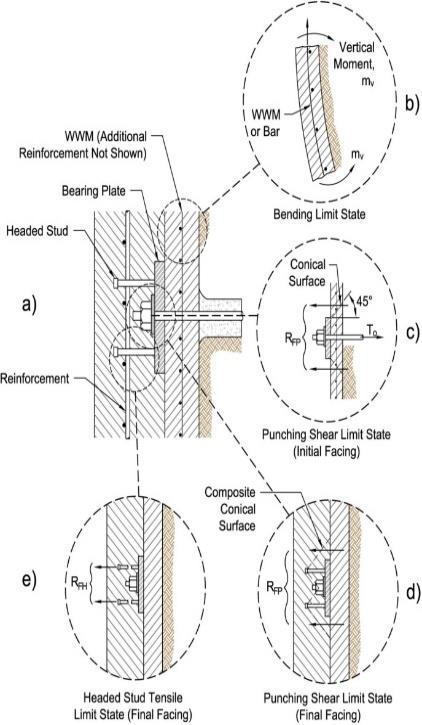
Fig6:Limitthedirtnailwall'ssides.thetensionofthe headedstud;thetendencyofafacingsegment;thepunch
shearintheinitialopposite;thepunchshearinthefinal facing;and(a)atypicalfacingscheme [7]
For the initial face, a normalised section of reinforced shotcreteorthickconcrete(orthickhfforthefinalfacing) is used schematically depicted in the figure, with the reinforcement in the centre of the section. WWM alone or in combination with rebar can be used as reinforcement. The height of hi (or hf) will be represented by the thickness.
According to the reinforced concrete design, a similar beam can withstand pure bending. The figure show the instant per unit length (mv) rotating along a horizontal axis [7]
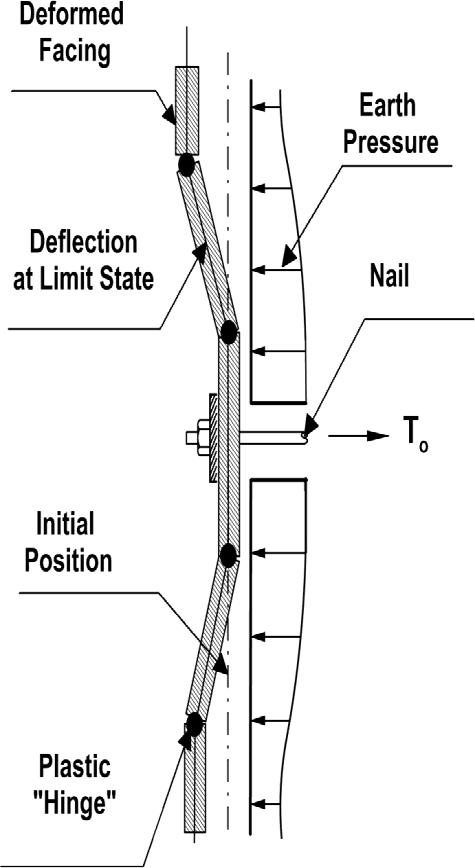
Fig7:IllustrationBendingmechanismandnailforcein facing.[7]
Following are the three possible causes of soil nailing failure:
a) A face failure:- When a soil nail wall with long nailsthathavebothhighandlowtensilestrengths collapses, it results in this type of failure. when a failure undermines the active region's ability to remain stable., the strength of the head will emerge.
International Research Journal of Engineering and Technology (IRJET) e-ISSN:2395-0056
Volume: 12 Issue: 09 | Sep 2025 www.irjet.net p-ISSN:2395-0072
b) Pull-out failure:- This occurs when the strength and tensile capacity of the soil nail are high, as well as restricted penetration into the passive withstandarea.Theforceproducedbythenailsin the active zone will depend on the length of the reinforcementinthepassivezone,andthisforceis expressedas.
Q = πqDDH
DDH stands for the effective diameter of the nail hole, Q for the mobilised pull-out per unit length, andQforthemobilisedshearstressactingonthe vicinity of the soil nail. By consider a only nail section that is subject to a tensile strength, T0, at one stop and applying a balance of forces along thedegreeofdifference lengthsection(Dx)ofthe nail, it is possible to determine the tensile force fromtheinterfaceshearstress:
dT=p qDDHdx = Qdx
Theanticipatedtotalpull-outforce(F)isgivenas followsifthepassiveregion'ssoilnail'simplanted lengthisLP:
F = Q.LP
c) Nail tendon Failure:- Failure of the nail tendon happens when there is enough nail length but a littleamountoftensilestress.[5]
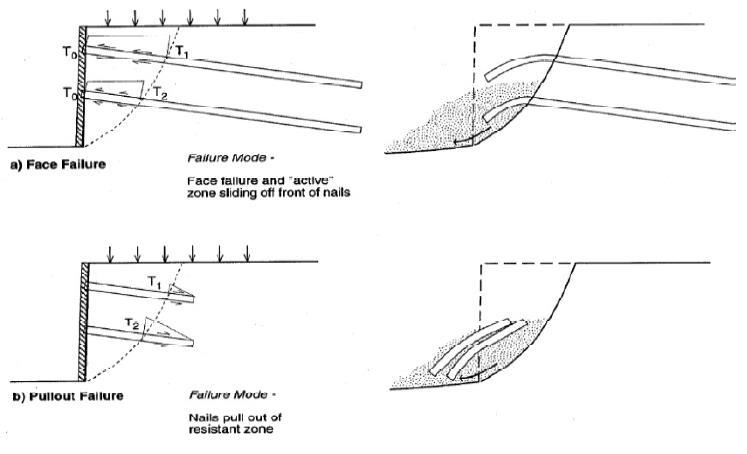
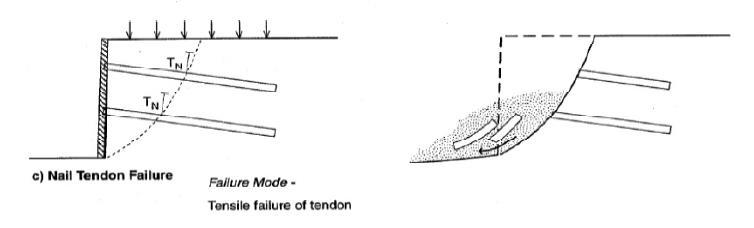
The suggested closed-form result is used to calculate the resistance factor (2017) by Bathurst et al. The approach bias statistics the relationship between the nominal load and resistance terms as well as the uncertainty in the nominal load and resistance terms' amounts for various combinations of load and resistance models, method bias values,anddependencebetweennominalstandardsareall taken into consideration in the method for calibrating resistance factors. Closed-form solutions also offer the advantage of simplifying the calculation of resistance factors using an Excel spreadsheet and the evaluation of the pressure of method bias and input limitation variability on the final resistance factor values[7][18][19]Soil wedges are passive additions that increase the soil's ability to withstand shear. Zones that are active and passive can be seen in the soil-nail system. The active zone becomes distorted during slope collapse, whereby the soil nails positioned across the slip plane experienceaxialdisplacement.Thesoilwedgeexperiences tensile pressures as a result. a passive zone that prevents the active region's deformation. This tension causes an increase in force reduces the driving shear force and the normalforceonthefalljet Therubbingofdirtandnailson theslopeispreventedbyclaynailsinsertedinthepassive zone [5]
8.1
1.Becausethismethodcreatesdynamicfrictionresistance with ground deformation, it cannot be employed in situationswherestrictdistortioncontrolisnecessary.
2.Forsoilnailing,sandandgravelmightnotbesuitable.
3.Areaswithhighwatertablesshouldnotbeused.
4. Extremely high soil nail densities may be necessary for soilnailinginsoilswithverylowshearstrengths.
International Research Journal of Engineering and Technology (IRJET) e-ISSN:2395-0056
Volume: 12 Issue: 09 | Sep 2025 www.irjet.net p-ISSN:2395-0072
5.Forlong-term,permanentapplications,soilnailingisnot advisedinexpansivesoilsandsensitivesoils.[5][20]
Thefollowingaresomebenefitsofadirtnailwall:
• Simple adjustment of soil nails while dealing with piles andotherundergroundobstructions.
• Lessens the impact on the environment and the disruptionoftraffic.
•Thequickconstructioncouldbetoblame.
• Affordable at difficult-to-reach places and distant regions.
•Successfulinrestoringlandslidesthataren'tontheslide trail.
• Fairly adaptable, allowing for both large aggregate and differentialmovements.
•Itfunctionsflawlesslyunderearthquakeloading.
Due to the greater redundancy than ground anchors, a passive system with relatively moderate tensile stresses exerted by the reinforcing elements, a well-established constructionqualityassuranceprogramme,andthehigher densityofreinforcingcomponentsperunitarea.
• More affordable than conventional earth retaining systemsforlengthsofover15feet.
• Ground anchors are typically equally as cost-effective as walls,ifnotmoreso.
Soil nailing is most commonly used for new building projects, including foundation excavation and slope stabilisation,bothtemporarilyandpermanently.Giventhe currenteconomictrends,itismostlikelythatthisindustry in India will be where nailing finds its most widespread use. The technology is equally useful for a variety of corrective tasks. It is envisioned that practical research collaboration between industry, universities, and governmentwillsupportthedevelopmentoftechnologyin India,muchlikeitdoesindevelopednationslikeGermany, France, It is most likely that this industry in India will be wherenailingfindsitsmostwidespreaduse. [20]
1) An all-inclusive technique for this work presents resistance factor calibration for nail pullout and tensile yieldstrengthofsteelbar(nailtendon)limitstates
2) Resistance factors were created utilising a number of load and resistance model combinations for the load and resistance factor design of nail pullout and tensile yield strengthlimitstates.
3) For the two cases, the resistors were calibrated for targetreliabilityindicesof2.33to3.54andloadfactorsof 1to2.Onemethodinvolvesdirectlyestimatingemploying the Hong Kong CDG and CDV soil characteristic data, the uncertainty in the nominal load and resistance values at thetimeofdesign
The second method, which was founded on the idea of understanding level, employed a more expansive definition of nominal load and the coefficient of variation ofnominalresistance
4) The calibrated resistance factors for the nail pullout limit state utilising the current load and resistance model were typically greater than 1.00 due to the model's inherent conservatism. The resistance factors were ascertained using the modified model. For the nail tensile yield strength limit condition, the expected resistance factors were all less than 1.00. An example design for soil nails supporting a 10-metre-high wall in Hong Kong CDG soil was used to show how calibrated resistance factors are implemented in the LRFD framework using various combinationsofloadandresistancemodels.
5)Theresistancefactorsintheexampledesignweresetto 1.00inordertomeetthesuppliesoftheLRFDdevisecode. The plan outcomes showed that the enhanced load and resistance model, combined with longer largely lengths of soilspikesandminorsteel bardiameters,provided better solutionsthantheexistingloadandresistancemodel.
6) This stresses the benefit of refining weight and resistance models for soil nail wall inside stability devise by empirical modification, as established in other related works.LRFDisasubsetofreliabilitytheory-basedanalysis and design, as described in the introduction. LRFD provides the designer with straightforward boundarystate equations for foundation design issues, including soil-structureinteraction.
7) Since the true margin of safety is unknown, there are fewer possibilities for the designer to further optimise
International Research Journal of Engineering and Technology (IRJET) e-ISSN:2395-0056
Volume: 12 Issue: 09 | Sep 2025 www.irjet.net p-ISSN:2395-0072
plan choices or possibly adopt a better boundary of security than that suggested by this learn or the one used todetermineresistancefactors.Thesamedata,model,and examplefromthisstudywereusedbyLynn,anLRFDcode writer, to offer a reliability-based devise (RBD) advance fordirtnailwalls.
8) Even though this research focuses on the resistance side, LRFD calibration was performed using Hong Kong soilnaildata;however,load-sidemodelsaremorebroadly applicable.
9)Asaresult,theresistancefactorsfoundforCase2inthis study may be used as default values for initial design purposesifthedesignerisconfidentthatthesoiltype,nail type,andinstallationmethodwillbereasonablysimilarfor subsequentprojects.
10) The similar is true of the determined tensile bound state resistance factors in this article. In a perfect world, load and resistance bias data from the same type of structure and for the same ground conditions would be used to calibrate any basic soil-structure boundary states. To the authors' knowledge, there is currently no information available regarding the contributions from loadandresistancetothetwolimitstatesexaminedinthis study. The LRFD calibration approach suggested in this research can be used with a variety of nail and soil type combinations if matching load and resistance data are supplied
[1]. Rabejac.S,andToudic.P,“Constructionofaretaining wall between Versailles-Chantiers and VersaillesMatelots”,Revuegénéraledescheminsdefer,French railwayreviewno.93,pp.232–237,1974.
[2]. Stoker. M, Korber. G, Gassler. G, and Gudehus. G, Soil nailing.International Conference on Soil Reinforcement.Paris, France, Vol. 2, p. 469–474, 1979.
[3]. Guideline for Design and construction of reinforced soilwalls,INDIANROADCONGRESS2014.
[4]. Huifen Liu,1Liansheng Tang,1,2 and Peiyuan Lin3, Maximum Likelihood Estimation of Model Uncertainty in Predicting Soil Nail Loads Using Default and Modified FHWA Simplified Methods, Hindawi Mathematical Problems in Engineering Volume 2017, Article ID 7901918, 14 pages https://doi.org/10.1155/2017/7901918
[5]. ArindamDey,IssuesandAspectsofSoilNailing,QIPSTC on Challenges and Recent Advances in Geotechnical Engineering Research and Practices IIT Guwahati2015.
[6]. Byrne, R. J., Cotton, D., Porterfield, J., Wolschlag, C. andUeblacker,G.(1998)“SoilManualfordesignand construction monitoring of soil nail wall” Manual of the Federal Highway Administration Division, No.FHWA0-SA-96-069R.
[7]. Carlos A. Lazarte, PE, PhD, GE; Helen Robinson, PE; JesúsE.Gómez,PhD,PE;AndrewBaxter,PE,PG;Allen Cadden, PE*; Ryan Berg, PE†, GEOTECHNICAL ENGINEERING CIRCULAR NO. 7 SOIL NAIL WALLSREFERENCE MANUAL, National Highway Institute ,U.S. Department of Transportation Federal Highway Administration,Washington,DC20590(2015).
[8]. (https://www.deepexcavation.com/en /products/snail-plus-soil-nailingsoftware/design-ofsoil-nail-wallsinformation,2022),DesignofSoil Nail Walls–Information
[9]. AASHTO(2014).“LRFDBridgeDesignSpecifications,” 7th Edition, American Association of State Highway andTransportationOfficials,Washington,DC.
[10].Sabatini, P.J., Pass, D.G., and Bachus, R.C. (1999). “Ground Anchors and Anchored Systems,” Geotechnical Engineering Circular No. 4, Report No. FHWA-IF-99-015, Federal Highway Administration, Washington,DC.,281p.
[11].Sabatini, P.J., Bachus, R.C., Mayne, P.W., Schneider, J.A., and Zettler, T.E. (2002). “Soil and Rock Properties,” Geotechnical Engineering Circular No. 5, Report No. FHWA-IF-02-034, Federal Highway Administration,Washington,DC.
[12]. Sabatini, P.J., Tanyu, B., Armour, T., Groneck, P., and Keeley,J.(2005).“MicropileDesignandConstruction. Reference labouring forNHI Course132078,” Report No. FHWA-NHI-05-039, Federal Highway Administration,Publication,Washington,DC.
[13].Structural Design II,J.S. Arora/ Q. Wang, LoadandResistFactor.doc(2022).
[14].FHWA.2015,GeotechnicalengineeringcircularNo.7 soil nail walls. Reference manual, Federal Highway Administration, Washington, D.C. Report FHWA0-IF03-07,2015.
International Research Journal of Engineering and Technology (IRJET) e-ISSN:2395-0056
Volume: 12 Issue: 09 | Sep 2025 www.irjet.net p-ISSN:2395-0072
[15].Prashant-C.Ramteke1,2*,Anil-kumar sahu1,Slope Stability Analusis of Soil nailed Structure by using ASDAnd LRFD Methods, international Advanced research Journal in Science Engineering and TechnologyVol.9,Issue2February2022
[16].Lazarte, C.A. (2011). “Proposed Specifications for LRFD Soil-Nailing Design and Construction,” NCHRP Report 701, Transportation Research Board, Washington,DC.
[17].Lazarte, C. A., H. Robinson, J. E. G´omez, A. Baxter, A. Cadden, and R. Berg. 2015. Geotechnical engineering circular No. 7: Soil nail walls, Reference manual.US Department of Transportation Publication No. FHWA-NHI-14-007.Washington,DC:FHWA.
[18].Lin, P., R. J. Bathurst, S. Javankhoshdel, and J. Liu. 2017a. “Statistical analysis of the effective stress method and modifications for prediction of ultimate bondstrengthofsoilnails.” ActaGeotech.12(1):171 182.https://doi.org/10.1007/s11440-016-0477-1
[19].GEO (Geotechnical Engineering Office). 2008. Geoguide 7: Guide to soil nail design and construction. GEO Rep. No. 197. Hong Kong: GEO, Civil Engineering and Development Dept., The GovernmentoftheHongKongSpecialAdministrative Region.
[20].PiyushSharma,THEORETICAL ANALYSIS OF SOIL NAILING: DESIGN, PERFORMANCE AND FUTURE ASPECTS