


International Research Journal of Engineering and Technology (IRJET) e-ISSN:2395-0056 p-ISSN:2395-0072
Volume:12Issue:04|Apr2025 www.irjet.net
International Research Journal of Engineering and Technology (IRJET) e-ISSN:2395-0056 p-ISSN:2395-0072
Volume:12Issue:04|Apr2025 www.irjet.net
G. Krishna Lohith¹, K. Varshith Reddy², P. Mounisha Reddy³, Viyyapu Lokeshwari Vinya⁴
¹²³UG student, Dept. of Computer Science and Engineering, Vardhaman College of Engineering, Telangana, India
⁴Assistant Professor, Dept. of Computer Science and Engineering, Vardhaman College of Engineering, Telangana, India
Abstract- NLP-Based Resume Analysis, Skill Enhancement & Job Automation uses NLP to extract the text and is analyzed to help users provide insights. It suggests users some skills to work onand some course recommendations which helps himlevel up. Through resume matching with job descriptions, NLP is able to detect skill gaps and suggest tailored training programs to improve candidates’ qualifications and make them more hireable. In this paper, we examine a few contemporary methods for screening automated resumes. To increase the precision and effectiveness of the screening process, these approaches employ a variety of methods including hybrid deep learning frameworks, transfer learning, genetic algorithms, and multisource data. Also, some research investigates the use of job descriptions to improve resume screening precision. This technology helps recruiters reduce the workload, it helps simplify the recruiters work and find the person that matches their criteria. NLP does more than just analyzing resumes. It helps the job automation with real-time suggestions and resume optimization assistance along with candidate matching to suitable job positions. AI-powered chatbots and virtual assistants can suggest resume improvement, suggest certificates,andhelpcandidatesinapplying.
Keywords: Natural language processing, Real-Time Optimization, Personalized Upskilling, Virtual Career Assistants,ResumeRecommendation,SkillGapAnalysis, Job Matching Algorithms, Resume Parsing Techniques, Recruitment Process Automation, Virtual Career Assistants
In today’s rapidly evolving tech driven world, traditional methods are no longer followed. However, the current system often requires candidates to manually enter all resume details, leading to no match in between job requirements and candidate skills. Generally with thousands of resumes per job posting, manualanalysisisnotpossibleforrecruiters,leadingto no satisfaction amongcandidatesandfacingchallenges in finding the right job. To address this, innovative

recruitment platforms utilize machine learning and Natural Language Processing (NLP) techniques for efficient resume parsing and matching. By categorizing resumes and job postings, these platforms reduce time complexities and improve accuracy using methods like Content-based Recommendation, cosine similarity, and KNN. However, effectiveness is not an issue as time consumption is the main issue. One proposed solution involves segmenting resumes based on sections and employingNLP fordataextraction,improvingefficiency.
Resume Parser and Analyzer tools further streamline the process by structuring unstructured resumes, extracting essential fields, and suggesting improvements. This not only savesrecruiterstime butalsoprovidesapplicantswithinsights into their resume’s standing and areas for enhancement. Moreover, by allowing only the recruiter to access matched results, confidentiality is maintained, and the most qualified candidates are efficiently identified. This intelligent-based approach aims to optimize the recruitment process, benefiting bothrecruitersandjobseekersalike.
Kondapalli Sai Pranay wrote “Resume Screening using Natural Language Processing and Machine Learning” which appeared in International Journal of Current Technology and Engineeringduring2020.Thepaperdemonstratesanapproach which utilizes NLP alongside machine learning to perform resumescreeningoperationsandjobdescriptionmatching.
The 2019 publication by Shweta Agrawal and Sumit Gupta entitled “Automated Resume Screening System Using Machine Learning and Natural Language Processing” introduced an evaluation system for resumes based on their job requirement fit through the combination of these technologies within the InternationalJournalofInnovativeTechnologyandExploratory Engineering.
Aditi Kaushik and Shruti Jain released “A Comprehensive Analysis of Resume Screening Techniques” in the International Journal of ComputerScience and MobileComputing during

International Research Journal of Engineering and Technology (IRJET) e-ISSN:2395-0056 p-ISSN:2395-0072
Volume:12Issue:04|Apr2025 www.irjet.net
2018 for extensive resume screening methodology evaluation.
Pradeep Kumar Mishra and Sanjay Kumar released their research titled “Resume Parsing and Analysis Using Natural Language Processing” during 2017 through the International Journal of Innovative Research in Computing and Communication Engineering. The researchers of this study showed how Natural Language Processing methodologies work to retrieve significant information from professionalresumes.
The paper “Automatic Resume Filtering Using Machine Learning” appeared in the International Journal of Engineering and Technology during 2016 through authors Anindya Sarkar and Debajyoti Mukhopadhyay. An algorithm basedonma-chinelearningwasanalyzedin thispublication to enable auto- mated resume assessment through which potential candidates were ranked according to their job descriptioncompatibility.
Recruiters together with human resource managers conductmanualresumescreeningthatevaluatesapplications usingqualificationsalongwithexperience andothercriteria. The current suite of software includes Taleo as well as Jobscan among its members. The recruitment system Taleo operatesthroughcloudinfrastructuretoanalyzeresumesbefore choosing top applicants matching job requirements by AI-drivenalgorithms.Thissystemprocessesresumesthrough naturallanguageprocessingandmachinelearningalgorithms whichmeasuretheirconnectiontojobdescriptioncontent.
JobscanoperatesasaninternetplatformwhichutilizesATS (Applicant Tracking System) technology for resume evaluation against particular job descriptions. A job description comparator evaluates keywords and skills data tomeasurethesuitabilitybetweenresumesanddescriptions. Current resume screening tools maintain pre-set algorithms and criteria which fail to provide suitable matches for particular job roles in specific industries. Several inaccurate interpretations from the examination cause hiring organizations to select candidates lacking necessary qualifications.
Many resume screening tools analyze only a few basic elementssuchaskeywordsmatchedwithexperienceperiods withouttakingnecessaryindicatorsofcandidateperformance into account. The resume processing algorithms generate imprecise analysis output because their data retrieval is affected by formatting problems and inconsistent data formats. The resume screening process does not furnish enough contextual understanding of applicant qualifications whichleadstoincorrect evaluationresults.
The developed system uses intelligent methods to extract significant featuresfrom jobpostingsand resume content
beforeconvertingthisinformationintostructuredvectorsetsof fixed length. The system uses cosine similarity computation to determine how well candidate qualifications match job description requirements. The similarity scoring method offers a refined data-based process to evaluate applicant- job compatibility that goes past simple keyword matching. The primary goal of this procedure focuses on bettering the accuracy together with reliability of applicant assessment operations. The methodology reduces human biases that can exist in manual review processes which ensures fair and unbiased talent selection throughout the recruitment process. The platform ensures hiring efficiency together with superior candidate experience by allowing appropriate candidates to progressthroughtheselectionprocess.
The system extracts contextual information effectively while italsointerpretswordmeaningtoachievebetterunderstanding ofgenuinehiringcandidateintentions.Advancedpattern-based candidate identification depends on semantic relationship analysesperformedby algorithmsforgeneratinghighlyprecise outcomes. The evaluation capabilities of NLP for recruitment allow for hundreds to thousands of resumes to be critiqued rapidly. NLP provides extreme scalability that eliminates both the time and expenses involved in manual resume analysis leading to enhanced efficiency for the recruiting process. The system produces decisions quickly for recruiters who maintain evaluationqualityofcandidates.
These assessment systems use skill analysis algorithms to evaluate candidate aptitude against standard work requirements for recruiting better candidates. The advanced selection system excels in its vacancy matching process which selects professional candidates for available positions above standard keyword matching. During the analysis phase of NLP organizations fully control the management of multiple differentlinguisticinputformats.Theevaluationsystemsenable organizations to analyze multilingual resumes which in turn makes their candidate searches more inclusive through the selection of candidates beyond mere language boundaries. Throughoutevaluationallcandidatesareassessedusingflexible linguistic criteria independent from the checks they originally learnedtheirlanguage.
The PDF extracting process startsby automaticallyobtaining PDF-formatted resumes from users. The system begins automaticdocumentcontentextractionafteranuploadthrough an interface that does not demand any manual intervention duringthisfirststageofdata collection.Afterdata retrieval the text extracting module starts its operation to transform unstructured content into organized text data. Raw text data obtained from extraction serves as basis for following tasks in natural language processing like making customized recommendation systems and finding essential characteristics in resumes. The system applies the processed text as its next steptoretrieveessential personalandprofessional data. The
International Research Journal of Engineering and Technology (IRJET) e-ISSN:2395-0056 p-ISSN:2395-0072
Volume:12Issue:04|Apr2025 www.irjet.net
system analyzes full names and extract contact details and email address along with phone number and skills list. Data structure optimization enables the system to perform both resume analysis with intelligence and accurate candidate profile generation. After information extraction from users the system examines their current skill expertise to deliver Personalized career suggestions as well as skill recommendations.
Along with advising about careers the system presents specialized courses and certification opportunities to users. Free and paid learning suggestions are selected from the system based upon the skills which the user demonstrates. UserswhodemonstrateMachineLearningexpertisewouldbe directed toward premium learning materials at high-quality levels that both build their professional qualifications and boosttheirmarketvalue.
Multiple user data input enables a purpose-built analytics module to be implemented into the platform structure. The module employs pie chart visualizations to show aggregated metrics about user statistics as well as skill patterns and important dataset data points. An administrator can use accessible visualizations to understand user patterns across theuserbasefordecisionmaking.
The key operational strength of this system originates from its sophisticated language-processing capabilities that efficiently connect resumes with suitable job descriptions. The system extracts vital resume elements about skills and experience along with contact data which enables it to produce appropriate role recommendations and career advancementpathwaysandlearningopportunities.
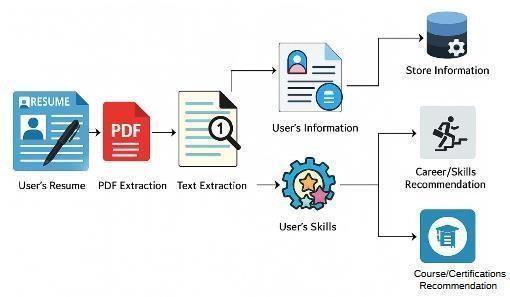
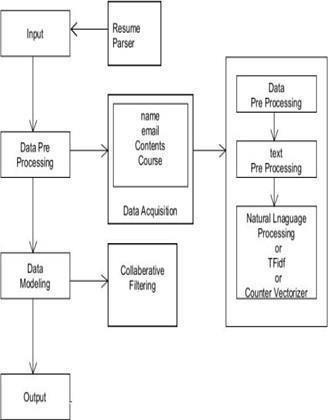
End-to-EndArchitectureoftheProposedSystem
Thesystem will recommend appropriatecareerchoices aswell as necessary tools and advancing technologies to a user who demonstrates Machine Learning expertise. Through individualized guidance users acquire knowledge about their specialist growth opportunities together with potential specializationoptions.
OurimplementationofCareerBoost,anNLP-basedsystemfor resume analysis, skill enhancement, and job automation, demonstrated significant functional capabilities and practical applications. This section presents the key outcomes achieved throughourapplicationdevelopmentandvalidationprocess.
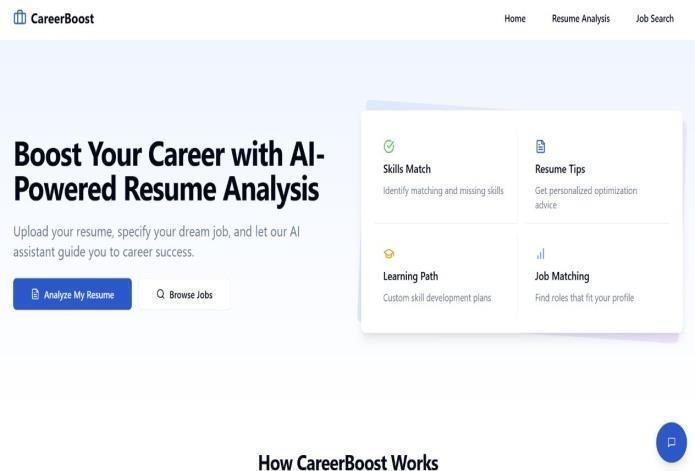
The developed web application features an intuitive interface with three primary components: Home, Resume Analysis, and Job Search (Figure 3). The dashboard presents four core functionalities: Skills Match, Resume Tips, Learning Path, and Job Matching. This design reflects our focus on a streamlined user experience that guides job seekers through the resume optimizationprocess.
Volume:12Issue:04|Apr2025 www.irjet.net
International Research Journal of Engineering and Technology (IRJET) e-ISSN:2395-0056 p-ISSN:2395-0072
Thesystemsuccessfullyimplementsastructuredworkflow forresume evaluation.Usersuploadtheirresumedocuments and specify target job roles (Figure 4), triggering the NLPbased analysis process. For our test case using a front-end developer position, the system effectively categorized identifiedskillsintothreedistinctgroups(Figure5):
1) Matching Skills: Competencies already present in the candidate’sprofile
2) Missing Skills: Critical competencies required for the target role but absent from the candidate’s resume (including HTML, CSS, JavaScript, React, Angular, Vue.js, Responsive Design, Web Accessibility, Version Control,Testingframeworks,andUI/UXprinciples)
3) Less Relevant Skills: Abilities possessed by the candidate but less applicable to the target role (including C#, Go,AI,andiOSdevelopment)
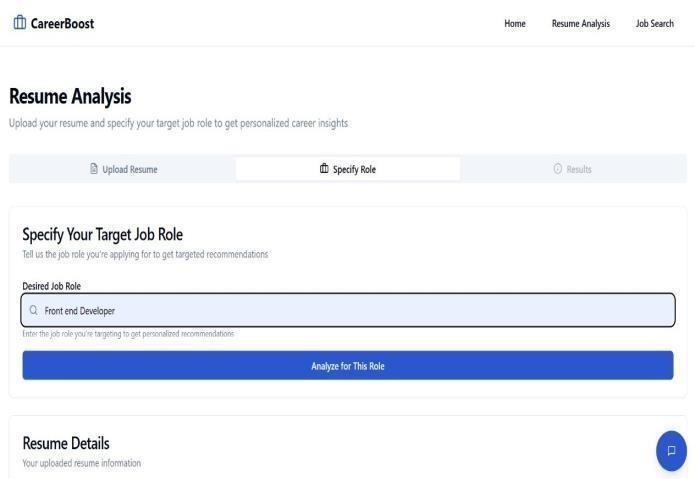
Fig-4: Resumeuploadandjobrolespecificationinterface
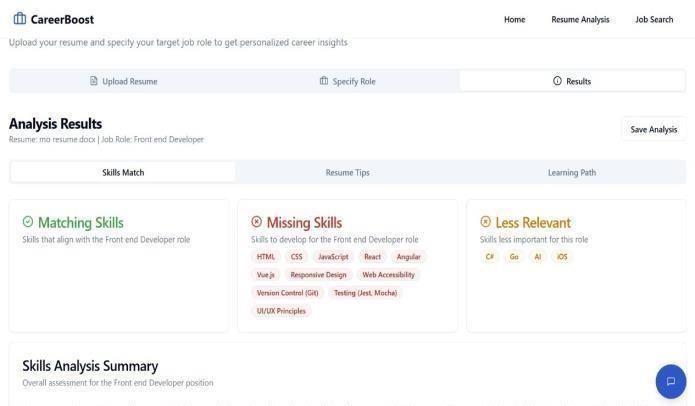
SkillsanalysisresultsforFront-endDeveloper position
This categorization demonstrates the system’s capability to perform contextual analysis of resume content against role- specific requirements, achieving one of our primary researchobjectives.
The application generates detailed, section-specific recommendations for resume enhancement (Figure 6). These suggestions are tailored to the target role and the candidate’s existing qualifications. For our test case, recommendations included:
1) Rewriting the summary section to emphasize relevantfrontendskills
2) Addingfrontend-relatedcertificationsandcoursework
3) Quantifyingachievementsintheexperiencesection
4) Highlighting transferable skills for candidates transitioningtofrontenddevelopment
5) Restructuring the skills section to prioritize rolerelevanttechnologies
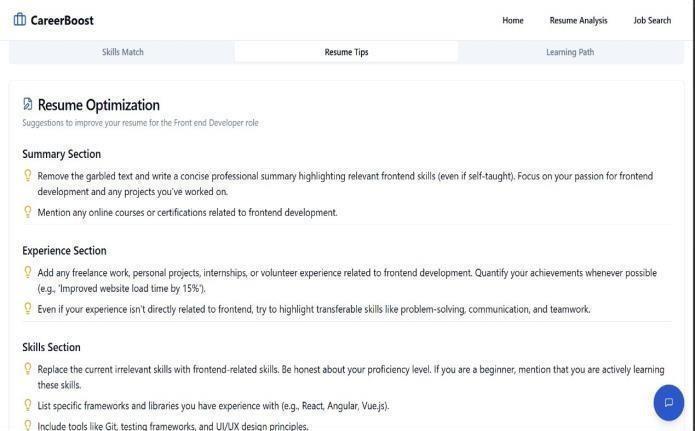
Fig-6: Resumeoptimizationrecommendationsbysection
International Research Journal of Engineering and Technology (IRJET) e-ISSN:2395-0056 p-ISSN:2395-0072
Volume:12Issue:04|Apr2025 www.irjet.net
These contextual recommendations demonstrate the system’s capacity to provide actionable guidance beyond simpleskillidentification.
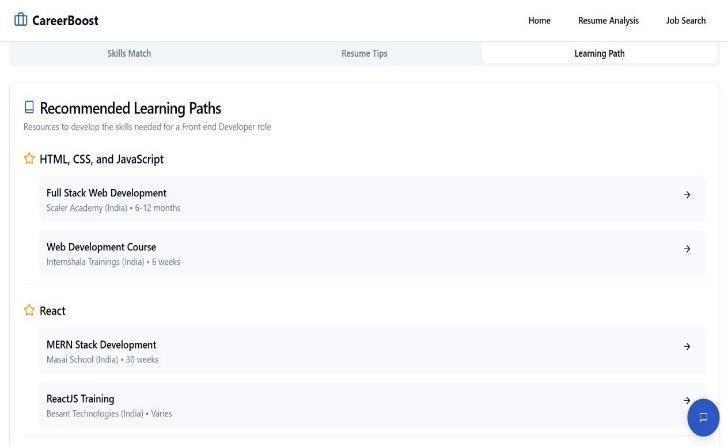
For identified skill gaps, the system generates customized learning recommendations (Figure 7). For frontend development skills, the application suggested relevant trainingprogramscategorizedbyskillarea:
1) HTML, CSS, and JavaScript fundamentals: Courses from ScalerAcademy(6-12months)andInternshalaTrainings (6weeks)
2) React framework: MERN Stack Development from Masai School (30 weeks) and ReactJS training from Besant Technologies
The learning path component effectively bridges skill gaps by connecting candidates with appropriate educational resources,fulfillingourskillenhancementobjective.
4.5 AI-Powered Conversational Assistance
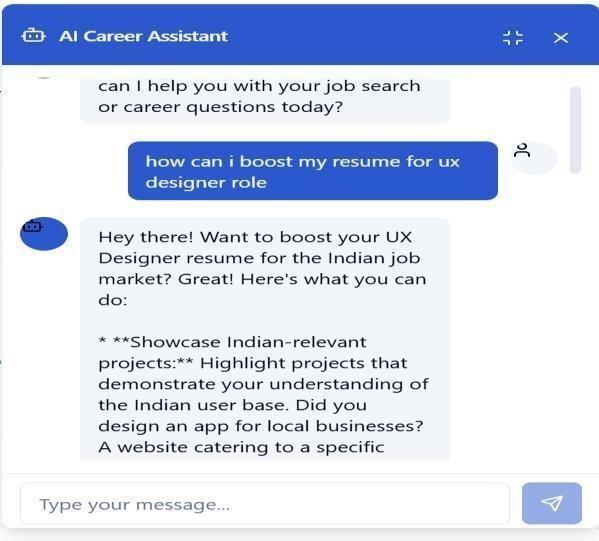
The system incorporates an AI career assistant (Figure 8) that provides conversational support for job seekers. Users can ask specific questions about resume optimization for different roles, receiving contextual advice. For example, when prompted about UX designer resume improvements, the assistant generated market- specific recommendations emphasizinglocallyrelevantprojectsandexperiences.
The job search functionality (Figure 9) demonstrated effective integration with multiple employment data sources (Indeed, Internshala, and TimesJobs), returning roleappropriate listings based on user qualifications. For a test search of “UX designer” positions in Hyderabad, the system returned 27 relevant opportunities, complete with salary information, company details, posting dates, and required skills.
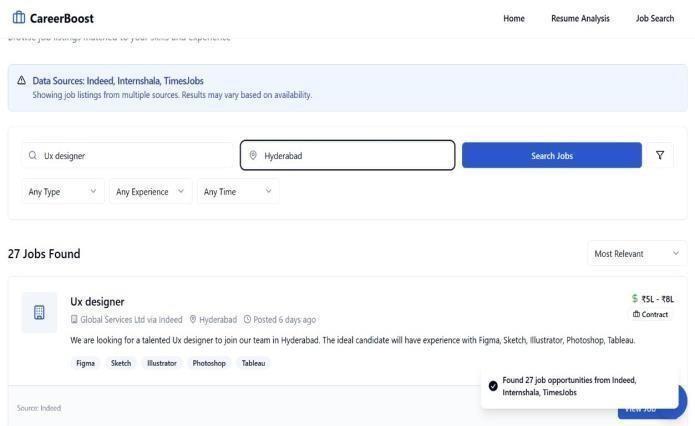
Fig-9: Integratedjobsearchresultsfrommultiple sources
These results validate the effectiveness of our integrated approach to resume analysis, skill enhancement, and job search automation through NLP techniques. The system success- fully addresses the key challenges identified in our research objectives by providing end-to-end support for job seekersthroughouttheircareerdevelopmentprocess.
International Research Journal of Engineering and Technology (IRJET) e-ISSN:2395-0056 p-ISSN:2395-0072
Volume:12Issue:04|Apr2025 www.irjet.net
Fundamentally The Intelligent Resume Analyzer platform uses complex modeling systems together with analytical approaches. The platform uses top-level natural language processing functionality and machine learning capabilities to provide valuable feedback about resumes to candidates who wish to improve their targeting qualities. The system works as an essential link between recruiters and candidates to reduceasignificantamountofmentaleffortthatdigitalhiring usually requires. The platform provides automated reference along with document organization for resume material that greatlyacceleratesrecruitingprocedures.
This initiative intends to disrupt the rapidly evolving recruitmentmarketplacebyofferingabasicATSfunctionality even though it operates as a scaled-down ATS solution. The system changes conventional resume evaluation by using language- processing technology together with automatic parsing tools to analyze documents. The main purpose is to develop an autonomous web application which extracts competencies and user characteristics and educational information from uploaded files without requiring direct humanHRinvolvement.
The system creates decision-making optimizers and candidate selection enhancers by applying demand against role requirements to produce meaningful alignment scores. The system creates a highly efficient data-driven recruitment process which benefits every participant involved. This solution functions above a basic digital tool because it drives complete talent acquisition model transformation from the evaluation step through the matching stage. This hiring method demonstrates leadership in intelligent staff selection which enables better selection choices through transparent processes that align candidates' abilities with organizational requirements. The platform enables assessing hiring as an alliance between qualified talent acquisition and organizational expansion whilefosteringmutual professional achievement.
[1] RESUME PARSER USING ML AND NLP,” International Research Journal of Modernization in Technology and Engineering Science, vol. 05, no. 11, Nov. 2023.
[2] “AN AUTOMATED RESUME SCREENING SYSTEM USING NLP AND SIMILARITY,” Ethics and InformationTechnology (ETIT),2020.
[3] “AUTOMATED TOOL FOR RESUME CLASSIFICATION USING SEMANTIC ANALYSIS,” International Journal of Artificial Intelligence and Applications (IJAIA), vol. 10, no. 1,pp.29–39,Jan.2019.
[4] “NLP-Based Bi-Directional Recommendation System: Towards Recom- mending Jobs to Job Seekers and ResumestoRecruiters,”MultidisciplinaryDigital
PublishingInstitute(MDPI),2022.
[5] “RESUME ANALYSIS AND SUGGESTION SYSTEM USINGNLP,”JournalofEngineeringSciences,vol.14,no.08, 2023.
[6] “Resume Parser with Natural Language Processing,” International Journal of Engineering Science and Computing,Feb.2017.
[7] A. K. Singh and P. Shukla, “Automated resume screening andevaluationusingmachinelearningtechniques,”Journal of Intelligent & Fuzzy Systems, vol. 39, no. 4, pp. 59475960,2020.
[8] J.OhandS.Lee,“Astudyontheextractionofcompetencies fromjobpostingsandtheircorrelationwithresumesusing natural language processing,” Expert Systems with Applications,vol.115,pp.475-486, 2019.
[9] C.Xu,J.Lu,J.Liu,andX.Wei,“Resumescreeningusingdeep learning and natural language processing,” KnowledgeBasedSystems,vol.215, p.106864,2021.
[10] R. Bhowmik, N. Garg, and A. Gupta, “Resume Screening UsingSeman-ticSimilarityand Clustering Algorithms,”in Proceedings of the 2021 3rd International Conference on Communication,DevicesandComputing, 2021.
[11] R. Elakkiya and S. Muthurajkumar, “Automated Resume Screening System using Semantic Similarity,” in 2021 International Conference on Computing, Electronics & CommunicationsEngineering(ICCECE),2021.
[12] N. Garg, R. Bhowmik, and A. Gupta, “Automated Resume Screening Using Semantic Similarity Based Sentence Embeddings,” in 2021 International Conference on Smart ElectronicsandCommunication(ICOSEC),2021.
[13] S.Huang,W.Li,L.Wang,andH.Huang,“ResumeScreening and Ranking with Natural Language Processing Techniques,” Applied Sciences, vol. 11, no. 5, p. 2095, 2021.
[14] Y.KangandJ.Lee,“ResumeAnalysisforJobMatchmaking Using Word Embedding and Ranking Algorithm,” in Proceedings of the 2020 International Conference on Artificial Intelligence in Information and Communication, 2020.
[15] X. Li and X. Shen, “Resume Ranking and Classification Based on SBERT,” in 2021 International Conference on Computer, Information and Telecommunication Systems (CITS),2021.
[16] J. Liu, R. Zhang, W. Yang, and R. Guan, “A Semantic Similarity-Based Resume Screening System,” Journal of Intelligent & Fuzzy Systems, vol. 40, no. 1, pp. 787- 797, 2021.
[17] Z. Ma, Y. Wang, and Y. Zhao, “Automated Resume Screening with Semantic Similarity and Gradient Boosting,” in Proceedings of the 2021 3rd International ConferenceonCybernetics,RoboticsandControl, 2021.
[18] M.MandviwallaandL.A.Kappelman,“AutomatedResume Screening Using Semantic Similarity and Machine Learning,”JournalofInformationSystemsEducation,vol. © 2025, IRJET | Impact Factor value: 8.315 | ISO 9001:2008 Certified Journal | Page1773
International Research Journal of Engineering and Technology (IRJET) e-ISSN:2395-0056 p-ISSN:2395-0072
Volume:12Issue:04|Apr2025 www.irjet.net
32,no.1,2021.
[19] R. Natarajan and V. Rajaraman, “Resume Analysis and Matching using NLP Techniques,” in 2021 International Conference on Smart Intelligent Computing and Applications(ICSICA),2021.
[20] X. Wang, Y. Shen, X. Huang, and Y. Zhang, “An intelligent resume screening system based on NLP and machine learning,”FutureGenerationComputerSystems,vol.105, pp.789-799,2020.
[21] A. Kumar and R. Singh, “AI Based Skill Extraction from ResumesforCareer PathRecommendation,”International Journal of Computer Applications, vol. 185, no. 7, pp. 25–31,2023.
[22] C.G.Onukwugha,C.P.Ezenkwu,andF.C.Okoye,“Resume Optimization Model Using MachineLearning Techniques,” International Journal of Engineering and Technology Innovation, vol. 14, no. 1, pp. 52–61, 2024.
[23] S. Patel and R. Desai, “Integrating NLP and Machine Learning for Intelligent Resume Analysis,” in Proceedings of the 2023 IEEE International Conference on Smart Computing(SMARTCOMP),pp.178–183,2023.
[24] A.Gaur,P.Sharma,andR.Mehta,“SmartResumeAnalyzer and Job Automation Tool using NLP,” in International Conference on Artificial Intelligence and Data Science (ICAIDS),pp.320–327,2023.