
International Research Journal of Engineering and Technology (IRJET) e-ISSN: 2395-0056
Volume: 12 Issue: 12 | Dec 2025 www.irjet.net p-ISSN: 2395-0072
International Research Journal of Engineering and Technology (IRJET) e-ISSN: 2395-0056
Volume: 12 Issue: 12 | Dec 2025 www.irjet.net p-ISSN: 2395-0072
Ajinkya Valanjoo1 , Pooja Vakhare2 , Manas Mahajan3 , Sahil Gupta4 , Prathmesh Dubey5 , Ajay Nambiar6
1Professor, Dept of Artificial Intelligence and Data Science, Vivekanand Education Society’s Institute of Technology, Maharashtra, India
2Professor, Dept of Artificial Intelligence and Data Science, Vivekanand Education Society’s Institute of Technology, Maharashtra, India
3Student, Dept. of Artificial Intelligence and Data Science, Vivekanand Education Society’s Institute of Technology, Maharashtra, India
4Student, Dept. of Artificial Intelligence and Data Science, Vivekanand Education Society’s Institute of Technology, Maharashtra, India
5Student, Dept. of Artificial Intelligence and Data Science, Vivekanand Education Society’s Institute of Technology, Maharashtra, India
6Student, Dept. of Artificial Intelligence and Data Science, Vivekanand Education Society’s Institute of Technology, Maharashtra, India*** Abstract - By embracing cultural diversity and traditional aesthetics, which are aspects that are sometimes overlooked by popular tools that emphasize modern minimalism, the My SPACE platform presents a novel take on home design. Through an easy-to-use, AI-powered interface, it enables people to showcase their culturalheritageandpersonalbeliefs in their homes. In order to facilitate flexible creative input, users can start their design journey by contributing written prompts, sketches, or inspirationphotos.Tocreatecustomized visual concepts, the platform uses sophisticated generative models, such as ControlNet and Kandinsky-2.2-Prior, which are implemented with the help of the Diffusers library. These models adjust elements such as overall composition, lighting ambiance, and material texture to match the user's desired aesthetic. To guarantee data security and performance dependability, rendering operations are carried out safely through the Hugging Face API. My SPACE develops an inclusive atmosphere wherehistoryandmoderndesigncoexist effortlessly, making personalized and culturally relevant interiors available to everyone
Key Words: Interior Design,Image Generation, Cultural Aesthetics, AI-Based Design, Visualization, 3D Rendering.
With cultural variety on the rise around the world, more peoplearelookingforinteriordesignsolutionsthatreflect theiruniqueoriginandpersonality.Manypeoplearelooking beyondthemainstreamattractionofminimalistandmodern stylestofindlivingspacesthatreflecttheirculturalvalues andregionalaesthetics.However,despitethisrisingneed, much of the interior design business remains focused onWestern-centric, contemporary themes, frequently
neglecting the special needs and nuances of culturally influenceddesignchoices.[1][6].
Considerahomeownerwhowantstodesigntheirhomewith traditional Indian features, including elaborate wooden carvings,colourfulfabrics,ortemple-inspiredarchitecture. Themajorityofpopulardesignapps,whichusuallymakeuse ofaugmentedrealityandmodulartemplates,finditdifficult tosuccessfullyincludesuchintricateculturalelements[14]. It may seem like a good alternative to hire an interior designer with cultural knowledge, but this option is sometimesunavailableormonetarilyunfeasible,particularly inruralorlower-incomecommunities.MySPACEisanAIdriven platform designed for culturally aware design in ordertoaddresstheseissues.Itstreamlinestheprocedure andmakescustomizedinteriordesignmoreaccessibletoa larger audience by taking input in the form of textual descriptions,hand-drawnillustrations,orpicturereferences.
The My SPACE platform relies heavily on powerful generative AI technology. ControlNet [2], a critical component,maintainsthemaintenanceofspatialstructure byfollowinguserinputssuchasdrawingsoredgeoutlines an essential element in design processes where layout precisionisimportant.StableDiffusion[3]isthecorepicture production engine,convertingtext-basedsuggestionsinto detailed, high-resolution graphics with precise semantic alignment. To efficiently adjust styles, the platform uses LoRA (Low-Rank Adaptation) [4], which allows for finetuningforvariousculturalaestheticswithouttheneedfor full-scaleretraining.Unlikeprevioussystems,whichfocused onlyonstructural layout[5]orvisual style[4],My SPACE incorporates several input modes text, drawings, and images into a cohesive generating framework. This technique gives users more freedom and creative power, allowing them to construct interior settings that are both realisticandculturallyexpressive.
International Research Journal of Engineering and Technology (IRJET) e-ISSN: 2395-0056
Volume: 12 Issue: 12 | Dec 2025 www.irjet.net p-ISSN: 2395-0072
Finally, My SPACE covers a fundamental gap in popular design tools: the absence of support for traditional and culturally rooted design themes. By combining cultural sensitivitywithstrongAI-basedvisualization,theplatform enables users to create interiors that reflect their identity while being cost-effective and accessible. It enables individualized interior design for people who do not have accesstoexpertdesignservicesorlargeresources.
MySPACEisintendedtofulfillthegrowingneedforinterior design solutions that value cultural variety and personal individualityintoday'slinkedworld.Asmorepeopleattempt toincorporateaspectsoftheirancestryandpersonalbeliefs into their houses, they frequently meet constraints in traditional design tools, which lack the suppleness to accommodate such diverse tastes [10][11]. In response, MySpace provides a more inclusive and dynamic platform thataccommodatesawiderangeofdesignstyles,breaking free from the confines of homogeneous, contemporary templates.
The platform generates high-quality, culturally relevant interior pictures using sophisticated technologies such as ControlNet [2] and Stable Diffusion [3]. Users may supply inputssuchasdrawings,referencephotographs,orextensive descriptions,allowingthesystemtogeneratepersonalized andvisuallyappealingdesigns.Thismodel-driventechnique not only encourages greater customization, but it also reduces the need for costly design consultants, making professional-grade visualization more accessible and affordable[4][5].Finally,MySpacealignswithcontemporary design preferences that value self-expression, cultural authenticity,andcreativeautonomy[11][12].
AI-driveninteriordesigncombinesseveraldisciplines,most notably computer vision (for image generation and scene reconstruction), natural language processing (to interpret userprompts,andhuman-computerinteraction(toprovide amoreaccessibleandintuitiveuserexperience).Withthe introduction of generative models, the area has advanced rapidly,thesetechnologiescannowconvertbothvisualand linguistic inputs into cohesive, photorealistic interior conceptionsthatcorrespondtohumanintent.
Oneofthemostimportantadvancesistheprogressoftextto-imagegeneratingmethods.Whileearlymodelsreliedon Generative Adversarial Networks (GANs), the focus has switched to diffusion models. Attn. GAN, for example, developedattention-basedapproachesthatenabledbetter alignmentoftextdescriptionsandpictureattributes[7].Xu etal.extendedthistechniquebyintroducingamulti-stage attentionpipelinetocreatepictureswithbetterclarityand semanticalignment[8].StableDiffusionmadeasignificant
leap by combining latent autoencoding architecture with text-conditioned diffusion, allowing for high-resolution outputs while preserving computational efficiency, an importantaspectfordesignapplications[3].
However, spatial awareness and control remain difficult problems for many generative algorithms, particularly in layout-sensitive applications such as interior design. ControlNetaddressesthisbyusingauxiliaryinputssuchas edgemaps,positiondata,orsegmentationmasks,allowing theproducedoutputstoadheretouser-definedstructural cues [2]. This makes it ideal for situations in which users provide drawings or other organized layout guidance. Similarly, systems such as InstructPix2Pix enable users to improve drawings interactively by delivering natural language commands to change things like item location, lighting,orcolorpalette[8].
AlexakisandArmenakisprovedthatU-Net++outperforms itspredecessorincollectingfinespatialcomponents,which is a critical need in layout-intensive settings [1]. On the optimization front, Hu et al. presented LoRA (Low-Rank Adaptation),a lightweight and efficientfine-tuningtool. It allows for domain-specific customization of big models without having to retrain them from the start, which is useful for platforms like MySpace that want to efficiently representregion-specificdesignaesthetics[4].
Whilepreviousmodelsinvestigatedeitherlayoutgeneration or stylistic control, few have merged these concepts in a multi-modalframework.Chenetal.,forexample,employed diffusion-based models to focus on style conditioning [4], whereasWuetal.createdstrategiesforgeneratinglayouts from geographical information [5]. Nonetheless, these attemptsarefrequentlylimitedinscope,allowingonlyone typeofinputandmissingthedynamicflexibilitynecessary for real-world applications. Even commercial interior technologies typically depend on AR-based previews that lackcreativepowersorculturalsignificance[14].
MySPACEtakesahugestepforwardbycombiningavariety of input types text prompts, hand-drawn drawings, and picture references into a single generating system. It combines the capabilities of models like Kandinsky 2.2, ControlNet, and LoRA-enhanced diffusion architectures to produce designs that represent cultural subtlety and individual preference. Although it uses 3D rendering with Three.jsforimmersivevisualization,itsmainstrengthisin creating individualized, culturally expressive rooms that capture the user's vision. Currently, no other platform providessuchacomplete,multi-modal,andculturally
International Research Journal of Engineering and Technology (IRJET) e-ISSN: 2395-0056
Volume: 12 Issue: 12 | Dec 2025 www.irjet.net p-ISSN: 2395-0072
Many people who want to personalize their living environmentsconfrontlimitsbecauseavailabledesigntools are mostly focused on modern and minimalist aesthetics. Theseplatformstypicallydisregardtraditionalandculturally distinctstyles,posingchallengesforconsumersseekingto incorporate their background into home design. Furthermore, the cost of engaging expert designers limits access,especiallyfor individualswhowant toincorporate personalnarrativesintotheirhouses.Accordingtoresearch, widely used design tools seldom include regional or traditional visual characteristics, leaving little room for substantialcustomization[10][11].MySPACEaddressesthis gap by providing a low-cost, AI-powered platform that allows users to view and integrate cultural aspects into interiorspacesviaaneasy-to-usedigitalinterface.
At the heart of MySpace is a dedication to diversity and adaptation.Theplatformisdesignedtoaccommodateusers from a wide rangeof geographical andcultural origins,as well as distinct design sensibilities, whether urban modernism or classical tradition. It provides several methods to engage, such as uploading images of existing interiors, creating freehand drawings, and providing descriptive prose. This input flexibility not only fosters creativeinquirybutalsoaccommodatesuserswithvarying degreesoftechnologicalskillanddistinctdesignconcepts. [3][4].
My SPACE makes use of powerful AI technologies like ControlNet [3] and Kandinsky-2.2-Prior [15] to transform thesediverseinputsintolifelike,culturallyrichdepictions. Thesemodelsarefine-tunedusinginteriordesigndatabases, allowing them to retain structural precision and visual harmony,particularlywhenreplicatinghistoricforms.The system also includes live feedback systems, which allow users to continually improve factors like as lighting, materials, and spatial layout during the design process [8][12].
My SPACE, which is web-based and device-independent, eliminates many of the limitations associated with traditional design tools. Its rich 360-degree visualization, driven by Three.js [16], allows users to examine spatial arrangements interactively and make educated aesthetic choices. By combining accessible technology and cultural expression,MySPACEtransformsthedesignprocessintoan inclusive,empoweringexperienceinwhichindividualsfrom all over the world can build spaces that genuinely reflect theiridentities[12][14].
The My SPACE platform is built on a strong, AI-powered architecturethatacceptsmulti-modalinputsandusesdeep learningtechniquestocreateindividualizedinteriordesign renderingsinboth2Dand3Dforms.Itsend-to-endsystem can handle a variety of input sources and turn them into custom visual outputs. Figure 1 depicts a schematic illustrationofthisprocess,beginningwithinputandending withfinaloutput.
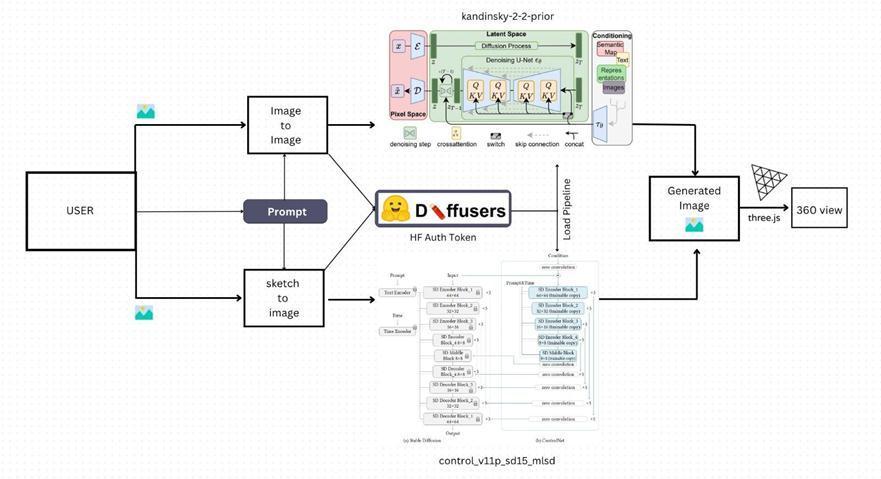
Theplatform'sMulti-ModalInputModuleofferscustomers threealternativemethodstostartthecreativeprocess.One optionallowsuserstotypeatextualpromptthatreflectsthe intendedtoneanddesignofaroom.Forexample,ausermay describe"acozyScandinavianlivingroomwithtribalAfrican decor,neutraltones,andsoftnaturallight."Thisdescription isanalyzedtoextractimportantsemanticfeatures,including stylistic direction, atmosphere, and featured components [6][15]. Another option allows the user to submit handdrawn sketches or floor plans that depict room layouts or furnitureplacement.Submittingareferenceimage,suchasa homeorspecificartifactslikeaMoroccanpendantlampora Japanese shōji screen, can help inspire culturally unique designgeneration(3).
The Hugging Face Diffusers framework [17] serves as the foundationofthepictureproductionpipeline,allowingfor the incorporation of complex generative models designed specificallyforinteriordesign.ThiscontainsKandinsky2.2Prior and ControlNet. Kandinsky 2.2 is a latent diffusion modelthatusesCLIP-basedpriorstoalignverbalprompts withvisualoutputs[15],assuringappropriatetranslationof color themes, regional décor, and cultural motifs into producedgraphics.ControlNetenhancesthisbypreserving structural accuracy, especially when users provide layoutbased inputs such as drawings or guidelines [3]. The implementationemploysafine-tunedversionofControlNet (control_v11p_sd15_mlsd),whichhasbeentrainedonlayoutspecific data from the ellljoy/interior-design dataset [19], enabling it to properly capture spatial signals such as furniturealignmentandarchitecturaldetails.
International Research Journal of Engineering and Technology (IRJET) e-ISSN: 2395-0056
Volume: 12 Issue: 12 | Dec 2025 www.irjet.net p-ISSN: 2395-0072
TheplatformisbuiltontheStableDiffusionengine,which usesthev1.5checkpointandisknownforproducingvisually pleasing and coherent outputs [2]. This model starts with random noise and then refines the image using denoising, whichisdirectedbytheuser'stextualandstructuralinputs. Low-RankAdaptation(LoRA)isusedtofine-tuneadaptation acrossmanyculturalaesthetics[4].LoRAallowsthemodelto rapidlyadapttonewvisualthemesorregionalstyleswithout retraining the entire architecture. For example, if a user wantsaseldomrepresentedethnicstyle,LoRAcanexecute lightweighttrainingonatinydatasettomeettherequest.
The Hugging Face Accelerate framework [18] effectively manages all training procedures and model updates, includingdeploymentlogistics,GPUresourcemanagement, andscalabilityincloud-basedapplications.Whenproducing photos, the platform uses the Hugging Face API to get the most recent model weights, ensuring fast and safe model access.Theresource-intensiveoperationsaredelegatedto GPU-poweredservers,allowinguserstoengagewithafluid, responsive interface while high-quality graphics are generatedseamlesslyinthebackground.
Access to well-annotated, diversified datasets reflecting a widerangeofinteriordesignstylesandculturalinfluences wascriticalintrainingthegenerativemodelspoweringMy SPACE. To achieve these requirements, two datasets from theHuggingFaceHubwerechosen Ellijay/interior-design andhammer888/interior_style_datasettocoverbothvisual aestheticsandstructurallayoutobjectives[19][20].
Theelljoy/interior-designdatasetcontainshigh-resolution photos of living rooms, each with a caption like "a living roomwithafireplaceandaviewoftheocean."Thisresource wasusefulintheearlystagesofdevelopment,assistingthe model in associating natural language descriptions with appropriatevisualoutputs.However,itsrelativelysmallsize limiteditsabilitytorepresentawiderrangeofglobaldesign styles.
The hammer888/interior_ style_ dataset [20] was used to helpthemodelgraspdifferentaestheticthemes.Thisbigger dataset has about 7,230 annotated photos in many styles, includingmodern,Japanese,Nordic,industrial,luxury,and country. Each image is labeled with descriptions like "A photoofmodern-styleinteriordesign,"givingthemodela richsemanticframeworktolearnfrom.Thedataissavedin Parquetformat,whichallowsforefficientprocessingwith toolssuchasHuggingFaceDatasetsandDusk
ThecombinationofthetwodatasetsenabledMySPACEto getabalancedunderstandingofstructuralconsistencyand cultural variance. In particular, the ControlNet model was fine-tuned on the ell joy dataset to improve spatial awareness of typical living room features such as sofas,
windows, entertainment systems, and so on. To avoid overfitting,an85/15training-validationsplitwasused,and LoRA-based fine-tuning was constantly monitored throughouttheprocess[4].
Models were trained using Hugging Face's Diffusers and Accelerate libraries [17][18], with pre-trained Stable DiffusionandControlNetmodelsservingasbasicstructures. Morerefinementwasaccomplishedbytrainingalightweight adaptor basedonKandinsky'searlier[15], builttohandle culturallyparticularcuessuchas"Mughal-style"or"Aztec motif." Synthetic image-caption pairings were generated using techniques similar to textual inversion and prompt tweaking, which allowed new cultural notions to be implantedinthemodel'slatentspace[21].
Although these databases provided extensive coverage of livingroomdesigns,areassuchaskitchensandbathrooms were underrepresented. To address this, a textual augmentation method was implemented, which involved addingspecifiedtermsandphrasesintotrainingpromptsto increasethemodel'sknowledgeoftheseunderrepresented regions. Expanding dataset variety across different room typesisatoppriorityforfutureMySpaceupgrades.
This section evaluates the My SPACE platform based on important performance parameters such as visual output quality, quick interpretation accuracy (training), model reactivity, and overall user experience. Each criterion is shownwithoutputexamplesfromtheplatform'sinterface that demonstrate both functionality and efficacy in realworldcircumstances.
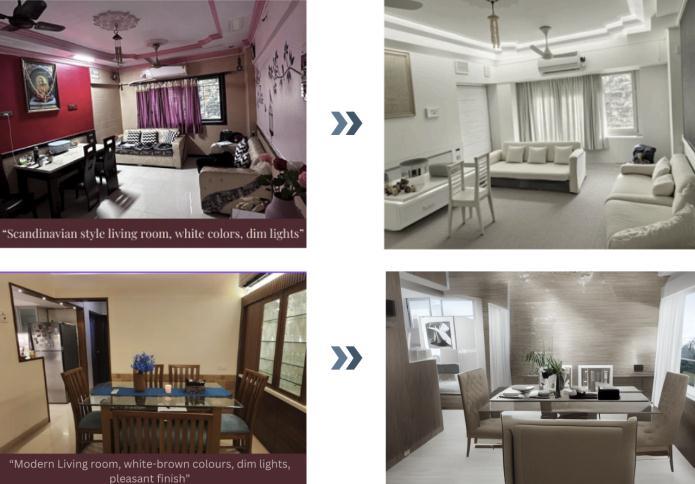
Thesoftwaredemonstratesaremarkablecapacitytocreate rooms that match the user's styles and preferences. For example,theprompt"Scandinavianstylelivingroom,white colors,dimlights"producedaminimalistdesignwithlight tones,clearfurniturelines,andmutedlighting,provingthe
International Research Journal of Engineering and Technology (IRJET) e-ISSN: 2395-0056
Volume: 12 Issue: 12 | Dec 2025 www.irjet.net p-ISSN: 2395-0072
compatibility of Kandinsky's previous model [15] with ControlNet [3]. Similarly, a suggestion like "Modern living room, white-brown colors, dim lights, pleasant finish" resultedinarenderingwithsoftwoodtexturesandambient lightingthatwasinkeepingwithcurrentaesthetics.These examplesdemonstratethemodels'semanticcomprehension andabilitytocreateartisticallyconsistentenvironments[15].
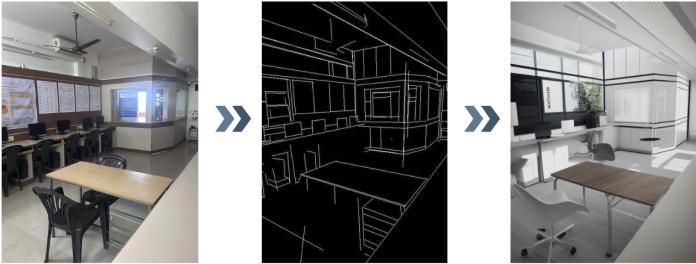
Using sketch-based inputs, such as a simple computer lab architecture (Figure 3), My SPACE effectively conserved spatial arrangements. ControlNet's edge-conditioning technology kept desks and equipment in their original positions, but stylistic upgrades gave the space a more polished and modern appearance. This performance demonstrates the model's capacity to balance structural guidelineswithimaginativevisualdesign[3].
The NVIDIA V100 GPU was used to measure inference performance.OptimizedwithFP16accuracy,formers,and HuggingFaceAccelerate[18],each512×512picturetookan averageof12.5secondstorender.Ontheaccuracyfront,the Structural Similarity Index (SSIM) returned an average of 0.78,indicatingahighdegreeofspatialalignmentwiththe sketch inputs. The average prompt-image consistency, as judgedbyCLIPcosinesimilarity,was0.85[15].Theobject renderingaccuracywasmeasuredat88%,indicatinghigh fidelitytouser-definedcomponents.
Usersurveyswithtenparticipantsprovidedmoreinsights. Participantsgaveanaveragescoreof4.6forvisualappeal, 4.8 for cultural significance, and 4.4 for usability. Furthermore,theFréchetInceptionDistance(FID)of18.4 indicatedtheoutstandingqualityofproducedpictureswhen comparedtoreal-worldinteriordesigns.
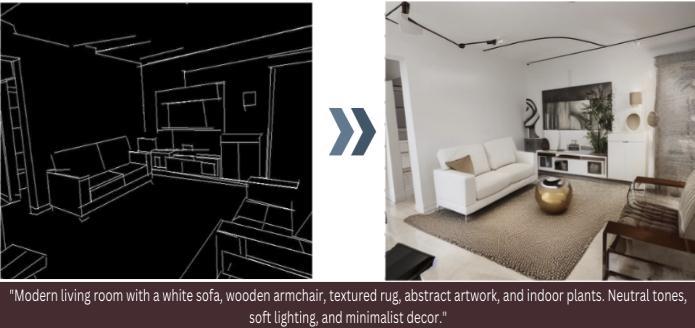
When given abstract edge maps with no precise characteristics, MyS PACE was able to retain room organization and object arrangement while producing ornamental and artistic aspects depending on the prompt (Figure 4). Even with simple inputs, the ControlNet + Kandinsky-2.2 combination proved excellent at inferring spatial structure, finding a compromise between layout correctnessandbeautifuldepiction[3][15].Therewereno conflicts between structural preservation and creative interpretation;therefore,theresultisappropriateforusein designplanningorvirtualstagingapplications.
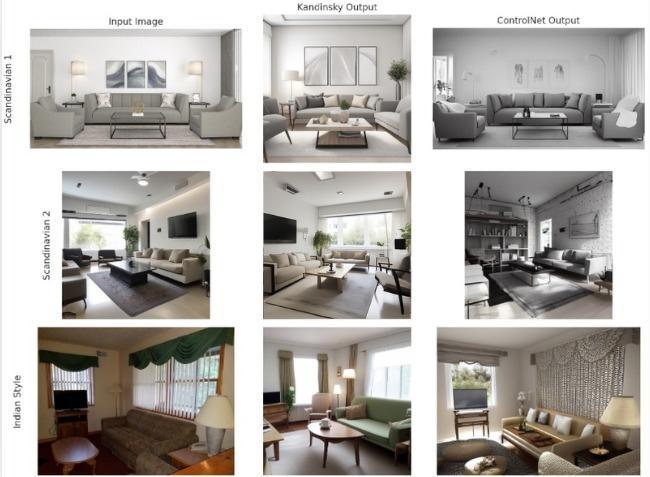
A comparison of Kandinsky and ControlNet was made utilizingvariousstylisticthemes,suchasScandinavianand Indianinteriors(Figure5).Bothmodelsfaredwellinterms of visual quality and comprehension of prompt context. Kandinsky produced comprehensive artistic outputs, encapsulatingculturalthemes,lightingsubtleties,andcolor tones with remarkable precision [15]. However, in other cases such as the Scandinavian 2 scene it resulted in structuralirregularitiessuchasinvertedfurniturepositions. This suggests limitations in Kandinsky's approach to geometry-sensitiveactivities.Ontheotherhand,ControlNet reliably maintained spatial layout integrity [2][3]. It precisely placed objects, such as sofas and windows, and retained architectural structure throughout the drawings. Although ControlNet's stylistic spectrum was slightly less than Kandinsky's, its structural stability made it more appropriateforscenariosneedingexactlayoutcontrol,such asarchitecturalvisualizationorpracticaldesignprocedures. Its capacity to mix artistic inventiveness and spatial precision distinguishes it as a more reliable tool for realworldapplications[2][3].
International Research Journal of Engineering and Technology (IRJET) e-ISSN: 2395-0056
Volume: 12 Issue: 12 | Dec 2025 www.irjet.net p-ISSN: 2395-0072
ThispaperintroducesMySPACE:YourVision,OurCreation, an innovative AI-powered platform that reinvents the interiordesignexperiencebyemphasizingbothindividuality andculturalrepresentationviaflexible,multi-modalinputs. MySpacecaterstoawiderangeofusers,fromcasualusersto skilleddesigners,byproducingoutputsthatarebothvisually consistentandculturallyrelevant.
Oneoftheprimarychallengeswithcurrentdesigntoolsis their inability to support culturally expressive or highly individualizedsettings[10][11].MySPACEovercomesthis limitationbycombiningafine-tunedControlNetarchitecture with an optimized diffusion pipeline, which enables it to interpret hand-drawn layouts, visual references, and descriptivelanguagetogenerateenvironmentsthatreflect users' cultural sensibilities and spatial preferences. This combination of AI and traditional design ideals creates a unique bridge between heritage-inspired creativity and modernlife.
Our findings show that AI, when used with intent and accuracy, can produce complicated creative outputs while retaining a high degree of user pleasure. The system's capacity to adapt to diverse input sources and the continually favorable reaction from users highlight its usefulness in real-world design situations. [4][15][18]. MySpaceisasourceofinspirationanditerationforexpert designers,whileitservesasavirtualenvironmentfordaily userstotestandvisualizeideasbeforeimplementation.
Finally,MySPACEdemonstratestheabilityofAItoincrease accesstocreativedesign,makingitmoreinclusiveandusercentric.AstechnologieslikeStableDiffusion[2]andLoRAenhancedfine-tuning[4]advance,platformslikeMySPACE arepoisedtobecomekeyco-creatorsinthefutureofinterior design, transforming varied ideas into appealing and culturallyrichvisualsolutionsforconsumersallaroundthe globe.
While My SPACE now provides a solid framework for AIdriven interior design, there is still room to increase its functionality, usability, and creative frontiers. Several advances might assist in increasing its technological complexityandmakeitmoreflexibletoawiderangeofuser requirements.
One appealing approach is to incorporate 2D-to-3D transformation,whichwouldallowthesystemtoturnflat drawings or photos into immersive, interactive threedimensionalsettings.Thisfunctionalitymightallowusersto visually walk around their created areas, rearrange components, and evaluate room layouts from various perspectives. To improve this experience even further,
technologies such as virtual reality (VR) and augmented reality(AR)mightbeintegratedwhetherviasmartphonesor specialistARheadsets,allowinguserstoevaluatetheirideas in real time within their actual surroundings. Such immersive technologies would assist in closing the gap betweenconceptualdesignandreal-worldexecution,giving usersabettergraspofhowtheirideastransferintoactual space.
A potential expansion might include text-based 3D object production,whichwouldallowuserstobuildspecificdesign componentssuchasfurniture,lighting,orornamentalitems byjustdescribingthem.Theseuniquepiecescouldthenbe moved aroundthevirtual area,transformingtheplatform into a highly dynamic design playground. To preserve aestheticconsistency,neuralrenderingandmeshsynthesis techniques, such as those employed in Dream Fusion and Shape-E, might be used to ensure that created elements match in size, texture, and visual theme. In practical applications, interior design frequently entails real-world restrictions such as space limits, material availability, and budget.Toaddresstheserealities,MySPACEmightgrowto allow constraint-aware design creation, where users can define particular criteria (e.g., room size "10×12 ft" or budget constraints "under $500"). By incorporating optimization techniques into the generative process, the platform might generate designs that are both visually appealingandviableundercertainlimits.
Dynamiclightingsimulationisanotherremarkablefeature. Usersmayobtainabetterunderstandingofhowaroomfeels atdifferenttimesofdayby customizingdesignoutputsto representvariedlightingsituations,suchasearlybrightness, warm evening tones, or the delicate flicker of candlelight. Animatedvisualizationsmightalsobeusedtodemonstrate how lighting changes over time, allowing users to judge mood and functioning under changing settings. Finally, increasingtheplatform'saccessibilitywithamoreintuitive designhasthepotentialtogreatlyincreaseuserengagement. Replacingdifficultpromptswithsimplevisualtoolssuchas drag-and-drop textures, click-to-replace choices, color palette selections, and style symbols like "Rustic" or "Victorian" would make the platform more approachable, particularly for individuals who are not comfortable with wordinput.Theseuser-focusedchangeswouldstreamline thedesignprocesswhileretainingtheversatilityrequired for creative customization, ensuring that My SPACE continuestoempowerbothnewandseasoneddesigners.
We express our deepest gratitude to the Vivekanand EducationSociety'sInstituteofTechnologyforrecognizing ourinitiativeandofferingsteadyassistancethroughoutits growth.Theinstitution'sencouragementandthetoolsmade availabletouswerecriticalinaidingstudyandinformation collection.Weareespeciallythankfultoourprojectmentor,
International Research Journal of Engineering and Technology (IRJET) e-ISSN: 2395-0056
Volume: 12 Issue: 12 | Dec 2025 www.irjet.net p-ISSN: 2395-0072
Mr.AjinkyaValanjoo,andco-mentor,Ms.PujaVakhare,for theirprofessionalguidance,insightfulinput,andconsistent support,whichprofoundlyaffectedthedirectionandquality ofourwork.Theircoachingwasimportantinmoldingour conceptsandpolishingourprojectdescription.Ourheartfelt gratitudealsogoestoDr.(Mrs.)M.Vijayalakshmi,Headof theDepartment ofArtificial IntelligenceandData Science, and to our Principal, Dr. (Mrs.) J.M. Nair, for providing us with this opportunity and nurturing an academic climate thatfosterscreativityandresearch.Theirconvictioninour skillshasbeenapowerfulsourceofdrive.Wealsothankthe AIandDataScienceDepartment'steachingandnon-teaching personnelfortheircooperationandassistanceinensuring the project's success. We are equally grateful to everyone whocontributedtheirtimeandexpertiseduringthe datagathering process. Finally, we thank our families for their continualencouragementandsupportduringourjourney.
[1]AugustusOdena,ChristopherOlah,andJonathonShlens, "AttnGAN: Fine-Grained Text to Image Generation with AttentionalGenerativeAdversarialNetworks,"arXiv.
[2] Lvmin Zhang, Anyi Rao, and Maneesh Agrawala, "ControlNet: Adding Conditional Control to Text-to-Image DiffusionModels,"arXiv.
[3] Robin Rombach, Andreas Blattmann, Dominik Lorenz, PatrickEsser,andBjörnOmmer,"StableDiffusion:AHighResolutionImageSynthesisFramework,"arXiv.
[4] Edward Hu, Yelong Shen, Phillip Wallis, Zeyuan AllenZhu,YuanzhiLi,SheanWang,LuWang,andWeizhuChen, "LoRA: Low-Rank Adaptation of Large Language Models," arXiv.
[5]K.SusheelKumar,VijayBhaskarSemwal, Shitala Prasad, andR.C.Tripathi,"Generating3DModelsfrom2DImagesof anObject,"IJEST.
[6] Shuang Liu, Liang Bai, Yanli Hu, and Haoran Wang, "ImageCaptioningBasedonDeepNeuralNetworks,"MATEC WebofConferences.
[7]TaoXu,PengchuanZhang,QiuyuanHuang,HanZhang, ZheGan,XiaoleiHuang,andXiaodongHe,"AttnGAN:FineGrained Text to Image Generation with Attentional GenerativeAdversarialNetworks,"ProceedingsoftheIEEE Conference on Computer Vision and Pattern Recognition (CVPR),2018.
[8] Jonathan Ho, Chitwan Saharia, William Chan, David J. Fleet, Mohammad Norouzi, and Tim Salimans, "InstructPix2Pix:Text-GuidedImageEditingwithDiffusion Models,"arXivpreprint,2022.
[9]E.BousiasAlexakisand C.Armenakis,"Evaluationof UNet and U-Net++ Architectures in High Resolution Image ChangeDetectionApplications,"ResearchGate.
[10]L.Manovich,CulturalAnalytics,MITPress,2020.This book explores how digital platforms increasingly reflect cultural diversity and personalization in visual media and design.
[11]C.SteeleandM.H.Kim,“CulturalInfluencesinInterior Design:AStudyonModernConsumerPreferences,”Journal ofInteriorDesign,vol.45,no.2,pp.22–41,2020.
[12] A. Kane and J. Lu, “Mass Customization in Design: Technology, Democratization, and User-Centered Aesthetics,”DesignStudies,vol.76,pp.100992,2021.
[13]H.Wu,J.Zhang,andZ.Lin,“Data-DrivenInteriorLayout GenerationwithGeometryConstraints,”ProceedingsofACM Transactions on Graphics (TOG), vol. 39, no. 4, pp. 78:1–78:14,2020.
[14] P. Chiu, J. Lin, and R. Lin, “AR for Interior Design: VisualizingFurniturePlacementUsingAugmentedReality,” InternationalJournalofHuman–ComputerInteraction,vol. 36,no.14,pp.1314–1328,2020.
[15] A. Gavrikov et al., “Kandinsky 2.2: Leveraging CrossAttentionforHigh-QualityText-to-ImageGeneration,”Sber AILabTechnicalReport,2023.
[16]Three.jsContributors,“Three.js:JavaScript3DLibrary,” [Online].Available:https://threejs.org/
[17] Hugging Face, “Diffusers: State-of-the-Art Diffusion Models,” GitHub Repository. [Online]. Available: https://github.com/huggingface/diffusers
[18] Hugging Face, “Accelerate: Training and inference at scale made simple, efficient and reproducible,” [Online]. Available:https://github.com/huggingface/accelerate
[19] Hugging Face Datasets, “ellljoy/interior-design,” Hugging Face Hub. [Online]. Available: https://huggingface.co/datasets/ellljoy/interior-design
[20] Hugging Face Datasets, “hammer888/interior_style_dataset,” Hugging Face Hub. [Online]. Available: https://huggingface.co/datasets/hammer888/interior_style _dataset
[21] R. Gal et al., “An Image is Worth One Word: Personalizing Text-to-Image Generation using Textual Inversion,”arXivpreprint,2022.
International Research Journal of Engineering and Technology (IRJET) e-ISSN: 2395-0056
[22]B.Poole,J.T.Barron,B.Mildenhall,etal.,“DreamFusion: Text-to-3Dusing2DDiffusion,”arXivpreprint,2022.
[23] J. Kim, S. Lee, and A. Jain, “Interactive Interfaces for Text-to-ImageGeneration:AHuman-CenteredPerspective,” Proceedings of CHI Conference on Human Factors in ComputingSystems,2023.
Volume: 12 Issue: 12 | Dec 2025 www.irjet.net p-ISSN: 2395-0072 © 2025, IRJET | Impact Factor value: 8.315 | ISO 9001:2008