
International Research Journal of Engineering and Technology (IRJET) e-ISSN: 2395-0056
Volume: 12 Issue: 12 | Dec 2025 www.irjet.net p-ISSN: 2395-0072
REAL-TIME HEALTH MONITORING SYSTEM FOR COMA PATIENTS
Anish Nadgouda1 , Deepak Sharma2 , Kushi Shetty3 , Mouna B4 , Dr. Aswathappa P. 5
*1*2*3*4 Student, Department of Electronics and Instrumentation, BIT, Bengaluru, Karnataka, India.
*5 Associate Professor and HOD, Department Of Electronics And Instrumentation Engineering, BIT, Bengaluru, Karnataka, India.
ABSTRACT - Coma patients require continuous and accurate monitoring of physiological parameters to prevent life-threatening conditions. Traditional observation methods rely on manual supervision, which is prone to delay and human error. This paper presents an IoT-based real-time health monitoring system that continuously tracks vital parameters, including heart rate, SpO₂, body temperature, and limb movement. The proposed system integrates MAX30102, DS18B20,FlexSensor, andDHT11 with an ESP32 controller to collect data andupload it to the Thing Speak cloudfor remote access. Incaseof abnormal readings, the system triggers alerts through a buzzer to notify caregivers. The show offers reliable data acquisition, low latency in cloud updates, and cost-effective operation suitable for hospital and home environments. Thissolutionenhancespatientsafetyandprovidesascalableframeworkforcontinuoushealthsurveillance.
Keywords: IoT, Coma Patients, Health Monitoring, MAX30102, ESP32, Thing Speak, Real-Time Alerts.
INTRODUCTION
Monitoring coma patients poses unique challenges since these individuals cannot communicate symptoms or distress. Continuoussupervisioniscriticaltodetectvariationsinvitalparameterssuchasoxygensaturation,heartrate,andbody temperature. Conventional hospital monitoring relies on periodic manual checks and expensive ICU-grade equipment, whichareunsuitableforlong-termorhome-basedcare.
Recent advancements in the Internet of Things (IoT) have enabled remote and automated health monitoring through sensor-basedsystems.Byintegratingbiomedicalsensorswithmicrocontrollersandcloudplatforms,real-timedatacanbe captured,analyzed,andtransmittedtohealthcareprovidersinstantly.
Theproposed Real-TimeHealthMonitoringSystemfor ComaPatients isdesignedtoprovide24/7automatedtrackingof keyphysiologicalparameters.Ituseslow-power,affordablecomponentstocontinuouslycollectdataandtransmititover Wi-Fito the cloud.Threshold-basedalerts enableimmediateactionduringcritical healthevents, reducingresponse time andimprovingsurvivalrates.
This system aims to bridge the gap between hospital-grade monitoring and affordable patient-centric healthcare by ensuringaccessibility,mobility,andreliability.
I. METHODOLOGY
The development of the proposed system follows a structured methodology consisting of hardware design, software programming,andcloudintegration.
Step 1 – Component Selection
Thesystememploysthefollowingkeycomponents:
ESP 32: MainmicrocontrollerwithWi-Ficapability.
MAX30102: MeasuresheartrateandSpO₂usingphotoplethysmograpy.
DS18B20: Digitalsensorforprecisebody-temperaturemeasurement.
Flex Sensor: Detectslimbmovementstoindicateneurologicalactivity.
DHT11: Monitorsambienttemperatureandhumidity.
I2C LCD: Displayslivesensorreadings.
Alerts: Generatesaudiblealertswhenthresholdsarecrossed.
International Research Journal of Engineering and Technology (IRJET) e-ISSN: 2395-0056
Volume: 12 Issue: 12 | Dec 2025 www.irjet.net p-ISSN: 2395-0072
Step 2 – System Design
All sensors are interfaced with the ESP 32, which processes signals and sends data to the Thing Speak cloud via Wi-Fi. Real-timereadingsarealsodisplayedlocallyontheLCDforclinicalreference.
Step 3 – Software Implementation
ThesystemisprogrammedusingtheAdrianoIDE. Thecodeinitializeseachsensor,readstheinputdata,convertsanalog signals to digital values, and periodically uploads the information to the Thing Speak channel through HTTP APIs. Thresholdconditions(e.g.,temperature>37.5°CorSpO₂<90%)activatethealertsandvisualindicators.
Step 4 – Cloud Data Management
Thing Speak enables real-time visualization through dynamic graphs, providing caregivers and doctors with historical trendsandinstantupdatesfromanylocation.
Step 5 – Testing and Validation
The prototype was tested with simulated patient conditions to ensure accuracy, reliability, and network stability. Sensor calibrationwasperformedtominimizedriftandenvironmentalinterference.
The block diagram illustrates the integration of biomedical sensors with the ESP32, serving as the main controller. The MAX30102 measures heart rate and SpO₂, the DS18B20 records body temperature, the Flex Sensor detects limb movement,andtheDHT11sensesambientconditions.Theacquireddataisprocessedbythe ESP32anddisplayedonthe I²C LCD. Using its built-in Wi-Fi, the controller transmits data to the Thing Speak cloud for remote monitoring. A buzzer providesanalertwheneveraparameterexceedsitssetthreshold.
SPO2SENSOR
FLEXSENSOR
TEMPERATURE SENSOR
International Research Journal of Engineering and Technology (IRJET) e-ISSN: 2395-0056
Volume: 12 Issue: 12 | Dec 2025 www.irjet.net p-ISSN: 2395-0072
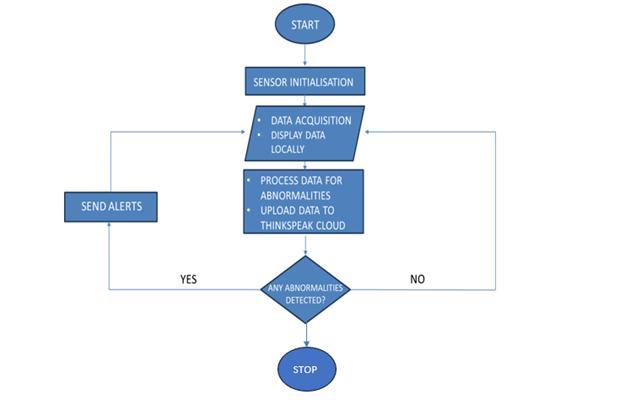
Figure 2: Flow ChartWhen powered on, the ESP32 initialises all connected sensors and connects to Wi-Fi. TheMAX30102usesredandinfraredlighttodetermineheartrateandSpO₂,theDS18B20providesbodytemperature,the FlexSensordetectspatientmovement,andtheDHT11recordsroomconditions.
All sensor outputs are processed and displayed on the LCD. The microcontroller then uploads the values to the Thing Speakcloudatregularintervalsforremoteaccess.Ifanyreadingexceedsthe presentthreshold,thebuzzerisactivatedto alert caregivers. This process repeats continuously, enabling 24/7 automatic monitoring of vital signs and providing immediateresponsetoabnormalconditionswithoutmanualintervention.
IV. DESIGN AND CIRCUIT DIAGRAM
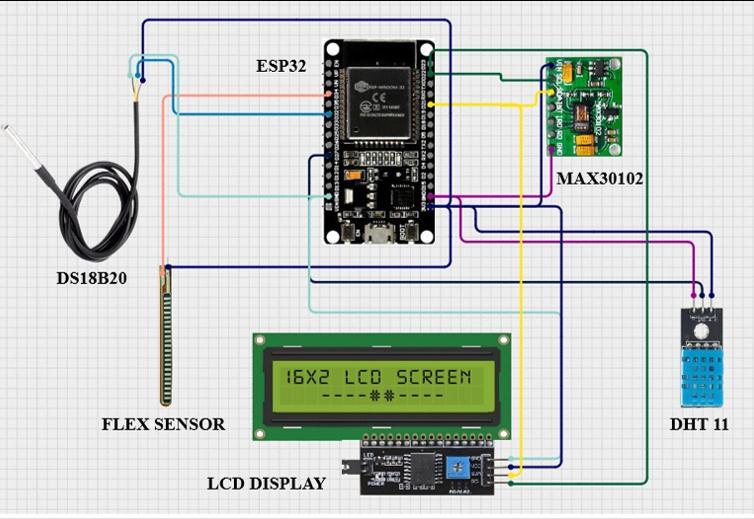
Circuit Diagramofthehardwareconnectionofthe ESP32 withflexsensorsandthe16×2LCDmoduleformeasuringthe extentof finger bend, eachflexsensorsareconnectedtotheanalog input pins of the respective ESP32 connections. The sensorsarevariableresistorswhichgivedifferentvoltageoutputsasafunctionofthepositionofthe fingers.TheESP32 interprets these analog signals to recognize the corresponding gesture. The LCD is adjustable by a 10kΩ potentiometer. wheretheLCDdatapinsconnectto ESP32digitalI/Opins fordisplaycontrol.Thesystem isconnectedtothepowervia theESP32’sUSBport,makingitrunstably.Thisisatextsystemthatusesreal-timefeedbacktoprovideinterpretationofa gestureandthendisplaytheinterpreted-textonanLCDscreen.
V. RESULTS AND DISCUSSION
Theprototypedemonstratedefficientacquisitionandtransmissionofvital-signdatawithminimallatency.
Accuracy: The MAX30102 and DS18B20 sensors provided consistent readings comparable to standard medical devices.
Real-Time Alerts: Thebuzzersuccessfullyactivatedwhenpredefinedthresholdswereexceeded.
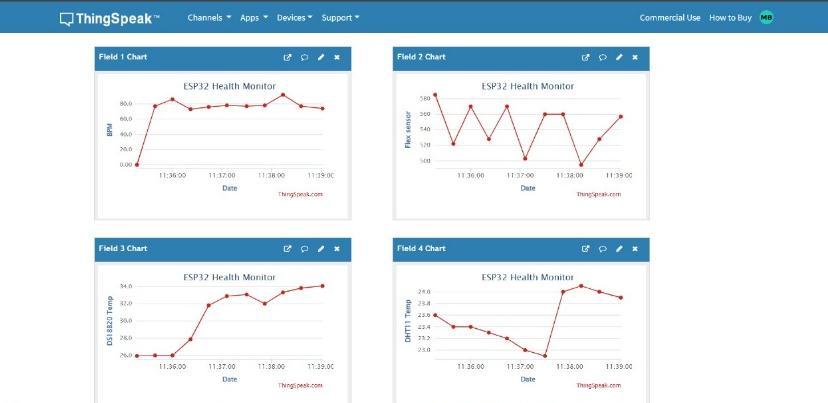
Remote Monitoring: Continuous cloud connectivity enabled healthcare professionals to monitor data trends remotelyviatheThingSpeakdashboard.
Cost Efficiency: The total hardware cost was significantly lower than existing hospital-grade systems, making it viableforhome-careandruralsetups.
© 2025, IRJET | Impact Factor value: 8.315 | ISO 9001:2008 Certified Journal | Page448
International Research Journal of Engineering and Technology (IRJET) e-ISSN: 2395-0056
Volume: 12 Issue: 12 | Dec 2025 www.irjet.net p-ISSN: 2395-0072
The system effectively reduces manual workload and enhances reliability. However, its dependence on continuous internet connectivity remains a limitation, which can be addressed by incorporating edge-based data storage or GSM modulesforbackupcommunication.
VI. CONCLUSION
Inconclusion,theReal-TimeHealthMonitoringSystemforComaPatientsshowsgreatpromiseforimprovingcarequality, lowering healthcare risks, and offering more comfort and reassurance to families. Its ability to track health parameters continuously,sendalertsduringemergencies,andallowforremotemonitoringmakesitavaluabletoolinmanagingcoma patients.Thisensuresthatmedicalinterventionsarepromptandeffective.Astechnologyprogresses,thesystemwillkeep evolving,providingevenmorebenefitsfortreatingandcaringforpatientswithseverehealthconditions.Toenhancecoma management worldwide, we need clear, evidence-based guidelines and a collaborative approach that unites different professionalsinthefield.
VII. REFERENCES
[1] Sheikdavood K, Soundar K, Yashwanth M G, TarunKumar P , “Smart Health Monitoring System for Coma Patients Using IoT”, 2023, pp. 1342-1347, DOI: 10.1109/ICCMC56507.2023.10084196. (https://ieeexplore.ieee.org/document/10084196)
[2] K. Thivyabrabha, C. Saranya, R. Aakash, T. Abishek and S. Mohamed Hussain, “Smart Health Monitoring for Comatose Patients: Integrating IoT and Real-Time Alerts”, 2024, pp. 462-466, DOI: 10.1109/ICECA63461.2024.10801103(https://ieeexplore.ieee.org/document/10801103)
[3] V. Tamilselvi, S. Sribalaji, P. Vigneshwaran, P. Vinu and J. GeethaRamani, “IoT Based Health Monitoring System” , 2020, pp.386-389,DOI:10.1109/ICACCS48705.2020.9074192 (https://ieeexplore.ieee.org/document/9074192)
[4] A. L. Virgin, K. Ananthalakshmi, P. Rajeswari, R. Narmatha Banu and B. Kiruthiga, “Coma Patient Monitoring System”,2023,pp.229-235,DOI:10.1049/icp.2024.0929 (https://ieeexplore.ieee.org/document/10510724)
[5]Youtube(2024)-HealthMonitoringSystemforComaPatientUsingIOTbyNarenProjects (https://youtu.be/XW6knwmATtU?si=pMefckL6mbqyyVMK)
[6]Dr.S.K.ManjuBargavi,AniketMishra,”AComatosePatientMonitoringSystemBasedonIoT”,2023,IJSER (https://www.ijser.in/archives/v11i4/SE23408002508.pdf)
[7] Sharmilee K, Pavithra P, Pravin S. A, Senthil Kumar K,” Coma Patient Health Monitoring System Using IoT”,2022,IJARSET (https://ijarsct.co.in/Paper3025.pdf)
[8]AnkitaRamtirthkar,JyothiDigge,V.R.Koli,”IotbasedHealthcareSystemforComaPatient”,2020,RetrievalNumber: A1126109119/2020©BEIESPDOI:10.35940/ijeat.A1126.029320(https://www.ijeat.org/wpcontent/uploads/papers/v9i3/A1126109119.pdf)
© 2025, IRJET | Impact Factor value: 8.315 | ISO 9001:2008 Certified
International Research Journal of Engineering and Technology (IRJET) e-ISSN: 2395-0056
Volume: 12 Issue: 12 | Dec 2025 www.irjet.net p-ISSN: 2395-0072
[9]V.Mantri,V.Aher,andA.Jalgaonkar,“IOTBasedHealthMonitoringSystemforComatosePatients,”no.7507,pp.1–4,EasyChair,2022. (https://easychair.org/publications/preprint/8rqM?utm)
[10] M.B. Meghana,“Design andImplementation of IOT based HealthMonitoring System for ComatosePatients,”vol. 29,no10S,pp.3689–3697,2020.
(https://www.researchgate.net/publication/342124145_Design_and_Implementation_of_IOT_based_Health_Monitori ng_System_for_Comatose_Patients?utm_)
[11] Nookhao. V. Thananant and T. Khunkhao, "Development of IoT Heartbeat and Body Temperature Monitoring SystemforCommunityHealthVolunteer",2020 JointInternational ConferenceonDigital ArtsMediaandTechnology with ECTI Northern Section Conference on Electrical Electronics Computer and Telecommunications Engineering (ECTIDAMT&NCON),pp.106-109,2020. (https://www.researchgate.net/publication/341319221_Development_of_IoT_Heartbeat_and_Body_Temperature_Mo nitoring_System_for_Community_Health_Volunteer?utm_)
[12] S. Sampeter and S. Padmavath, "An improved health monitoring system for coma patients using Internet of Things",(IJETIE),vol.5,pp.408-412,2019.
(https://papers.ssrn.com/sol3/Delivery.cfm/SSRN_ID3405300_code3361480.pdf?abstractid=3405300&mirid=1&ut m_)
[13] Ganesh, "Health monitoring system using Rasbery Pi and IoT", Oriental Journal of Computer Science and Technology,vol.12,2019,ISSN0974-6471, DOI : http://dx.doi.org/10.13005/ojcst12.01.03 (https://www.computerscijournal.org/vol12no1/health-monitoring-system-using-raspberry-pi-and-iot/?utm_)
[14] K. Narendra Swaroop, Kavitha Chandu, Ramesh Gorrepotu, Subimal Deb, A health monitoring system for vital signsusingIoT.(2019).(https://www.sciencedirect.com/science/article/abs/pii/S2542660518300349?utm_)
[15] A. L. Virgin, K. Ananthalakshmi, P. Rajeswari, R. Narmatha Banu and B. Kiruthiga, "Coma patient monitoring system," 7th IET Smart Cities Symposium (SCS 2023), Hybrid Conference, Bahrain, 2023, pp. 229-235, doi: 10.1049/icp.2024.0929.(https://ieeexplore.ieee.org/document/10510724)
[16] K. Thivyabrabha, C. Saranya, R. Aakash, T. Abishek and S. Mohamed Hussain, "Smart Health Monitoring for Comatose Patients: Integrating IoT and Real-Time Alerts," 2024 8th International Conference on Electronics, Communication and Aerospace Technology (ICECA), Coimbatore, India, 2024, pp. 462-466, doi: 10.1109/ICECA63461.2024.10801103. (https://ieeexplore.ieee.org/document/10801103)
[17] V. Tamilselvi, S. Sribalaji, P. Vigneshwaran, P. Vinu and J. GeethaRamani, "IoT Based Health Monitoring System," 2020 6th International Conference on Advanced Computing and Communication Systems (ICACCS), Coimbatore,India, 2020, pp. 386-389, doi: 10.1109/ICACCS48705.2020.9074192.(https://ieeexplore.ieee.org/document/9074192)
[18]S.K,S.K,Y.M.GandT.P,"SmartHealthMonitoringSystemforComaPatientsusingIoT," 2023 7th International Conference on Computing Methodologies and Communication (ICCMC), Erode, India, 2023, pp. 1342-1347, doi: 10.1109/ICCMC56507.2023.10084196. (https://ieeexplore.ieee.org/document/10084196)