
International Research Journal of Engineering and Technology (IRJET) e-ISSN: 2395-0056
Volume: 12 Issue: 12 | Dec 2025 www.irjet.net p-ISSN: 2395-0072
International Research Journal of Engineering and Technology (IRJET) e-ISSN: 2395-0056
Volume: 12 Issue: 12 | Dec 2025 www.irjet.net p-ISSN: 2395-0072
1Professor, Master of Computer Application, VTU’s CPGS, Kalaburagi, Karnataka, India
2Student, Master of Computer Application, VTU’s CPGS, Kalaburagi, Karnataka, India
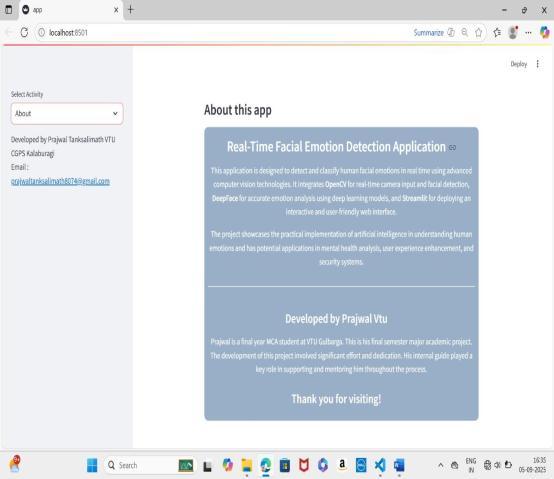
Abstract-The "Emotion Tracker" Project is a real Time Facial Emotion Detection platform using open CV (Computer Vision) and Deep Face (AI-based Emotion Classification). This platform will take a live webcam video feed and analyze it to detect the face of the subject(s) and classify their emotional state (Happy, Sad, Angry, Fearful, Surprised, Disgusted, or Neutral). The classification will occur inreal time andonce completed, the classificationcan then be logged to the database for future analysis. Approximately 90% accurate, reasonably priced, easy to use and capable of operating in "Offline Mode", this platform can be beneficial for a variety of industries (Healthcare, Education, Customer Service, and Security) in numerous ways.
Keywords: Facial Emotion Recognition, Real-Time Detection, Deep Learning, Open CV, Deep Face, Computer Vision, HCI.
Trafficcongestionisanexpandingchallengeincities,often resulting in extensive delays and poor vehicle movement. Fixed-time traffic signals, the default for controlling car flow,cannotrespondtofluctuatingconditionsmaking the traffic signal ineffective at peak hours or unexpected surges. Emerging technologies, specifically in computer visionand machinelearning,makeitpossibleto remotely and in real-time analyse traffic flow without on-site inspection using video based detection, tracking, and density estimation. The intelligent signal control system proposed here employs intelligent signal control techniquesusingcomputervisionandmachinelearningto develop simulation models that can assess car flow and dynamically apply signal timing using a max-pressure algorithm. The ultimate goal is to reduce wait times, reduce congestion and increase the efficiency of traffic management.
Detecting facial expressions in real time is difficult because of the many factors involved (e.g. the way someone is feeling, the type of lighting they are in, their angle of view, and whether they are hiding their face). Most traditional techniques are not very accurate or robust, while the vast majority of modern deep learning
algorithmsareeithercomputationallyintensive,relianton cloud storage, or designed to work with still images only. Therefore,alow-costandrapidoptionforonlinedetection of facial expressions is needed that can generate accurate and time-sensitive results from a video feed, as well as allow for an easy and intuitive viewing experience. To address this issue, the Emotion Tracker Project utilizes bothOpenCVandDeepFace.
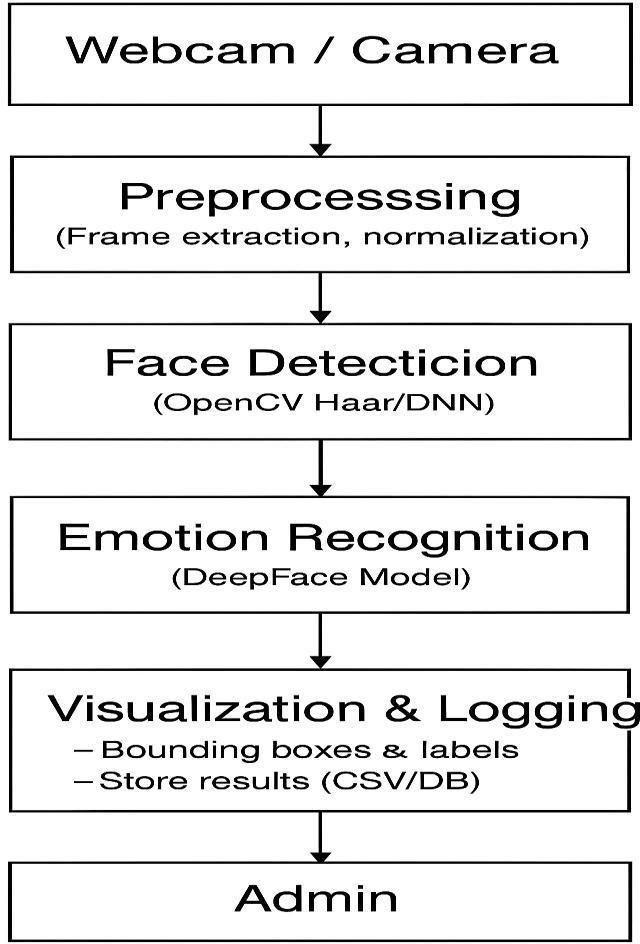
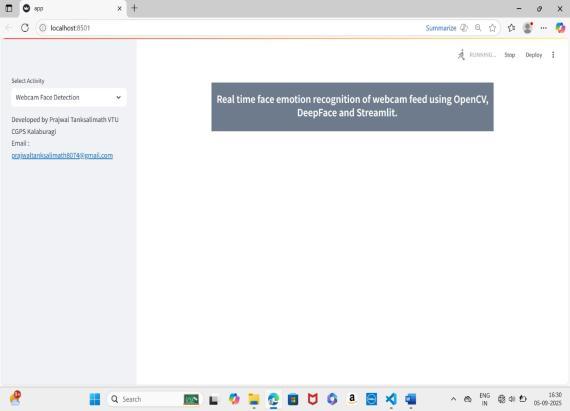
Emotion Tracker aims to build an Emotion detection system that captures facial expressions in real-time using OpenCVandDeepFace.Itwillcapturehumanfaceimages from live-streaming video data, accurately detect and classify 6 Different Emotions (using facial recognition technology)onreal-timeandcaptureemotioninformation for later analysis. The Emotion Tracker will also be designed to be extensibleandmodularto allowforfuture adaptations (including integration into other applications).
The project uses a systematic process that consists of requirement analysis, system design, implementation, testing, and deployment. The webcam captures the video stream live; Open CV detects faces in the video, and Deep Faceisusedforemotionclassification.Thesystemwill be tested in various conditions to confirm that it operates in real-timewithhighlevelsofaccuracyanddependability.
At first, early systems for identifying facial expressions used hand-constructed characteristics and conventional algorithms. However, these systems did not offer very reliable performance in a real-world environment. With the introduction of deep learning and Convolutional Neural Networks (CNNs) into the space, the effectiveness ofidentifyingemotionsincreasedsignificantly.Pre-trained models like VGG-Face and tools such as Deep Face allow for much quicker and more precise construction of emotion detection systems. Nevertheless, despite the availabilityofvariousdevelopedsolutionstoday,manyare still expensive to run, require usage of the cloud, and thereforecannotbeusedforreal-timeapplications.Thatis
International Research Journal of Engineering and Technology (IRJET) e-ISSN: 2395-0056
Volume: 12 Issue: 12 | Dec 2025 www.irjet.net p-ISSN: 2395-0072
why there is a demand for developing an emotion recognition system that is lightweight, accurately identifies emotions in real-time, and has the capability to operateoffline.Theintendedgoalofthisproposedproject istoprovidesuchasolution..
6.SYSTEM DESIGN
7. SCREENSHOT
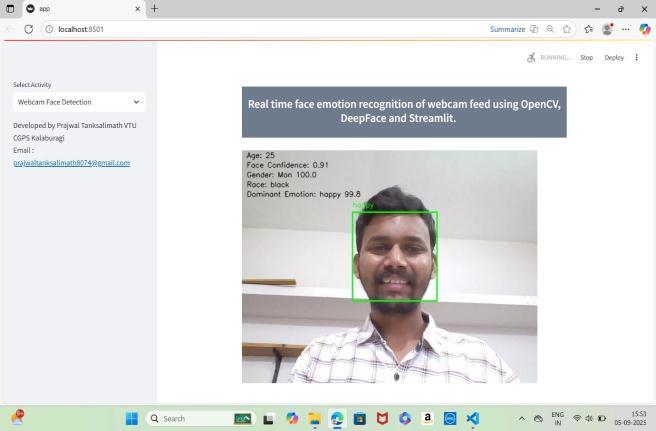
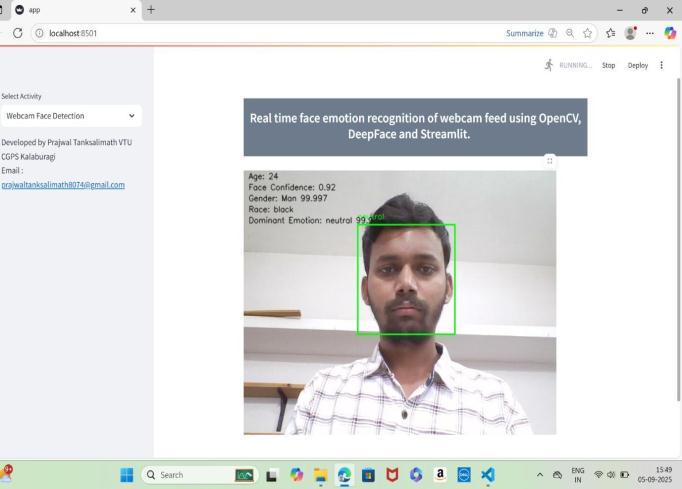
International Research Journal of Engineering and Technology (IRJET) e-ISSN: 2395-0056
Volume: 12 Issue: 12 | Dec 2025 www.irjet.net p-ISSN: 2395-0072
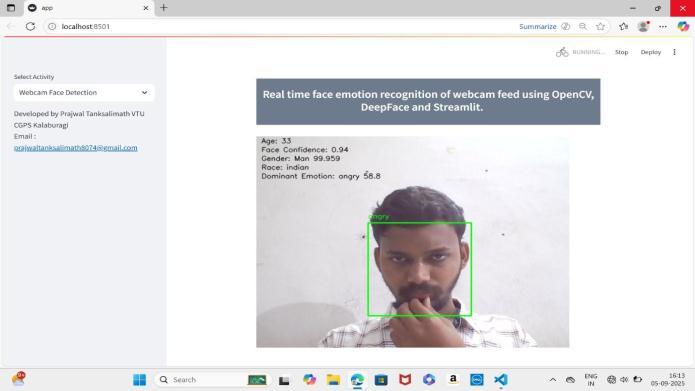
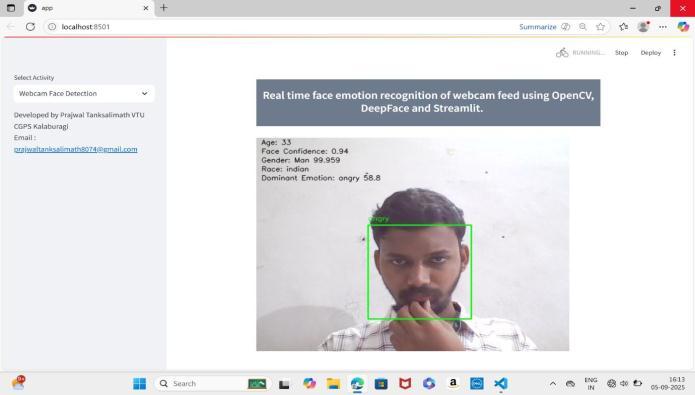
The Emotion Tracker project utilizes a facial emotion detection(recognition)systeminreal-time,utilizingOpen CV and Deep Face methods, both of which have achieved highaccuracyaswellasreal-timeperformanceonnormal hardware.Thiswasdemonstratedasproofthat,byusinga combination of both computer vision and deep learning, emotion-aware applications can be created and utilized effectively within the fields of health care, education, securityandhuman-computerinteraction.
Future improvements anticipated to be implemented are GPUacceleration,support formultiplecameras,advanced emotional recognition, user profiling, deployment on mobile and web-based devices, cloud-based data analysis, andtheimplementationofotherAImodulesforincreased scalability and increased impact on the physical world throughreal-timeemotion-basedapplications.
1. Open CV Documentation, 2023. https://opencv.org/ Open Source Computer VisionLibrary.
2. Deep Face: A Framework for Face Recognition and Facial Attribute Analysis (published as a research article by Serengil, S., & Ozpinar, A., in 2020).
3. Deep Face: An Approach That Is Closing the Gap between Human Performance and Machine Performance for Face Verification (published in the proceedings of the 2014 IEEE Conference on Computer Vision and Pattern Recognition by Taigman,Y.,Yang,M.,Ranzato,M.A.,&Wolf,L).
4. Rapid Object Detection Using a Boosted Cascade ofSimpleFeatures(publishedbyViola,P.&Jones, M. at the IEEE Conference on Computer Vision andPatternRecognitionin2001).
5. Facial Expression: Emotion (published in American Psychologist, Vol. 48, No. 4, by Ekman, P.).
6. Reliable Crowdsourcing and Deep LocalityPreserving Learning for Facial Expression Recognition (published in IEEE Transactions on ImageProcessing,Vol.29,2020,byLi,S.,Deng,W. &Du,J.).
7. Deep Learning (published by Good fellow, I.et al. MITPress,2016).
8. Facial Expression Recognition: A Survey (published in IEEE Transactions on Affective Computing,2018,byZeng,Z.etal.).
9. Real-Time Emotion Detection Using Deep Learning and Computer Vision Techniques (published in the International Journal of Advanced Computer Science and Applications, Vol.12,No.5,byKhan,F.A.etal.,2021).
10. Deep Face Git Hub Repository – 2018. A lightweight face recognition and facial attribute analysisframework..